Review of Term 1

We’ve reached the end of term 1 of the 2021-22 academic year. Whilst he summer holidays seem like an age ago, the term has gone by in a flash!

We began the term at the end of August with on-site testing for students beginning the academic year. The amazing team of staff completed 2664 lateral flow tests over seven days, including 649 tests in one day. This process allowed us to get the term underway as safely as possible.

Our new Year 7 and Year 12 students were the first to start back, getting to grips with their new surroundings, new expectations and new curriculum with great energy and enthusiasm. Before long, they were joined by the returning students in other years, keen to be back and ready to learn. The Academy now has the largest number of students on roll in over a decade, with 1668 students currently attending!

Some of our students have achieved amazing things this term!

I began the year with my “welcome back” assemblies, outlining our expectations and highlighting the Academy’s priorities for the year ahead. Since that point we have seen excellent progress across all our priorities. I have been particularly impressed this year by our student leaders, including the inclusion and diversity group who prepared a thought-provoking assembly for students over recent weeks. Staff have also had some really powerful training in this area, as well as teachers working in small professional development groups to explore ideas around metacognition and self-regulated learning, which we are all putting into practice in our classrooms. This work accompanies the launch of our new curriculum, and I have seen some really fantastic innovative and interesting lessons being taught across the Academy throughout this term. Our fifth priority this year is sustainability – and I have a blog post planned to coincide with the COP26 summit in November to tell you what we have been up to, and what we have planned, as we work towards a greener future.

I spent an enjoyable hour with a panel of our youngest students towards the end of September, finding out about their experiences of starting at Churchill Academy & Sixth Form in 2021. This was soon followed by the return of our Open Evening – the first in-person event since the pandemic began. We were inundated with interest and it was so lovely to show off our school to so many curious families!

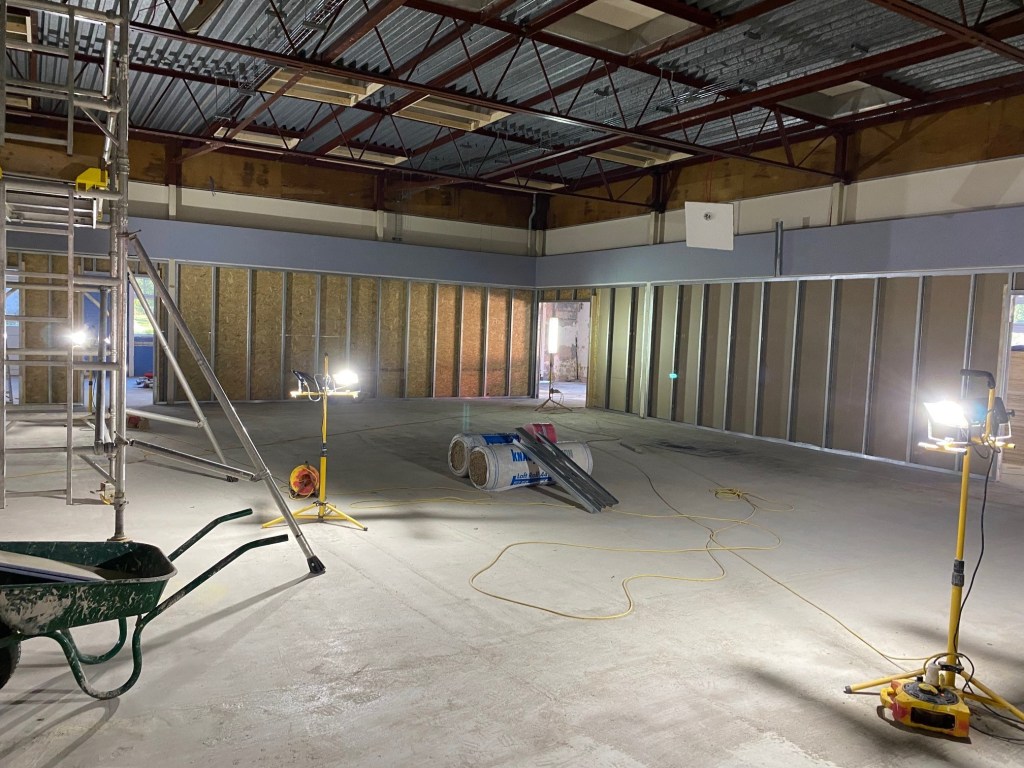
We are also continuing the redevelopment of our learning environment, with work ongoing in Stuart House to create climate-controlled, sound-insulated, 21st century classrooms for the teaching of History, Geography and RE. Stuart House tutors and Humanities teachers and classes have been really flexible this term as their home base has been completely gutted, but there are positive signs already as the walls are put back in place. We are still on track to reopen these facilities in March 2022!
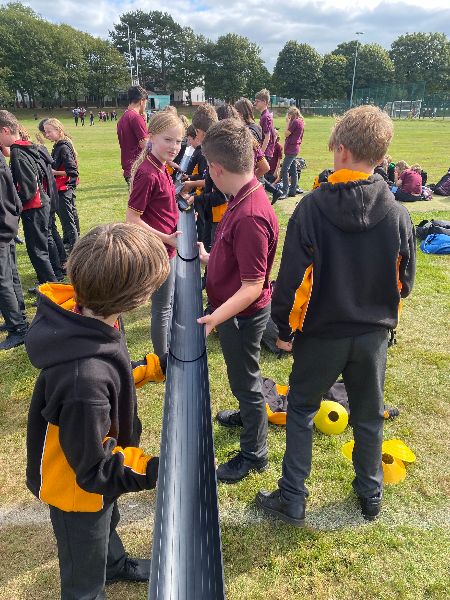
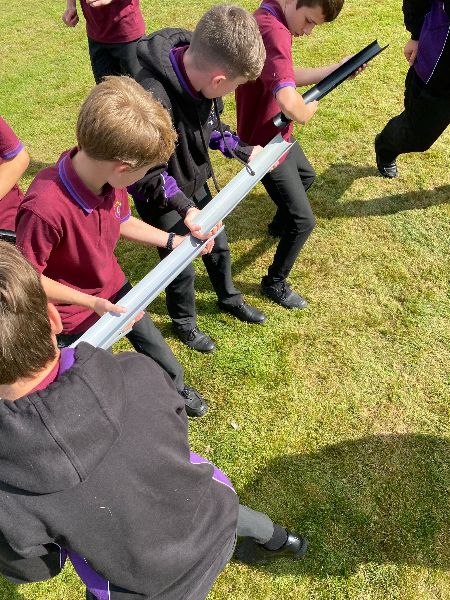
One of the real pleasures this term has been the return of our extra-curricular programme. Chess Club was one of the first to get started, and it was soon joined by many more. Our Duke of Edinburgh expeditions have been out and returned safely, and students have finally been able to go back to the theatre! After the end of the school day, the Academy echoes with the sounds of music, dance and drama from Performing Arts, including this year’s production of Rock of Ages which is already sounding terrific. And, of course, extra-curricular PE is back, with training and fixtures most days. You can see our full extra-curricular programme on the Academy website.

Sadly COVID has continued to cause disruption. This term has seen many students and staff self-isolating with infections, and as a result face coverings were re-introduced for main school students indoors. We are grateful to everyone for doing their bit to help, including staff covering for absent colleagues, families offering support and words of encouragement, and students for adapting to the protective measures without a fuss. Although it has been difficult, we have not been as badly hit as some other schools where lessons have been suspended for entire year groups, and some have been forced to close altogether. Nonetheless, we all need the half term to recover, before we see what November and December have in store for us!

Term 2 is certainly packed. As the nights draw in, we have concerts and celebrations to look forward to. Year 11 will be taking their mock exams, which this year are especially significant in light of the latest announcements around exams in 2022. Before we know it, I will be breaking out the festive knitwear and looking forward to Christmas!

I’d like to thank all the staff, students and families in our Academy community for making this term such a pleasure. A school full of children is a joyous place to be – and Churchill students are simply the best. Enjoy your half term everyone – I will see you in November.
Making the leap

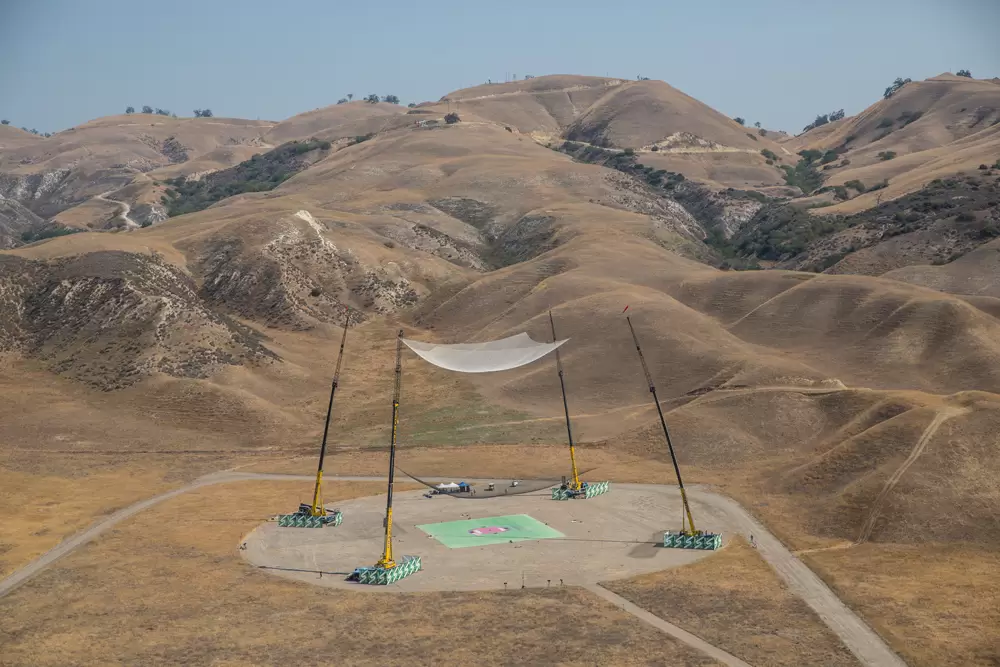
In 2016, Luke Aikins became the first person to complete a planned jump from an aeroplane without a parachute or a wingsuit. Jumping from 25,000 feet, he sped earthwards before eventually landing in a net just 30m square.

Such behaviour might seem like complete madness to most people. The nerve required to take that leap of faith is unimaginable. But the experienced skydiver had been preparing for this moment for 18 months, as had the team around him. He had practised the movements he would need to make to adjust his freefall to hit the target precisely, and he had worked with gymnasts to rehearse the flip he would need to perform to ensure he landed safely on his back (you can see him practising the “flip” move at about 1:30 into the video above).

Meanwhile, the net was precision engineered to cushion his impact. Civil Engineer John Cruikshank had worked out the maths and physics required to slow the plummeting man from 193km/h to zero safely. The net was suspended high in the air from four cranes, supported by air pistons which would compress on impact. It took eight months of testing to be sure that the mechanism would work safely.

The landing site

I use Luke Aikins’ story when I am talking to students about preparing for their exams. Aikins has his team around him, supporting him, for the first part of his fall. These are teachers, friends, family. But there is a moment of truth – about 1:40 into the video for Luke Aikins -when you are on your own and you have to rely on all the preparation you have done to deliver the result you want. It’s just you and the task in hand. The better your preparation, the higher the chance of a good outcome. Of course, it’s never guaranteed: even with the best preparation in the world, things can sometimes go wrong. That’s why it’s never possible to take the stress out of such situations completely. But, if you know that you’ve practised, you know what you need to do, and you know how to do it, you will have the confidence to make the leap and land safely.

We all need to take a deep breath before we make our leap. But, if we know we’ve prepared as well as possible, it gives us the confidence to take that step and – as far as we can – to enjoy the ride.

What’s happening with exams in 2022?

Last week, the exams regulator (Ofqual) and the Department for Education published information about how exams will work in 2022. This included information about adaptations to exams to accommodate the impact of the COVID-19 pandemic on education, the standards which will be used to grade examinations in 2022, results days, and contingency plans in case the pandemic further disrupts education this year. In this week’s blog, I have summarised the key announcements which affect Churchill students taking GCSE, A-level, Cambridge National, BTEC, Cambridge Technical and other qualifications for assessment in summer 2022. I have also recorded a short presentation for students, which you can view below.

Adaptations to exams

Ofqual and the Department for Education have recognised that the pandemic has significantly impacted the educational experience of students over the past two years. To take account of this, the following adaptations will be made to examinations in 2022:

  • GCSE English literature, history, and geography: there will be optional topic and content for these qualifications. This means that certain topics, normally on the specification for assessment, will not be required for the exams in 2022. At Churchill, this means:
    • GCSE English literature: the poetry anthology will not be assessed
    • GCSE history: Elizabethan England 1558-1588 will not be assessed
    • GCSE geography: paper 1, topic 3: challenges of an urbanising world will not be assessed
  • GCSE sciences: if necessary, centres will be allowed to deliver practical work in GCSE sciences by demonstration. We will not be using this adaptation at Churchill as we believe it is essential that students taking GCSE sciences experience practical work themselves, rather than simply seeing it demonstrated.
  • A level sciences: centres will be allowed to assess the Common Practical Assessment Criteria (CPAC) across the minimum number of practical activities required to enable students to demonstrate their competence in A-level biology, chemistry, and physics. We will not be using this adaptation as we believe it is important for our A-level scientists to experience the full range of practical work available to them with our state-of-the-art equipment and facilities in the Athene Donald Building. We believe that this will support their progress and lead to better examination outcomes.
  • GCSE and A-level art and design and textiles: students taking GCSE, AS and A level art and design (including textiles) will be assessed on their portfolio only, with no final examination.
  • Advance notice for all other GCSE, AS and A-level subjects: exam boards will provide advanced information about the focus of the content of exams for all GCSE, AS and A-level subjects except GCSE English literature, history, and geography by 7 February 2022 at the latest. This is normally the time by which the majority of courses of study have been completed, and teaching turns to exam preparation and revision. This adaptation means that teachers and candidates will know which topics will and won’t come up in the exams in the summer, enabling revision to focus just on those aspects which will be assessed.
  • Formula sheets: students will be given a formula sheet for GCSE mathematics and a revised equation sheet for GCSE physics and combined science. This means that they will not need to memorise so many formulae and equations in preparation for the exams – although they will still need to know how and when to use them correctly.

We think that this is a reasonable and fair set of adaptations to take account of pandemic disruption. It will relieve pressure on the intensive revision period through the spring, enabling students and their teachers to focus on the content they will need for their exams in the summer.

Grading standards

There has been much discussion about what standard will be used to assess examinations in 2022. The “standard” essentially means deciding how many candidates should receive each grade in each subject – how many “A” grades, “B” grades and so on there should be (or the equivalent numerical grades at GCSE). A significantly higher number of candidates achieved the top grades nationally in 2020 and 2021 under the Centre Assessed Grades and Teacher Assessed Grades systems used in place of exams, than achieved top grades the last time exams were sat (in 2019).

Ofqual has announced that it intends to get back quickly to how grading was before the pandemic. However, to recognise the disruption from the pandemic, they won’t do it in one jump. Instead, 2022 will be a transition year to reflect that we are in a pandemic recovery period. The standard set by Ofqual for 2022 will reflect a point midway between 2021 and 2019 when it comes to grading, before returning in 2023 to results that are in line with those before the pandemic began. Jo Saxton, the Chief Regulator, explains the rationale for this decision in a blog on Ofqual’s website, which you can read here.

We feel this is a reasonable compromise, with a return to normal exam standards preceded by a transition year which recognises the disruption caused by COVID-19. It means that more top grades will be available to students in 2022 than was the case in 2019, or than will be the case in 2023. All students, across England, will be competing across the same exam papers to achieve those grades.

We do not yet know what this midway point between 2021 and 2019 will look like on a subject-by-subject basis. Exam boards will use data as a starting point, to align their standards in a subject. But the grade boundaries for each subject will be set by the senior examiners after they have reviewed the work produced by students in their exams – these boundaries will not be available to teachers or to candidates in advance.

UCAS predicted grades

For Year 13 students applying to university or other courses through UCAS, teachers have been advised to use the 2019 standards to determine predicted grades. This is because 2019 was the last time clear grade boundaries in each subject were published, so it is the only consistent standard it is possible to use. Here at Churchill we will use existing Year 12 assessments and the 2019 grading standards to generate UCAS predicted grades, although we will follow the regulator’s guidance to give any borderline students the benefit of any doubt in this process. Please remember, however, that UCAS predictions are made by teachers using their professional judgment and experience; they cannot be negotiated upwards by students or their families.

Results Days

Results days will be on:

  • Thursday 18th August 2022: AS, A-level and other level 3 qualifications
  • Thursday 25th August 2022: GCSE and other level 2 qualifications

Further details about the format of these days will be released nearer the time.

Contingency Plans

Having learned the lesson of the past two years, I am pleased to confirm that the government is drawing up contingency plans in case the pandemic takes an unexpected turn and exams cannot proceed in summer 2022 as planned. The current proposals are that Teacher Assessed Grades would again be used, but with much clearer guidance on the kinds of evidence that could be used to support the teacher assessment. This is likely to be based around mock exams in the majority of subjects.

At Churchill, we hope and expect that exams will go ahead as planned in 2022. However, all examination candidates, especially those in Year 11 and 13, should prepare for their mock exams as though they were the real thing. Not only will this provide a good evidence base in case of further disruption, but it will put students at a significant advantage in terms of revision and preparation for the summer.

Exam preparation advice

Balance in all things (source)

The announcements last week confirm the plan for exams to go ahead in 2022, with some additional support to recognise the disruption to education that students have experienced. We believe these measures are as fair as could be expected in the circumstances.

Our message to students is this: your exams are going ahead. You know what you need to revise, and you will be able to focus this even more as you approach the summer. Listen to the feedback you get from your teachers, and use the revision techniques that you have been given and that will continue to be provided throughout the year. Don’t leave it all until the last minute: you should be revising consistently, a little and often, throughout this year.

Above all, keep a sense of balance and proportion: these exams are important, and we know they really matter, but you also need to look after yourselves. Make sure you are taking regular breaks, maintaining your leisure activities, and talking to someone you trust if you are struggling. We want you to get the best possible results, whilst staying healthy: keeping things in balance and proportion is your top priority. We will do everything we can to support you with this.