This week students at the Academy have been thinking about bullying and “banter.” We started by defining our terms. What is bullying?
The repetitive, intentional hurting of one person or group by another person or group, where the relationship involves an imbalance of power. Bullying can be physical, verbal or psychological.
It can happen face to face or online.
Banter, on the other hand, is defined as “the playful and friendly exchange of teasing remarks.” This makes it seem like banter is okay, but bullying is not. However, it can be very difficult to draw a line where the “exchange of teasing remarks” tips over into “intentional hurting.” It is also the case that what someone intends as “playful and friendly” may not always be received in the same manner. So – where is the line?
We asked students to explore different statements about bullying, and to discuss whether they agreed or disagreed with them:
- If someone is my friend, we can banter about whatever we like – agree or disagree?
- People should lighten up and know when to take a joke – agree or disagree?
- Saying “it’s just banter” or ending a message with “LOL JKZ” makes it okay – agree or disagree?
We discussed how there is no such thing as simple banter. It’s a complicated thing, where there may be large gaps between the intention and the receipt of words and actions. This is illustrated below, in the intersections between the circles, where it is impossible to tell whether someone is being friendly, ignorant or malicious:
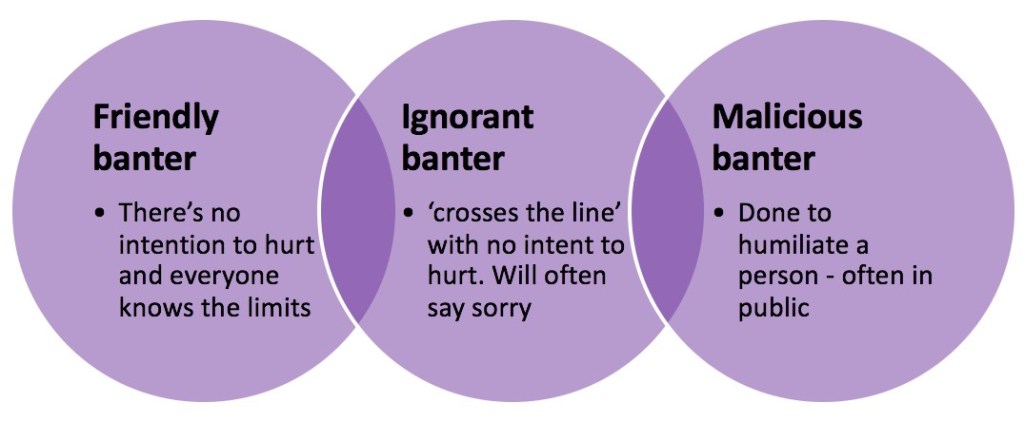
And so, because it is so complicated, we concluded that we should always err on the side of caution. If there is a risk that our words or actions might hurt or upset someone, we should not say or do those things. Banter is not okay – because once the damage is done, no amount of apology can undo it. A culture where banter is permitted is one where bullying can easily take root.
Banter allows bullying to exist in plain sight
We also gave students tips on what to do if they are concerned about banter or bullying:

If students are concerned they should speak to their tutor, Head of House, or a trusted adult in school – if bullying is reported, any member of staff at the Academy will take it seriously and pass it on to make sure it is thoroughly investigated. But prevention is better than a cure, and if we all think carefully about our words and actions before we say or do things, everyone’s lives will be better.

 The Headteacher's Blog
Pingback: 2023: the year in review | The Headteacher's Blog