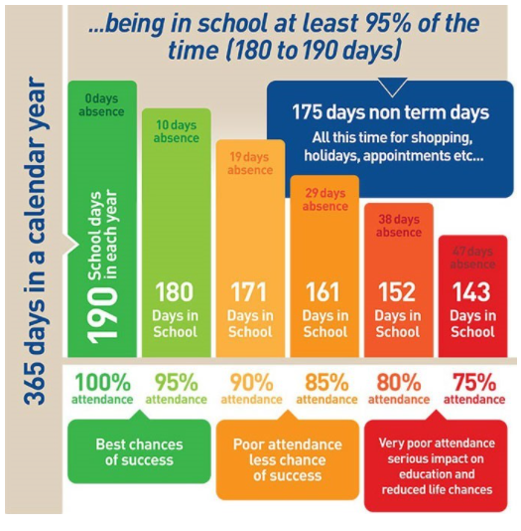
We all know that attendance at school is really important. If attendance is low, students miss out on vital lessons. It attendance is patchy, so is learning. The impact is summarised in this table:
Whilst attendance at Churchill is above the national average, that national average is lower than it was before the pandemic. This means that, across the country – including at Churchill – too many children are missing out on their education.
The link between attendance and attainment is clear: 36% of children who were persistently absent in KS4 got 9 to 4 in their English and maths GCSEs, compared with 84% of those who attended regularly. But attendance is important for more than just attainment: regular school attendance can facilitate positive peer relationships, which is a protective factor for mental health and wellbeing.
The good news is, it’s never too late to benefit from good attendance. More than half (54%) of pupils in England who were persistently in Year 10 and then rarely absent in Year 11, passed at least 5 GCSEs, compared to 36% of pupils who were persistently absent in both years.
We know attendance really matters – and that’s why it’s so important that every single student attends school every day that it is possible for them to do so. And there is a wealth of guidance out there to help and support families with school attendance:
Is my child too ill for school? The NHS’s comprehensive guide to when you should keep your child off school (and how long for), and when it’s okay to send them in if they are feeling ill.
Members of the Attendance Action Alliance have worked with the Department for Education to develop this short guide which helps parents understand how they can work with their school and local authority to support their children to attend school and get the right support.
We implemented a new behaviour policy in September 2023. The aim of that policy is to improve behaviour in lessons and around the Academy, so that our students can learn in classrooms free from disruption and feel safe and confident in their learning environment.
Our new approach required a significant adjustment from staff, students and families. It was a big change. But has it worked? Is it working?
We asked the Lighthouse Schools Partnership to commission an independent school improvement partner (SIP) to find out. The SIP worked with the Trust’s Director of Secondary Education to undertake a whole-school behaviour review on Wednesday 15th November. The review included visits to lessons in Year 7, 8, 9 and 10 (Year 11 were doing mock exams), visits to tutor time, discussions with students and staff, observations of transitions between lessons and social times, and visits to the Refocus Room. It was a thorough and detailed review of all we are doing to improve behaviour.
We received the report last week, and the findings are overwhelmingly positive. Some findings include:
Behaviour in all lessons seen was improved on previous visits.
Teachers have communicated and used the new behaviour system and expectations well to establish positive learning climates.
Transitions are smoother between lessons and the increased presence and vigilance of staff is a factor in keeping students moving to their next lessons.
Strong practice was evident in the work of heads of house and some other staff in a ‘warm-strict’ approach.
Students’ behaviour at unstructured time has improved. The cafeteria was orderly, with students queuing sensibly with seemingly little need for any adult supervision.
Students were polite and respectful when speaking with unfamiliar adults, yet not afraid to give their views…the group of Year 11 boys spoken with at breaktime recognised that the new behaviour system was working well and that behaviour had improved across the school.
Visits to the tutor times in two houses found much improved student attitudes and a purposeful start to the day. Silent reading for pleasure for ten minutes is settling students ahead of lessons and all students had a book of choice. Strong relationships were evident at all levels.
The visits to the Refocus Room found a calm, purposeful environment and numbers entering the room have reduced.
All students in a broad range of informal discussions commented that they like the fact that there is a reset system to start each term afresh.
It is heartening to see the views that we have, working in the Academy every day, reflected back from visitors offering an independent, expert perspsective. Behaviour has significantly improved – and students are learning more as a result.
Of course, we are not done – there is always more to do. Our next priorities are on punctuality to school and to lessons, to ensure that students don’t miss out on valuable learning time, and on orderly entry to the classroom, focused on line-ups and the “strong start.”
We will also continue to work with students who are struggling with their behaviour to help them to improve. We have seen great strides with many of our young people, with some dramatic improvements in their conduct points scores over the course of the first two terms of this year, and a huge reduction in the frequency of their visits to Refocus.
I feel very proud of the improvements that we have seen. I want to thank my colleagues for their wholehearted commitment to our new approach, and their tireless efforts in implementing our new system – which is really paying off. I also want to thank the families in our Academy community for supporting our new policy, and for opening up constructive dialogue with us where they have had questions. These conversation have helped us to continue to improve.
But, above all, I want to thank our students. They have really grasped the message that disruptive behaviour affects everyone, and that our efforts to eliminate it are a shared endeavour. I have always been so impressed by our students who consistently behave well; but I also want to pay tribute to those students who have really pushed themselves to improve their behaviour, to avoid being sent to refocus – and, in doing to, to avoid disrupting the learning of others. This effort to make a positive difference is exactly what our Academy is set up for. I could not be more impressed by what I have seen.
This week Mr Davies has been taking assemblies, and helping our students reflect on the importance of marginal gains.
“The aggregation of marginal gains” was part of the success of British Cycling in the run up to the London 2012 Olympic Games and beyond. The philosophy was to look at every aspect of performance, and to look for any tiny improvements that could be made. Heat pads to warm up cyclists’ muscles to the optimum temperature; tiny savings in weight from each pedal crank; cyclists travelling with their own pillows to reduce the chance of catching a virus from hotel pillows – these were just some of the examples of marginal gains made by the cyclists.
On their own, each tweak to the programme might only make a millisecond of difference to the cyclist’s overall time around the track. But, the philosophy said, if you made lots and lots of those tiny gains, they would all add up and might give you the edge over a competitor.
Mr Davies then asked students to consider the marginal gains they could make at school to improve their educational performance. He gave three examples:
Attendance: Mr Davies explained the difference that attendance makes. He asked: is 90% attendance good enough? 90% means that you miss one day in every ten – that’s one per fortnight. If you have 90% attendance over a school year, that means you have missed four weeks of education. If you have 90% attendance over five years at school, you would have missed half a year’s worth of lessons. We know that many students struggle with health issues and can’t achieve 100% attendance. But the point Mr Davies was making was that every day of attendance is a day of education – and every little bit matters.
Punctuality: We are really insistent that students are punctual to their lessons. You might not think that being five minutes late to a lesson matters – but it does. It disrupts the learning of others. It means the teacher has to re-start and re-explain the beginning of the lesson, wasting the time of those that were punctual. Then Mr Davies did some sums: if you were five minutes late to every lesson, you would miss 25 minutes a day, which adds up to two lessons a week, or 79 lessons a year – that’s three weeks in a school year. So that five minutes matters.
Attention: when called to attention, we require our students to be silent straight away and show they are listening by tracking the speaker with their eyes. Again, this is about the aggregation of marginal gains, ensuring that transitions between tasks are swift and that as little time is wasted as possible. These tiny differences will all add up, over time, to significant gains in learning time.
Mr Davies then challenged the students to think about their own marginal gains as they went about their lessons this term. It might be that little extra effort on a classwork or homework task. It may be that final check through a piece of work before declaring it “finished.” It may be that little bit of initiative to push learning further, ask a question, or take on an extension or challenge task. It may just be sitting up straight and paying that extra bit of attention to an explanation or a demonstration. On its own, no single action is going to make the difference: added up, they will definitely help.
Finally, Mr Davies reinforced the importance of good, safe behaviour at social time. Injuries and accidents can happen at any time, and sometimes they can’t be helped. However, students need to ensure they are minimising the risk of accidents happening by playing safely; injuries, if they do happen, are painful and distressing – but they can also lead to lost learning time.
This week (on 17th May) was National Numeracy Day – a day designed to help raise low levels of numeracy among both adults and children in the UK, and to promote the importance of everyday maths skills. The day aims to challenge negative attitudes towards maths and numbers, influence public policy and offer practical ways to help adults and children improve their numeracy.
We share the vision of the National Numeracy Trust. We also want to enable all our students to be confident and competent with using numbers and data, so they can make good decisions in their daily lives. Our strong Maths curriculum is testament to this, as is the fact that Maths is currently the most popular subject in our Sixth Form.
Understanding numbers and data is more important now than ever. The advent of ChatGPT this year, and the announcement that Google will be using AI within its search function, has highlighted the fact that we are entering a new era of partnership between humans and computers. Machine learning and artificial intelligence, driven by algorithms and the analysis of stupendously large datasets, will be an ever-increasing feature of all our lives over the coming years. The children we are teaching now will grow up in that world: we need to teach them to be ready.
Data is a massive part of all our lives, and it moves quickly. I can remember, when I started teaching in 1997, that we got the first computer in our English Department, and we used it to collect the exam results in a spreadsheet. It was an absolute revelation that we were able to show which students had done well in specific questions at the click of a mouse, and work out which bits of the curriculum to revise with them. Such analysis is now taken completely for granted, and it is layered with masses of additional information to enable us to make informed decisions about our work.
And this is not, of course, unique to education: every industry relies on data to help make sensible decisions, whatever the inputs and outputs – from healthcare to finance, engineering to retail, entertainment to research. Understanding that data, spotting and interpreting the patterns within it, and being able to manipulate it to reach informed conclusions, is an essential employability skill for a whole range of occupations.
Dr Hannah Fry shows why spotting patterns in data is essential for car racing, space exploration, government and more
But, at Churchill, we don’t see maths as purely utilitarian. We strongly believe that maths should be enjoyable for its own sake – for its elegance, its complexity and simplicity, for the stories that it can tell about our world, and for its quirky fun. I remember, for example, Mr Gale telling me about Belphegor’s Prime – a bizarre palindromic prime number which is a 1, followed by thirteen zeroes, followed by 666, followed by another thirteen zeroes and a final 1: 1000000000000066600000000000001. This number reads the same forwards as backwards; it is only divisible by itself and one; it contains 31 digits (which is 13 backwards). No wonder, with all these traditionally bad luck numbers layered into it, that the number was named after Belphegor, one of the seven princes of Hell, who is known primarily for tempting mortals with the gift of discovery and invention! What I find even stranger that 1000000000000077700000000000001 is also a prime number…
I have always been grateful to my maths education – even as an English Language and Literature graduate. It taught me to look for patterns, to analyse and try to understand the deeper structure of the thing that I was looking at – whether a poem, a play, a novel or, in my teaching career, a dataset, a budget or a behaviour or attendance record. This is what we aim for in our maths curriculum at Churchill – and, looking at our thriving sixth form uptake, it looks like it’s paying off.
Term 5 is a pressurised term – this year especially. It’s just five weeks from Easter to the May half term, with formal GCSE and A-level exams starting on May 16th. The exams suddenly go from seeming a long way off, to being…well, next week!
The final furlong of exam preparation is about finishing touches. Courses have been finished, despite the pandemic disruption. Students have the knowledge and skills they need now to tackle the exams ahead of them. This final few days is all about honing exam technique to a sharp point: what exactly do the examiners want to see in an answer to this particular type of question? How can you manipulate what you know to squeeze as many marks as possible out of each part of the paper? How should you manage your time to ensure you leave enough to cover everything fully?
Despite two years without exams, teachers are well versed in the mystic art of exam technique. Exam preparation classes across the Academy are full of last-minute reminders about what to include, where, and how. In a exam situation, this is almost as important as the knowledge itself!
You can put yourself at an advantage by preparing well. Revision is essential, of course – you can find revision tips in the Revision category on this blog. But just as important is a good night’s sleep, and a healthy meal before an exam. An all-night revision session honestly won’t help as much as you wish it would – the brain works best when well rested and fuelled. Get to bed, sleep well, and have a good breakfast.
Once you’re in the exam itself, there are some general tips that I always swear by:
Be sure to answer all the questions – turn every page. Including the back page…yes, every year someone comes out ashen-faced when they realise there were eight questions, not seven.
Jot down your key ideas – don’t be afraid to do some rough work, or write down some key notes as soon as the invigilator says “you may begin.” Getting key ideas down will ensure that you remember them!
Write something for every question – if you’re not sure, make your best educated guess at the question. If you’ve written something, you’re in with a shout of some marks. If you write nothing – you’re definitely going to score zero.
Keep an eye on the time – you know how many questions are on the paper. You know how long you’ve got. Make sure you leave enough time to answer them all.
Check – use every minute of the exam. Check for silly mistakes. Check that you’ve written what you think you’ve written. Check for accuracy of spelling, punctuation, and grammar. Give yourself time to add in that extra bit that you forgot the first time through. It could make all the difference.
Exams bring stress and pressure with them – that’s an inevitable part of the process. Managing that pressure is an essential part of succeeding. Being well-prepared is the best way to ensure that the pressure works in your favour, rather than against you.
I hope these last minute tips have been helpful. Above all, I wish all our exam candidates the very best of luck. You deserve it.
We know that good behaviour is essential for learning to take place. We reinforce this with our Code of Conduct and Effort Grades, and we incentivise it through our rewards system. We know that, over the past few years, it has been difficult to maintain consistency. COVID lockdowns, followed by periods of high staff and student absence, and the disruption to rooming in the Academy caused by works to Stuart House and Lancaster House have all contributed to a “stop-start” feeling for some classes, groups and individual students. We are certainly not alone in this: we have heard of many local schools having to close to entire year groups due to staff shortages this term, which is thankfully not a step that we have had to take.
Our Code of Conduct and Effort Grades
We hope that we will now be moving into a more settled period. Stuart House is open, and the long ten-day isolation periods for COVID infections are a thing of the past. Given the disruption of recent years, attendance is more important than ever – students cannot afford to miss any more school.
But simply turning up isn’t enough. For real learning to happen, students need to work hard. Learning is difficult; it requires effort. And this is where behaviour for learning comes in.
Behaviour for learning is about more than just being kind, polite and respectful. It is about more than just wearing the correct uniform and bringing the right equipment and making sure your mobile phone is not seen or heard around the Academy. These things are important, of course – but behaviour for learning is about engaging in those actions that will enable you to take in information accurately and store it in your long term memory for later retrieval. It is rooted in our learning values, which are displayed around the Academy every day. We believe in the value of:
Determined and consistent effort
A hunger to learn new things
Challenging ourselves to go beyond what is comfortable
Viewing setbacks and mistakes as opportunities to learn and grow
Seeking and responding to feedback
Encouraging others to succeed
It is these values which underpin our approach to learning across the curriculum.
This is one of my favourite videos to illustrate “passive” learning: these characters are well-behaved, but they aren’t able to take action to “unstick” themselves when they get stuck, or to apply effort to solve a problem for themselves. They are forced to wait around for someone to come and help them out. These are not Churchill learners!
When we return after the Easter break, we will be working hard with all our students to refocus on the key elements of behaviour for learning. This includes the Code of Conduct and Effort Grades, and our learning values. But we will also be clarifying and reinforcing our expectations of behaviour for learning in lessons.
In every lesson, every time, we expect students to follow our Behaviour for Learning Top 5:
Strong start: We arrive on time, line up and enter the classroom calmly
Full attention: We are immediately silent and face the speaker when called to attention
Full effort: We apply ourselves with our full effort to the learning tasks set
Full focus: We focus all our attention on the learning tasks set
Calm finish: At the end of the lesson we wait in silence for the member of staff to dismiss us
The return to school after Easter gives us a perfect opportunity to ensure that our students make the most of every moment they have at school, and use it to make progress in their learning. Staff will be working together to ensure that these expectations are clearly explained to students, and that they are supported and challenged to meet them – in every lesson, every time. Because, after the disruption of the past couple of years, we can’t afford to waste a single moment.
My welcome back assembly this week was delivered as a YouTube video, rather than live in the Academy hall, due to the ongoing COVID-19 restrictions. And that is – inevitably – how I opened my assembly: going through the COVID protocols for the month of January with a run-through of the rules about face coverings; expectations around twice-weekly testing; an explanation of the teacher’s role in balancing the need for good ventilation with a comfortable working temperature in winter; and an update on what we know about vaccinations for 12-15 and 16-18 year olds.
Once this reminder was out of the way, I wanted to focus my assembly on the importance of effort in learning. At Churchill, we have outlined the six things we know make the biggest difference to learning.
The six things that make the biggest difference to learning
These six things are grounded in educational research, and our experience and data shows that students who show these behaviours in learning are the most successful in terms of their progress and outcomes. And there, right at the top of the list, is determined and consistent effort.
But what does effort look like? Back in pre-pandemic times, we worked hard to describe what our expectations of student effort were. The result of this work was the launch of our effort grades system in September 2020 – which you can read about on this blog here, or on the Academy website here.
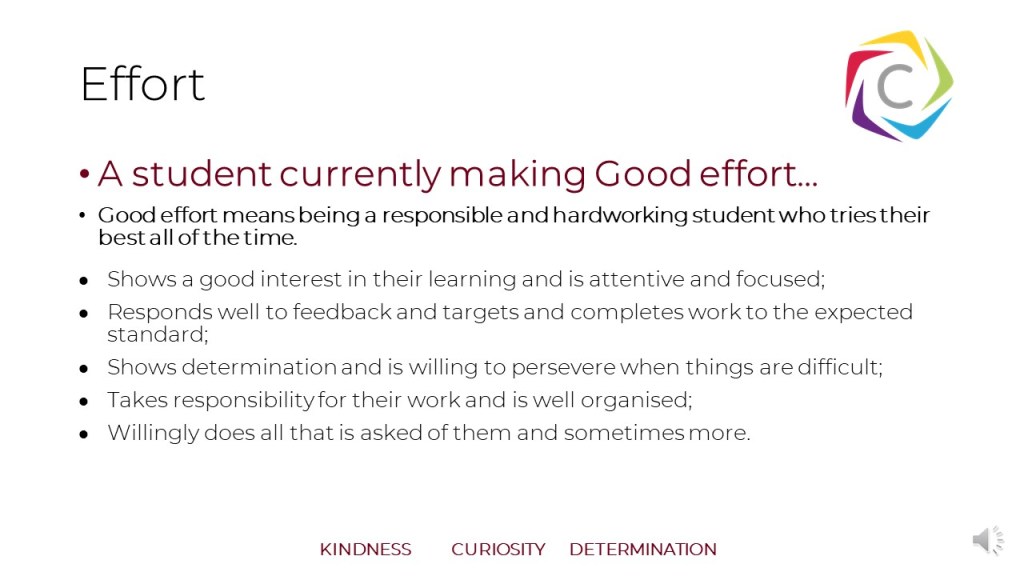
Our effort grades system sets up the expectation that all students will make at least “Good” effort. Anything less than “Good” isn’t enough – so it is graded “Insufficient” or “Poor.” It’s really important that our students know what teachers are looking for when we say we are looking for “good effort,” so we have set it out really clearly in their planners – and in my assembly!
Good effort
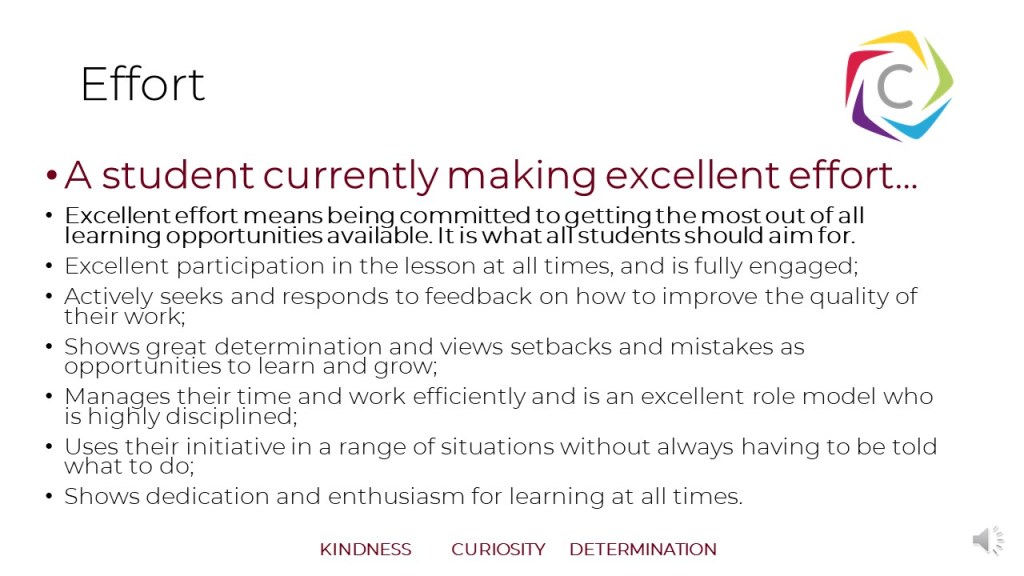
We have deliberately tried to write the descriptors for our effort grades as things that teachers can see the students doing in their classes, so that it makes it clear for the students how to show the teachers that they are trying their best. And those students who really push themselves can show that they are putting in excellent effort:
The effort grades that students achieve in their reports three times a year are really important to us at Churchill. We count students’ effort grades towards the House Cup: every Good and Excellent grade adds points to the House total! We also track them carefully to see how students are improving their effort, so we can congratulate them. Alternatively, if their effort is declining, we will try to understand the cause of this and offer support or challenge to them so they can bring it back up. But, vitally, the only one who can control the effort that a student puts in is the student themselves: they must take responsibility for the investment they make in their learning.
In my assembly, I talked about two students whose effort grades were tracked through Year 9, 10 and 11, and how they did in their GCSE exams (these examples were from before the pandemic, when exams still took place). The percentages shown are the students’ average effort grade score across all their subjects.
Student A started Year 9 with below average effort grades, but worked really hard to improve them. Despite a small dip in the middle of Year 11, this student got better and better over time – and this investment paid off. The student made, on average, 1.3 grades more progress than similar students nationally in their GCSEs. The difference: the effort they put in.
Student B tells a different story. They started Year 9 roughly where student A finished Year 11 in terms of effort, but gradually declined across the three years. The result of putting less and less effort in each time: the student performed, on average, one and a half grades less well across their GCSEs than similar students nationally.
We see this played out time and time again across the students we teach. In class, all students are taught the same lesson, but they don’t all learn the material equally well. There are lots of factors in the mix to explain why that is, but the single biggest differentiator is the effort that the students put in. That is why, at Churchill, we put such an emphasis on effort grades – and it is why, at the start of 2022, I used my assembly to remind students of why if matters, and what we expect.
Whenever you get results back from a test, an assessment, or a piece of work, there are two competing priorities at work in your mind. On the one hand, you want to feel good. You want to feel proud of what you have achieved. You want your teacher, or whoever has assessed the work, to have recognised the effort you have put in and what you have achieved.
On the other hand, you want to learn. You want to know how to improve so that you can get even better next time. Your eye is instantly drawn to the questions you got wrong, to the notes in the margin, which tell you that you’re not quite there…yet.
It would be great to turn in the perfect piece of work, to get it back 100% correct, with full marks and a shiny gold star on it. That would feel amazing. But, as I tell students and their families when they join the Academy in Year 7, if you’re getting everything right then you’re not learning anything. The chances are the work wasn’t challenging enough: it just gave you an opportunity to show things that you already knew, or to practise skills you had already mastered. That has its place – but the real learning happens when you’re grappling with material you haven’t quite nailed down yet, or attempting a really difficult problem that you haven’t quite grasped…yet.
Researcher Dylan Wiliam calls these two types of response to feedback “ego-involved” and “task-involved.” When you get your work back, or receive some feedback, your ego is always involved. This is the part of your brain that wants to preserve your wellbeing. It wants you to feel good about yourself. It wants you to think you’re brilliant. The problem with this is that it gets in the way of learning. It means you will be afraid to try difficult and challenging tasks, in case you fail: it protects you from the damage to your self-esteem that failure can dish out.
In the other side, a “task-involved” response means that your first reaction when getting your work back is not to react emotionally, not to act to preserve your wellbeing, but instead to think. A task-involved approach means that you are analytical in response to your feedback, and focused overwhelmingly on the learning you can gain from it. Of course, you are interested in what you did well: it’s important to recognise the progress you have made, the hard work that’s paid off, and the knowledge and skills that you have secured. But you are also focused on the room for improvement: the silly mistakes you’ve made, the ideas you hadn’t quite grasped yet, the bits of knowledge you had misunderstood or not expressed clearly enough. And – crucially – you are focused on what you are going to do about it. How you are going to avoid the same mistakes next time. The bits of the course you are going to go back over. How you are going to improve.
It’s impossible to divorce the emotional “ego-involved” response altogether. It’s natural to feel disappointed if a mark isn’t as high as you wanted, or if you made a silly mistake that dropped you from one grade to the next. That’s normal! But, at Churchill, we work really hard to help our students to manage their emotional responses to feedback, and focus as rapidly as possible on the learning that comes from it. Because the only point in doing school work at all is to learn from it!
Over the coming days, our Year 11 students are getting their mock exam results back. There is a lot of emotion tied up in these results for our students, especially with the additional pressure that the pandemic has placed on mocks after two years of cancelled public exams. But the most important thing for our Year 11 students – and for any students, at any stage, getting a piece of work or an assessment back – is to focus on the learning. What did I do well, and how can I improve? What does this assessment tell me about where I am in my progress in this subject? And what do I need to do to make sure that I continue to get better?
The grade or mark you get on an assessment only matters twice in school: in your actual GCSE exams in Year 11, and in your actual A-level exams in the Sixth Form. At every other point in school, the grade or mark is not the most important thing: it’s what you learn from it.
A couple of years ago I started to keep a list in my phone of all the books I read each year. It’s great to look back over them and take stock of what I’ve been reading!
In 2020 I only managed ten books. In my defence there was a lot going on that year and I didn’t really get my normal holidays due to the pandemic! I’d also note that one of the ten was A Little Life by Hanya Yanagihara, which was 720 pages long and took me ages. It was worth it though, as I explain in my books I read in 2020 post last year.
This year I have managed 21 books, so I’m feeling quite proud of myself! If you’re looking for a recommendation, here are my favourites (in no particular order!)
The Ballad of Songbirds and Snakes
By Suzanne Collins
Suitable for Year 8+
I love the Hunger Games books, and Suzanne Collins revisited the world of Panem for this prequel following the early life of Coriolanus Snow – the President Snow of Katniss Everdeen’s story – in the early years of the Hunger Games. As well as adding additional colour and detail to the world of the books – including the origin of the “Hanging Tree” folk song – I found this a gripping and exciting tale, with lots of twists and turns.
A Skinful of Shadows
By Frances Hardinge
Suitable for Year 7+
I think Frances Hardinge is my current favourite young adult author. I read The Lie Tree last year and Deeplight this year as well, but A Skinful of Shadows was really terrific. Set in the English Civil War, it mixes historical fiction with some supernatural fantasy as the twelve-year-old narrator, a girl called Makepeace, discovers that she has inherited a paranormal gift from her family – the ability to host the ghostly spirits of the dead within her. This discovery leads her on a breathtaking adventure – part espionage thriller, part gothic horror – that had me hooked throughout.
Piranesi
By Susanna Clarke
Suitable for Year 9+
Every now and again you come across a book of such audacious originality that you marvel at how boundless the human imagination really is. This was one such book. The concept of this story is so unexpected that I find it astonishing that anyone could ever have dreamt it up! Piranesi, the narrator, lives in a strange house with many rooms and levels, which also hosts an ocean. He is surrounded by statues, and he is alone except for the occasional visits of someone known only as The Other. As Piranesi explores, he begins to suspect that the world he knows is not all that it appears to be…to say any more would be to spoil the story. If you read it, prepare to have your mind blown!
Hamnet
By Maggie O’Farrell
Suitable for Year 10+
In another breathtaking act of imagination, Maggie O’Farrell tells the story of the life and early death of Hamnet, William Shakespeare’s son. We know from the historical record that Hamnet was a twin, and that he died aged 11. Scholars have long imagined that Shakespeare’s grief for his lost son inspired the play Hamlet, written a few years later. O’Farrell takes these ideas and spins them into an enthralling tale, where Shakespeare himself is really a fringe character, who is never mentioned by name. This is, rather, the tale of his wife, Agnes, who is brought to vivid life in simply stunning prose. An unforgettable read.
A Promised Land
By Barack Obama
Suitable for Year 9+
In this first part of his autobiography, President Obama takes us through his early life, his education, his entry into politics and into his first term in the White House. It is a long read, but all the more fascinating for it. As well as giving the inside view on what happened, Obama explains the rationale for decisions he made – good and bad – and the consequences and responsibilities he carried as a result. What I found most touching was his discussion of balancing his career with his responsibilities as a husband and father: having read Michelle Obama’s book Becoming a couple of years ago, it was fascinating to see her husband’s perspective on the same events and issues. The book concludes with an account of the mission to eliminate Osama bin Laden, the man responsible for the 9/11 attacks: you can feel the tension in every word on the page. I can’t wait for part two!
An American Marriage
By Tayari Jones
Suitable for Year 11+
This was the first book I read in 2021, and I loved it so much I went on to read the author’s first book, Silver Sparrow, in the summer. The novel tells the story of a young black couple, Celestial and Roy, in the southern United States. Their marriage is placed under pressure when Roy is arrested and convicted for a crime Celestial knows he did not commit. The unravelling of the consequences of this fateful event is brilliantly told, and the novel explores the complexity of racial tensions in America throughout. Tayari Jones is an astonishing writer – Silver Sparrow is just as good.
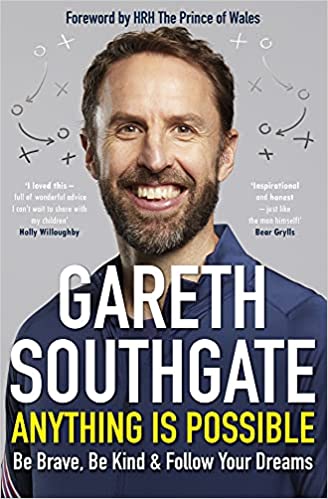
Anything is possible
by Gareth Southgate
Suitable for Year 7+
I was caught up in football fever this summer as England looked like they might just win something! Although that didn’t quite go to plan, Gareth Southgate’s calm, positive leadership of the England setup as been an inspiration. In this book – aimed at children – he uses his own life story to pass on messages about how to achieve your goals (not just in the footballing sense!) with wisdom, good sense, and practical advice. I gave a copy to each of our new House Captains this year to help them in their leadership roles – they said they liked it too! Highly recommended, whether you’re into football or not.
To The Lighthouse
by Virginia Woolf
Suitable for Year 9+
I last read To The Lighthouse when I was at university, as part of my degree. I was reminded of it when it was the subject of an episode of the Literate podcast, reviewing the New York Public Library’s books of the 20th century, and picked it up to remind myself why it was so special. I wasn’t disappointed. It’s a book in which very little happens: in the first section, the Ramsay family and their house guests spend the afternoon and evening together at their holiday home; in the short middle section, “Time Passes”, taking in the First World War and the changes to the family; and in the final section, several of the characters return to the holiday house to complete the long-promised but not-completed journey to the lighthouse off the coast. It doesn’t sound like much, but Virginia Woolf uses it to explore the depths of human relationships, the nature of art, and our perceptions of one another. Her writing is simply astonishing.
As you can tell, I love talking about books, so if you’ve read one of the books on this year’s favourites list, please tell me what you thought of it in the comments below. I’m also open to recommendations for my “to read” pile, which is currently substantial but not endless!
We are all busy. We have many things competing for our attention all the time. In this week’s blog, I want to introduce you to the techniques that I use to help me to prioritise all the things I have to do. They really work!
The Eisenhower Matrix
The Eisenhower Matrix or Grid. It’s often drawn in a different configuration, but I always think of it this way, like a graph!
The idea is simple. You make a simple grid with four quadrants, as in the image above, and you place the tasks on your to do list in one of the four quadrants according to how urgent, and how important, they are.
Quadrant 1 – urgent and important: DO NOW. Items in the top right corner of the grid are the most important and the most urgent. They need to be done right away and they cannot wait. The aim is to work smart to make sure as few things as possible end up in this quadrant, by doing them in plenty of time so they don’t become urgent. But sometimes, stuff happens, and it needs to be dealt with right away!
Quadrant 2 – important but not urgent: WORK IN THIS ZONE. This is where I try to spend most of my time. Here, you are dealing with things that are important, but not yet urgent. Spending time in this zone should prevent things moving into quadrant 1 where you get panicky as the deadline approaches. It’s also really satisfying to know that you are spending your time on the stuff that matters.
Quadrant 3- urgent but not important: GET RID. This is stuff that needs to be done but you don’t really want to spend time in this quadrant. Get this stuff done as quickly as possible – or, if you are lucky enough to have someone else around, get them to do it for you!
Quadrant 4 – not important and not urgent: DON’T BOTHER. If it’s not important, and it’s not urgent, don’t bother! Just be careful that the thing you’re not bothering with now won’t actually become important later – otherwise, it might suddenly pop up in quadrant 1 and send you into a panic!
When I first came across the Eisenhower Matrix, it was in a work context. I have used it ever since to help me prioritise my work as a teacher, a school leader, and as a Headteacher. It’s become so ingrained in my mind that I have found it also spills over into other parts of my life as well! Sometimes, the most important thing to do is spend time with your family, or go for a walk, or to take some exercise. Prioritising those things alongside work is essential for my own wellbeing. Over time, I think I have got better at weighing up which I need to prioritise and when – but nobody’s perfect and we’re learning all the time.
Which leads me to my second technique.
Eat the biggest frog first
“If it’s your job to eat a frog, it’s best to do it first thing in the morning. And if it’s your job to eat two frogs, it’s best to eat the biggest one first.”
Mark Twain
I first came across this quotation from a colleague Headteacher, who shared it with at an event she was leading. It really stuck! What Mark Twain was saying is that, sometimes, we have unpleasant things to do. Things that we don’t want to do, but unfortunately we have to. In those situations, it’s best to get them out of the way as soon as possible. And, given the choice of two things you could be doing, it’s best to get the most difficult and horrible one out of the way first.
I’ll be honest, I don’t always follow this advice. Sometimes, like anyone, I’ll put off that difficult and horrible job and tick off a few simpler and easier ones first. But I know I’m delaying the inevitable and that, sooner or later, I’m going to have to eat that frog. So, wherever possible, I try to follow Mark Twain’s advice and get on with that difficult, horrible job first. Get it done, get it out of the way, and after that everything else seems like plain sailing.
But don’t actually eat a frog. It’s a metaphor. You knew that, right?
Getting your priorities straight
I have found that these two simple techniques really help me keep my priorities straight, and make sure that the important work of running a school gets done. Students could apply these techniques to their school work and home life priorities; maybe even some of the grown-up readers of the Headteacher’s Blog might find them useful too? Let me know if you did – or let me know how you prioritise and make sure you get stuff done. We’re always learning!



















 The Headteacher's Blog