How to revise #3: Elaboration


elaboration


This is the third post in a series looking at the most effective ways to revise, based on the work of The Learning Scientists. The Learning Scientists are cognitive psychologists who want to make scientific research on learning more accessible to students and teachers. Their aim is to motivate students to study and increase the use of effective study and teaching strategies that are backed by research. I’ve met Yana Weinstein PhD at an education conference in Southampton last week – she’s the real deal!

Read all the revision posts here. 

Elaboration: what is it?

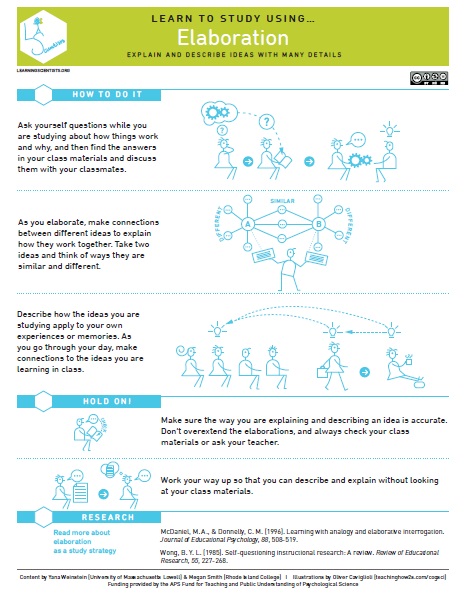
When you are elaborating, you are explaining and describing what you are revising with as many details as possible. You are looking for answers to why and how things work, and you are looking for connections between the material and other things you know.

Elaboration: why?

When you elaborate, you focus on the details and the connections between the material (what you are revising) and things in your own experience and knowledge (already safely in your long-term memory). These details and connections create “hooks” to help you remember the material you are revising.

Also, by working the material through your brain and doing something with it, you are strengthening the connections in your memory.

Elaboration: how do I do it?

How you elaborate depends on what it is that you are revising. Let’s say you are revising Biology, and you want to remember cell structures. You could ask yourself why animal and plant cells differ, and how they differ. Note the answers down, or say them out loud to yourself (or into a voice memo recorder). You could then ask yourself how they are similar, and why.

Always check that your elaborations are accurate after you’ve done them. Refer back to your notes, textbooks, or online resources. Correct and mistakes and repeat the elaboration with the corrections, otherwise you’ll risk remembering the incorrect material.

Elaboration: next steps

In the early stages of elaboration, it’s a good idea to have your notes around you to refer to. The eventual aim, however, is to get to the point where you can describe and explain accurately without the material in front of you.

Elaboration: watch the video


How to revise #2: Spaced Practice


This is the second post in a series looking at the most effective ways to revise, based on the work of The Learning Scientists. The Learning Scientists are cognitive psychologists who want to make scientific research on learning more accessible to students and teachers. Their aim is to motivate students to study and increase the use of effective study and teaching strategies that are backed by research. I’ve met Yana Weinstein PhD at an education conference in Southampton – she’s the real deal!

Read all the revision posts here.

Spaced Practice: what is it?

Spaced practice, sometimes called distributed practice, means that you revise little and often rather than all at once.

Spaced Practice: why?

forgetting curve

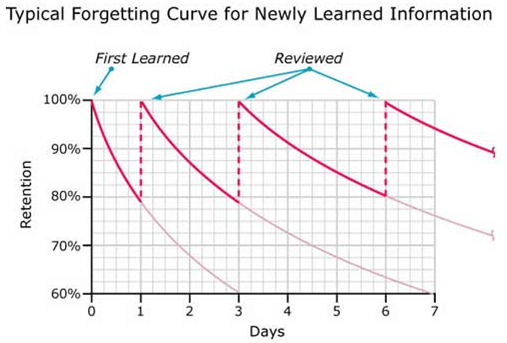
The Ebbinghaus Forgetting Curve – reviews over time lead to better retention of learned information

Spacing out your revision so that you revisit your material again and again  over time with breaks in between is far more effective than cramming all at once. Studies have shown that revisiting material helps secure the connections in your brain.

Spaced Practice: how do I do it?

Spaced practice needs planning – but it can start straight away. In any year, you can start spaced practice immediately to help secure your learning for the future. At the weekend, give yourself time to go over what you’ve learned in the previous week. It doesn’t need to be long – just a few minutes to make sure you’ve remembered what you’ve studied during the week.

Spaced Practice: next steps

After a few weeks, go back over the stuff from a month ago to make sure it’s still there. If you have to remind yourself of things that you’ve forgotten – don’t worry! Re-learning and reminding yourself of things you’ve forgotten actually makes the retention rate better.

In the run-up to exams, make sure you revise your material a little and often, leaving spaces of a few days between sessions on the same subject.

When you are revising, use the retrieval practice method, elaboration (see post #3!) and self-testing. Don’t just read over your notes – make your brain work hard with the material so you remember it better.

Finally, don’t leave all your revision to the night before – you won’t remember it! You’re actually far better off getting a good night’s sleep than pulling an all-nighter. Your brain will be sharper and more effective for the exam if you’re well rested.

Spaced Practice: watch the video

How to Revise #1: Retrieval Practice

This is the first post in a series looking at the most effective ways to revise, based on the work of The Learning Scientists. The Learning Scientists are cognitive psychologists who want to make scientific research on learning more accessible to students and teachers. Their aim is to motivate students to study and increase the use of effective study and teaching strategies that are backed by research. I’ve met Yana Weinstein PhD at an education conference in Southampton last week – she’s the real deal!

Retrieval Practice: what is it?

Retrieval practice is when you make your brain recall information from memory, and then do something with that information.

Retrieval Practice: why?

By forcing your brain to recall information from memory, it strengthens the connection in the long term memory and makes it easier to remember it next time. Failure to retrieve information also helps. If you can’t remember an important piece of information, fact or idea, it tells you that you need to re-learn it carefully so you can retrieve it next time.

Retrieval Practice: how do I do it?


Flashcards are particularly useful. Write a concept or keyword on one side, and the definition on the reverse. Alternatively, write a question on one side, and the answer on the other. Look at the front and remember the information on the reverse. Don’t be tempted to flip the card – if you do, you’re just reading the information, not recalling it from memory, and this isn’t helping with retrieval.

Retrieval Practice: next steps

Testing yourself is difficult! Don’t worry if you find it hard. The struggle is actually making the connections in your brain more secure. Follow the advice above and it will get easier – but if you cheat and look at the answers, you aren’t securing those connections to your memory.

It’s also vital to check that you’ve recalled information correctly, otherwise you might be cementing incorrect definitions and ideas into your memory!

Retrieval Practice: watch the video

In this video, the Learning Scientists explain about retrieval practice:


Happy revising!