This year we are using a new national programme to help structure some of our assemblies and tutor times: Votes for Schools.
Votes for Schools is a weekly current affairs-based voting platform designed to engage young people in political and social issues. Through weekly discussion and voting, not only are voters learning about the world around them, but they are also becoming active citizens and preparing for participating in our democratic processes as adults.
We have already had some good discussions about cultural appreciation vs cultural appropriation, linked to Black History Month. Families can get involved too – here are some great ways for you to get involved in the conversation!
Check the website
At 4PM every Friday, the latest Vote Topic goes live! Anyone can check the Votes for Schools website – www.votesforschools.com – to see what students across the country will be debating and voting on in the coming school week.
Discuss the topic at home
Ask your child to give arguments for each side of the debate to encourage critical thinking. Votes for Schools produces a weekly Home Information Sheet that can help you with this, which you can download from their website.
Discuss the results
When the new Vote Topic is available, the national results of the previous topic will be too! Why not ask your child how they voted and why, and discuss how the rest of the country voted?
Brush up on your knowledge
You can read up on any topics your child is discussing, or has discussed, to see what your take on it is. For more sensitive topics, Votes for Schools also provide a list of useful resources and organisations where you or your child can find out more or seek support.
Share your ideas and find out more
Please talk to your child about which issues they would like to see discussed at Votes for Schools. You can let them know their thoughts, or encourage them to reach out to Votes for Schools directly. You can email them directly at secondary@votesforschools.com, or visit the website www.votesforschools.com to make suggestions or to find out more.
We began the year focusing on our value of kindness, before turning our attention to determination to see us through the dark, cold winter. Last week’s assemblies, as the days lengthen into spring, focused on our value of Curiosity.
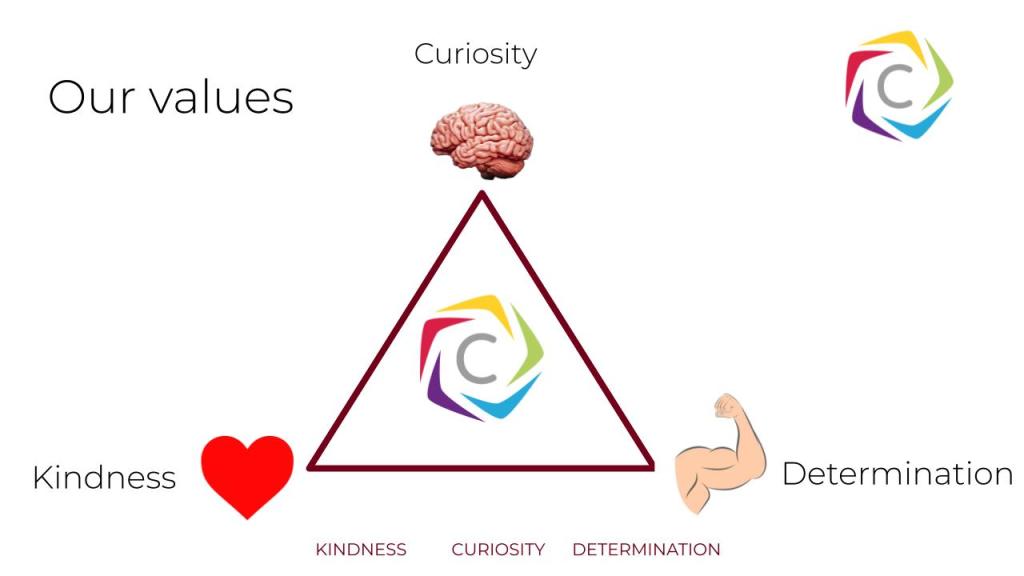
Our three values form three points on a character triangle, based on the work of CharacterLab. Kindness is a strength of the heart; curiosity a strength of the mind; determination a strength of the will. All three work together to support our students to be successful in school, and beyond, in pursuit of Martin Luther King’s maxim: “intelligence plus character – that is the goal of true education.”
Curiosity enables independent thinking and enquiry, and is the basis of human flourishing. Stone age man was driven by curiosity: what happens if I bang these two rocks together? Can I use this animal skin to store water, so I can travel further from the lake? And so on, generation after generation, we have built on the discoveries of our predecessors in a way which is unique to our species. And we are never satisfied, continuing to push the boundaries of what we know, to solve mysteries, to understand more about the world around us and the universe beyond.
It was this curiosity that led Einstein to develop his general theory of relativity – his attempt to explain how and why the universe behaves as it does. He was driven by a passionate desire to understand, to explain, to make sense of things. It is this uniquely human desire that we seek to foster in school.
This desire for discovery continues to this day, with the Curiosity Rover on Mars and recent landings on the moon. We continue to strive to know more, to understand more, to answer questions, to solve problems – and there is always more to learn.
A dopamine molecule
Curiosity has many benefits:
Good for our brains and aids memory: the more we learn, the better our brain gets at learning. This is because our broader general knowledge gives us more “anchor points” for new knowledge to hook onto, to connect with, and to secure itself in our memories.
Helps us to be empathetic: understanding people who are different to us is essential to help us collaborate and cooperate with one another, to develop our empathy, and to improve our communities.
Increases confidence: the more we understand about the world, the more confident we feel within it. We feel most insecure when we are uncertain, when we don’t know what is happening or why, or when we don’t understand things. The more we know, the more confident we feel.
Contributes to happiness: when we learn something new, solve a problem, or something slots into place in our mind – that “lightbulb” moment – we feel a little rush of satisfaction. That is the release of dopamine into our system, a chemical designed to reinforce achievements by making us feel happy. So satisfying our curiosity actually makes us happier!
In my assembly, I went through all the ways we can satisfy our curiosity and extend our learning. The first – and most important – is through reading. Reading much, and reading widely, is how humanity has broadened and extended its knowledge over millennia. Using the library to ensure that we are reading books that we are interested in, and which take us beyond what we already know, is a guaranteed way to help us learn!
We are fortunate also to live in the age of the internet, where all the world’s knowledge is at our fingertips. Satisfying our curiosity has never been easier: we can ask Siri, ask Alexa, ask Google, ask ChatGPT. But we must be careful when using these sources, and always be curious about the answers we get back. Information we get online needs to be verified, as its accuracy cannot always be trusted. And AI, whilst it is useful, is subject to similar cautions: the answers we get from AI are only as good as the questions we ask, and the sources that the AI relies on. So there is no substitute for our human curiosity – we mustn’t become lazy, and let the machines think for us.
I concluded with three ways our students can show curiosity in the classroom and beyond:
Enquire: Ask questions – “why” and “how” – and actively listen to the answers
Explore: read around the subject – find out more
Experience: Seek out new experiences, people and challenges
Keeping an open mind allows us, the inheritors of the benefits of millennia of human curiosity, to continue mankind’s constant journey to know and understand more – and to contribute to human progress. What a privilege learning is!
In this week’s assemblies, Heads of House have been talking to students about social media. We can’t avoid these apps and services – they are part of our lives and the society we live in. What we need to do is ensure we use them carefully, kindly, and appropriately. And that means we need to think about them.
Social media apps make money through advertising. Advertisers want audiences looking at their apps. So that means, for a social media service to be successful, it has to be good at grabbing our attention, and then keeping us focused on it for as long as possible. The whole business model of these apps is designed to get us hooked, and keep us hooked.
Excessive use of social media creates increased loneliness, fear of missing out (FOMO), and decreased life satisfaction. There are also strong links between excessive social media use and body image dissatisfaction, low mood, lowered self-esteem, and disrupted sleep patterns. No wonder there are age limits on these apps:
WhatsApp: 16
Facebook: 13
X (formerly Twitter): 13
Snapchat: 13
Instagram: 13
TikTok: 13
Another big risk around social media is the risk of cyberbullying. Unkindness is rife online. People hide behind keyboards and screens and say things they would never say to someone’s face – but the impact is just as severe. Only this week, an inquest has heard evidence of how online bullying was a factor in the death of a 14-year-old schoolgirl in London in 2021. UEFA have launched a campaign called Outraged to raise awareness of the impact of online abuse on footballers.
Because there are also positives in social media. It can facilitate social connections and peer support, offering the opportunity to talk about things that you may feel you can’t face to face . It can provide a space for rewarding social interactions. There is a wealth of educational and informative content which can help us learn, develop new skills, and broaden our world view. And we can find humour and feel good stories across social media which can reduce stress as well as entertaining us.
So, it’s not all bad. But if we choose to use social media, it is our responsibility to use it kindly and constructively, for our own good and for the good of those around us who are also on those platforms – and in moderation.
It has been great to welcome staff and students back for the new year this January. I have held assemblies in this first full week back, to remind students about our expectations, to provide a few updates, and to encourage students to reflect on the idea of self improvement.
I reminded students about our classroom and social time top 5 expectations, and our system for punctuality. It has been really encouraging to see so many students starting the new year so positively, with lots of Headteacher’s and Governors’ Commendations to hand out at the start of each assembly.
The Sports Centre
I also updated students on the work going on in the Sports Centre. Following a complete replacement of the roof, contractors are now hard at work inside the building. They are converting the old swimming pool into a multi-use hall, and are redecorating and refurbishing the internal spaces .Over the coming weeks, doors and windows will be replaced, to ensure that the building is ready for our use when it is handed over to us. We are very grateful to the Lighthouse Schools Partnership for their support in overseeing this work, which will greatly improve our facilities and enable PE and Performing Arts to continue to thrive – even during exam season!
Resolutions
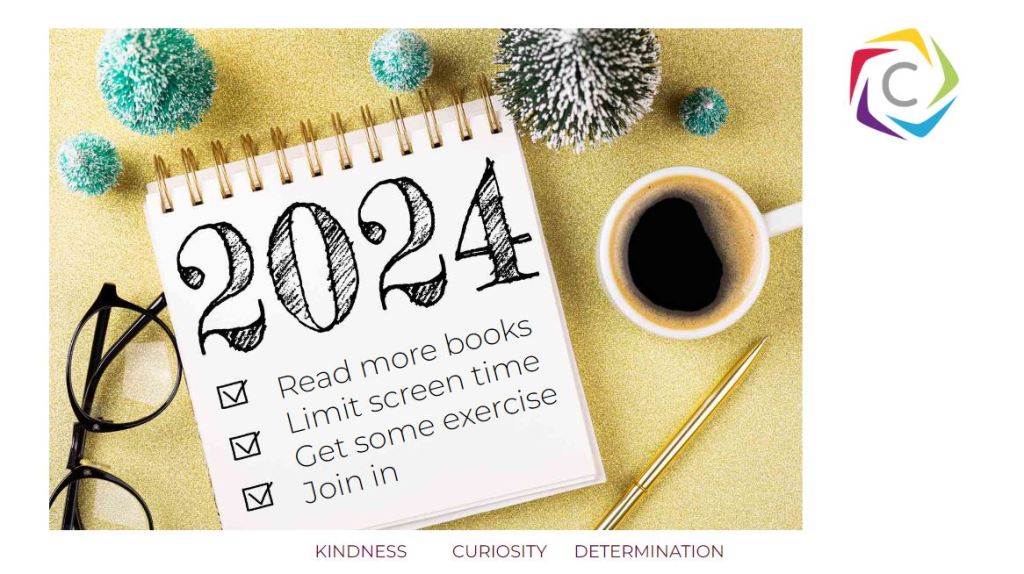
I also talked about the idea of new year’s resolutions, offering four options for students to consider as they think about improving themselves over the course of 2024.
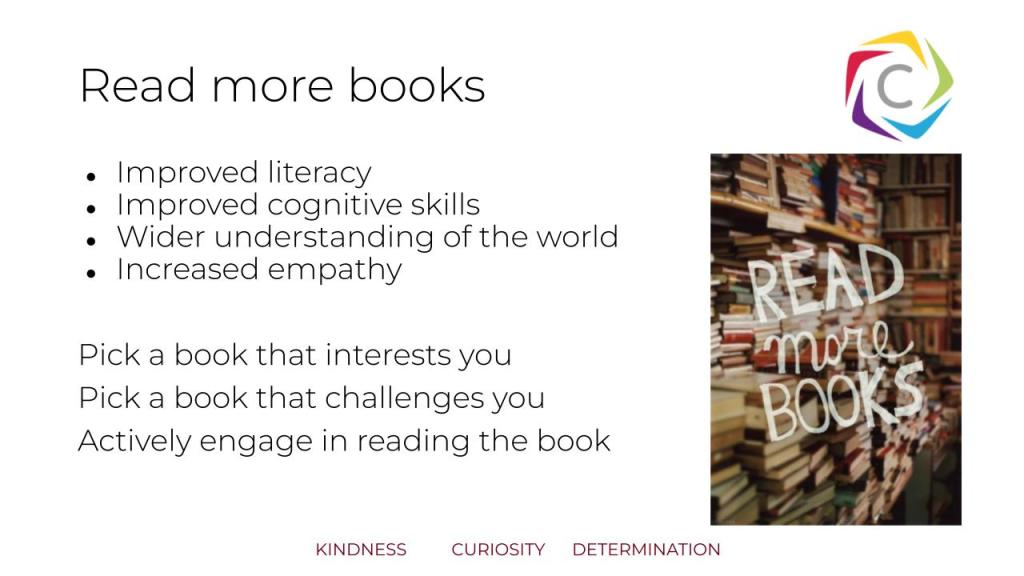
We know that regular reading not only improved literacy and cognitive skills, but helps us understand more about the world we live in, and the people who we share it with. I encouraged students to make the most of the regular reading time we provide to choose a book that interests and challenges them, and to push themselves to read more books. This is one I am constantly striving for myself!
I then spoke about the importance of a healthy relationship with technology. We know that reductions in screen time improve mental and physical health, reducing stress and anxiety and leading to better sleep patterns. I urged students to consider steps such as turning off notifications, setting time limits and down time, and ensuring that phones are charged outside of the bedroom so they don’t interfere with sleep. We ensure that students have time away from their devices during the school day – in line with government guidance – but outside of school, it’s up to them. Mobile devices are part of our lives, and will be part of our futures, so developing a healthy relationship with technology is essential for our students to be successful adults.
Thirdly, I asked students to consider monitoring their physical activity, in line with guidance from the World Health Organization. Replacing inactive “sedentary” time with physical activity has many health benefits – any activity is better than none, and more activity is better! So making sure that every move counts would be a great resolution for 2024.
Finally, I asked students to ensure that they made the most of the opportunities on offer to them in 2024. I don’t want any students to look back in twelve months’ time and think “if only…” We want our students to participate fully in their lessons and beyond, to get involved and take part, and to take control of their own self-improvement.
I concluded the assembly with the launch of the 2024 inter-house poetry competition – a great opportunity to get involved and join in straight away! All students have the opportunity to submit a poem in this year’s competition, in any form, under the theme of either “growth” or “solitude.” All entries to be handed in to the English Department by 9th February!
It’s been a great start to the year so far – I look forward to continuing to improve every day as we move through 2024.
This week Mr Davies has been taking assemblies, and helping our students reflect on the importance of marginal gains.
“The aggregation of marginal gains” was part of the success of British Cycling in the run up to the London 2012 Olympic Games and beyond. The philosophy was to look at every aspect of performance, and to look for any tiny improvements that could be made. Heat pads to warm up cyclists’ muscles to the optimum temperature; tiny savings in weight from each pedal crank; cyclists travelling with their own pillows to reduce the chance of catching a virus from hotel pillows – these were just some of the examples of marginal gains made by the cyclists.
On their own, each tweak to the programme might only make a millisecond of difference to the cyclist’s overall time around the track. But, the philosophy said, if you made lots and lots of those tiny gains, they would all add up and might give you the edge over a competitor.
Mr Davies then asked students to consider the marginal gains they could make at school to improve their educational performance. He gave three examples:
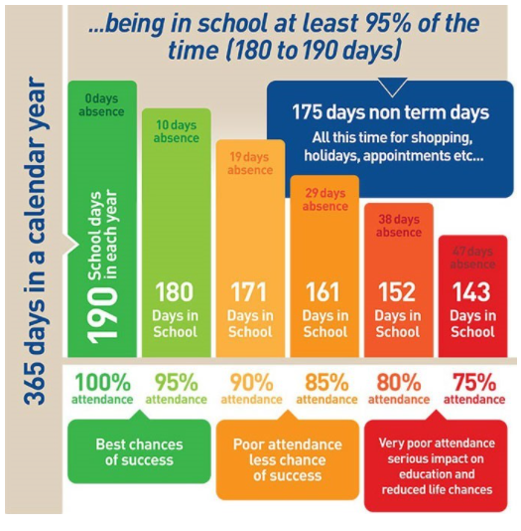
Attendance: Mr Davies explained the difference that attendance makes. He asked: is 90% attendance good enough? 90% means that you miss one day in every ten – that’s one per fortnight. If you have 90% attendance over a school year, that means you have missed four weeks of education. If you have 90% attendance over five years at school, you would have missed half a year’s worth of lessons. We know that many students struggle with health issues and can’t achieve 100% attendance. But the point Mr Davies was making was that every day of attendance is a day of education – and every little bit matters.
Punctuality: We are really insistent that students are punctual to their lessons. You might not think that being five minutes late to a lesson matters – but it does. It disrupts the learning of others. It means the teacher has to re-start and re-explain the beginning of the lesson, wasting the time of those that were punctual. Then Mr Davies did some sums: if you were five minutes late to every lesson, you would miss 25 minutes a day, which adds up to two lessons a week, or 79 lessons a year – that’s three weeks in a school year. So that five minutes matters.
Attention: when called to attention, we require our students to be silent straight away and show they are listening by tracking the speaker with their eyes. Again, this is about the aggregation of marginal gains, ensuring that transitions between tasks are swift and that as little time is wasted as possible. These tiny differences will all add up, over time, to significant gains in learning time.
Mr Davies then challenged the students to think about their own marginal gains as they went about their lessons this term. It might be that little extra effort on a classwork or homework task. It may be that final check through a piece of work before declaring it “finished.” It may be that little bit of initiative to push learning further, ask a question, or take on an extension or challenge task. It may just be sitting up straight and paying that extra bit of attention to an explanation or a demonstration. On its own, no single action is going to make the difference: added up, they will definitely help.
Finally, Mr Davies reinforced the importance of good, safe behaviour at social time. Injuries and accidents can happen at any time, and sometimes they can’t be helped. However, students need to ensure they are minimising the risk of accidents happening by playing safely; injuries, if they do happen, are painful and distressing – but they can also lead to lost learning time.
In this week’s assembly, I welcomed our students back after the Christmas break. After a quick reminder of our behaviour expectations, Mrs McKay and I focused our assembly on the key topic of ensuring that our Academy community is a safe and inclusive one.
My part of the assembly focused on the way we use our words. I was inspired by talking to our Year 11 House Captains, who said that one of the things they wanted to concentrate on during their their year in post was on language used by their fellow students which can offend, upset, provoke or disturb them. This echoed the work of last year’s inclusion and diversity group, who presented to our Trustees on the impact that micro-aggressions can have on students’ feelings of belonging and inclusion.
There are occasions when students use words deliberately to be unkind, to upset others, to provoke them, or to offend. This is always wrong. But we can also use words thoughtlessly or carelessly, and we can offend, upset, exclude or alienate others through our ignorance or lack of consideration. Perhaps we didn’t fully understand the language we were using, or its implications, or perhaps we didn’t think carefully enough before opening our mouths. We need to be clear that this is just as problematic: our words can hurt, whether we intended them to or not.
I therefore asked our students to use the “THINK” acronym above – and to “THINK” before they speak. I used a little bit of audience participation to demonstrate this principle in the assembly. A willing volunteer from the audience donned the important safety equipment, before attempting to squirt all the toothpaste out of a tube as quickly as possible (Stuart were the best at this so far, with a time of just under 7 seconds). The second part of the experiment saw the volunteers try to put the toothpaste back into the tube. This proved much more difficult.
The experiment was designed to show that squeezing the toothpaste is like blurting something out without thinking about it. It’s easy to do – the work of a moment – and actually feels pretty good in that moment! But once it’s out, there’s no putting it back, and any attempt to do so actually creates a worse mess than you started with.
It’s also important to think about the way we “speak” online. Mrs McKay has already spoken to students this year about the importance of e-safety, but we often see how people “say” things online they would never say in person. I used this quote from the film The Social Network to demonstrate this principle:
Our words – or the images, videos, gifs and emojis we post, and the posts we like, re-post and share – define us online. Employers (including schools, under new safeguarding guidance) conduct checks on candidates’ online presence, and there are plenty of examples of thoughtless online behaviour landing people in trouble – including losing their jobs.
As well as the risk to ourselves of thoughtless online behaviour, the damage to others can be significant. Words can hurt just as much – if not more – delivered online than in person, and there is a lot of evidence to suggest that people will “say” things online – often to complete strangers – that they would never dream of saying to someone’s face. This means that we should all be even more careful with our behaviour online, as you never know the damage that you could be doing.
Mrs McKay concluded our assembly with a reminder of the things we all need to do to make sure our Academy stays a safe, inclusive environment, and how we can all work together to make sure that Churchill continues to be a supportive community – for everyone.
In this week’s assemblies I started with some facts and figures. I told the students:
That there were 1,663 of them at the Academy
That we have 168 staff to teach, care for and support them
160,100 rewards points issued – an average of 92.81 per student
That 542 students have reached the milestone of 125 conduct points required for a Headteacher’s Commendation
That 220 have reached the 175 points needed for a Trustees’ Commendation
512 students ordered a maroon “clubs” hoodie in the first round of ordering, to celebrate their participation in extra-curricular activities this year
There were only two points between first and second place in this year’s inter-house academics competition
Of course, the facts and figures only tell part of the story. I went back through the photo archive to jog memories of some of the things our students have got up to this year:
Even these pictures don’t tell the full story. They don’t capture the daily successes and setbacks of lessons and social times, the small things that make a big difference. I spoke at the Celebration of Success events this week about how the mark of a Churchill student is how they respond to both; what they learn from both the achievements and the obstacles to their progress; how they overcome their difficulties, how they build on their accomplishments. These are truly the things that we should celebrate this year.
Priorities
I also spoke to students about the progress we have made on our priorities. I spoke to them about our sustainability initiatives, and how proud we are to have reduced our carbon footprint by just over 70% since 2015. I also congratulated students who had participated in our Seeking Sustainability competition, especially the winning teams from Tudor House with Project Paperless, and Lancaster House’s Chicken Team, who will be implementing their projects over the coming academic year.
We also reviewed our progress on our priority for inclusion and diversity, and I reinforced the importance that every single one of us has to ensure that every student feels welcome and included at school. We have made great strides forward over the course of the year, but we know that this work is never finished – and we are committed to continuing our efforts to educate and empower our students to go on making a positive difference.
The House Cup
The House Cup: who will win?
It was an unusual end-of-year assembly, because I was not able to award the House Cup. The postponement of Sports Day means that, at the time of writing, there are still enough points up for grabs that any house could still triumph in the year-long competition. Tudor are in the lead, but Windsor are only just behind them, with Lancaster, Stuart and Hanover snapping at their heels. Tudor have already won the Academics Cup this year, and Lancaster have won the Head of House Challenge Cup – but the overall competition is still wide open. I am assured that, through the wonders of modern technology, the Sports Day scores will be fed instantaneously into the supercomputer to provide us with an overall total for both competitions on Friday. So, at the end of the events, we will be able to award the Tug of War trophy, the Sports Day cup, and the overall House Cup – all in one go! Check the Academy’s newsletter for the final result…
Summer
Finally, I went through the plans we have in place to ensure all students stay safe in the coming heatwave, before wishing them all a restful and relaxing summer holiday – which is well deserved after this rollercoaster of a year!
And, just like that, we’re back! It has been fantastic this week to have the Academy full of students again, getting back to learning. The screens are already filling up with extra curricular opportunities, including auditions for the school production. It promises to be spectacular!
As term has begun, I have met with all main school students for their “welcome back” assemblies. In those assemblies I have been through the practical arrangements for the year ahead, but also taken the opportunity to reinforce our vision, values and expectations so that everyone is clear.
Site Development
The interior of Stuart House, August 2021
Over the summer we have completed the second and begun the third and final phase of our redevelopment works in Stuart and Lancaster House, home to Humanities and Languages. The second phase has seen the completion of the middle section of the building, with further new air-conditioned classrooms, staff offices, and facilities. The third phase began with the removal of all the internal walls and classrooms around the Stuart Green Room – as you can see in the picture above, it created a massive space! Contractors are now beginning the process of building new classrooms, offices, student toilets and a social space, all with the latest materials designed to control acoustics within the building – and with air conditioning as standard. We expect this work to be completed by March 2022, when we will be able to move in!
COVID
COVID is still with us, and we are still taking precautions in line with the government guidance. This includes the testing of students on their return to school, and the re-introduction of twice-weekly home testing for COVID-19. In my assemblies, I reiterated the current COVID guidance and procedures, which are explained in detail on the website.
Why are we here?
The start of the year is the ideal time to remind us all of why we are here – why Churchill Academy & Sixth Form exists in the first place. Our purpose is simple:
To inspire and enable young people to make a positive difference
I talked to our students about the positive difference they can make to themselves, every single day they attend the Academy. At the end of each day, I asked them to reflect to themselves: what do I know now that I didn’t know yesterday? What am I better at now than I was twenty four hours ago? How have I improved?
It’s also the case that our students can make a positive difference to the Academy that they belong to. Each of them is unique; each of them brings something special to our community. Their being here – the contribution that they make – makes the Academy better.
And, finally, it is our ambition that our students can go out into the world and – as a result of all they have learned at Churchill – make a positive difference in our society. We hope that they will be able to solve problems, help others, and improve things for all of us and for generations to come. It’s a lofty ambition, but when you look at the potential of our Churchill students this year I genuinely believe that anything is possible.
Inclusion and diversity
I outlined an important focus of our work this year, on inclusion and diversity, but explaining what we mean by it. In simple terms, this priority is about:
Ensuring that everybody is welcome, and every member of the Academy feels that they belong
This is a shared responsibility for us all, and something we will be promoting and developing – with the help of our students – throughout the year. It is essential we get this right so we can continue to build the friendly, welcoming community we are all so proud to be a part of.
Sustainability
Our second area of focus for the year is on our own sustainability. We have an ambition to be a carbon-neutral school by 2030. This is no easy task in a resource-hungry institution like ours! But, again with our students’ help, we are driving down energy usage, driving down waste, and improving recycling, encouraging re-usable resources, and looking after our green spaces and facilities. Lots more to follow on this as the year progresses.
Learning
At the end of my “welcome back” assembly, I turn to our core business: learning. I take every opportunity, including this one, to remind our students of the six habits and dispositions that have been shown through research to have the biggest impact on successful learning. These are the things that we promote through our effort grades, our values, our lesson planning, and our classroom expectations.
Our learning values
These are the things that we expect from our students every minute of every hour of every day. From my visits to classrooms this week, they have taken this message to heart. I saw Year 8 students grappling with the concept of infinity in Maths and exploring the story of Edward Colston in Drama; Year 10 students learning about synecdoche in English; Year 7s exploring the Norman conquest of Britain and responding to medieval Occitan troubadour music; Year 11 learning about the nervous system’s response to stimuli; and Sixth Form students learning from alumni about successfully applying to Oxford and Cambridge University. And that’s just scratching the surface!
The year’s got off to a great start: it’s up to all of us to keep it going!
In my end-of-year assemblies this week, I have tried to do three things. Firstly, I have tried to look back over the year that we’ve had. Secondly, I have celebrated the successes of our students – including awarding the House Cup! And finally, I have looked ahead to next year.
The year gone by
SARS-CoV-2 virus
The year has, of course, been dominated by the coronavirus. It is a tiny thing, ≈0.1 μm in diameter, yet it has led to more than 5m cases and 128,000 deaths in England, according to government figures. It’s worth remembering: this is not normal. This is not how we are used to living. And we hope that it will change.
It’s easy to characterise the year gone by in terms of what we’ve missed out on. From October, we’ve missed out on our vertical tutor groups, which make our House system so strong. After Christmas we were locked down, with some students joining us in school for Frontline, but most of them set up at home with laptops, tablets or mobile phones to access Google Meets and Zooms. We missed out on face to face teaching, on seeing our friends, and on seeing our families. We’ve missed out on holidays, on trips to the cinema or the theatre, on seeing live music and sporting events.
It has been a hard year. But I don’t want to focus on what we’ve missed out on. What I want to do is to be grateful for the fact that we are here. We are together at the end of this really difficult year with a lot to be grateful for. If we start with where we are as a country, we can see that many, many fewer people are now dying as a result of COVID-19. We should be grateful to the amazing National Health Service for the vaccination programme they have rolled out, as well as the incredible care they have offered during this pandemic.
As a school we are grateful that, thanks to the efforts and focus of our students during lockdown and beyond, we are seeing that the vast majority have remained on track with learning through this year. In other words, our students are not a million miles away from where we would expect them to be in if they hadn’t spend several months learning through a screen.
Celebrating success
I was really pleased that we were able to complete our Activities Week and Sports Day towards the end of term, despite the pandemic. These were great opportunities to celebrate successes, including learning beyond the classroom in different environments. Of course, Tudor House won through on Sports Day, although Lancaster led the way in Year 8, and Hanover in Years 9 and 10 – so next year it’s all up for grabs!
Over this last week of term, alongside holding the finals of our Bake Off, Poetry and Spelling Bee competitions, we have been sending home our Celebration of Success certificates to students whose attitude to learning, academic accomplishments, and personal qualities shine through day after day, week after week, month after month. It has been a great honour to review those awards and see them added to this year’s Roll of Honour. I hope that, next year, we will be able to hand them out in person.
The established end-of-year traditions have also been disrupted this year – and the House Cup competition is no exception. There have been many fewer inter-house events than we would have normally held, and we are really looking forward to coming back full throttle next year! The competition was still held however, with the following winners:
Academics: combination of each House’s attendance, conduct points and effort grades – winners STUART HOUSE and LANCASTER HOUSE.
Competitions: combined totals from all the inter-house competitions – winners TUDOR HOUSE.
Overall House Cup Winners: combined totals from all the inter-house activities – winners TUDOR HOUSE
Congratulations to all our students – and especially to Tudor House!
Looking ahead
The pandemic will still be with us in the year ahead. However the new guidance on contact tracing and isolation outlined in my recent update letter to parents will, we hope, reduce the disruption caused to education. We are looking forward to what we hope will be an uninterrupted year with our students, to get back to what we do best – inspiring and enabling young people to make a positive difference.
We are so grateful to our students for the positive difference they have made to our Academy community by being part of it this year. In our students I see bundles of potential, just waiting to be channelled and unleashed on the world. Even when things have been difficult, they have been a pleasure to work with. We are so proud of the positive difference they have made to themselves this year: the progress they have made in their learning; the confidence, resilience and determination they have built up as they have overcome challenges; and the kindness they have shown to themselves and others in their actions. As we step forward to next year in pursuit of the priorities laid out in our development plan, we look forward to what we can achieve together.
More immediately, of course, we are looking forward to a well-deserved summer break. After the year we’ve had, our students deserve some time to rest, recharge and recover – and our staff desperately need it too! The Headteacher’s Blog will return in September.
The Black Lives Matter movement changed the fabric of Bristol itself in the removal of the statue of Edward Colston (source)
This week I produced a video assembly for students on the theme of anti-racism. Over the course of lockdown, the killing of George Floyd and the subsequent surge of support for the Black Lives Matter movement has caused all of us – myself included – to examine this issue afresh. There is no doubt that racism is a deep and systemic problem in our country and our society. Centuries of discrimination, based on lies, have left us with an enormous legacy of injustice to overturn. It’s a big, difficult problem – there are no easy answers. But I am hopeful and determined that we can be part of the solution, and must start right here in the Academy. Because we know that racism is out there in our country, and in our community – and that is why we need to fight it here in our Academy.
In my assembly, I started by explaining to all students exactly where we stand on this issue, and what is and is not acceptable here at Churchill. What follows here is the script I used for my assembly.
Everyone is welcome
Firstly, everybody is welcome here at Churchill. No matter the colour of our skin, the language we speak at home, where our families come from, our religious beliefs, our cultural background, or where we have lived before: we are all members of this community, students and staff together, and we are all welcome here. Nobody – and I mean nobody – has the right to make anyone feel upset, discriminated against or excluded from this community for any reason. If you make somebody feel upset because of the colour of their skin, the language they speak at home, where their families come from, their religious beliefs, their cultural background, or where they have lived before – that is racist behaviour, pure and simple, and it has no place in our Academy. It simply must not happen.
I need to make their completely clear to every single student in the Academy – there are no excuses for racist behaviour in our school.
“I didn’t know that word was racist” – doesn’t matter. Don’t use the words if you don’t know what they mean.
“But they’re my friend – it was just a bit of banter” – doesn’t matter. Racist behaviour is racist behaviour, whether between the best of friends of the worst of enemies. It has no place here.
“I didn’t mean to upset anyone.” – doesn’t matter. Racist behaviour is racist behaviour. It has no place here.
“I just wasn’t thinking.” – that’s not good enough. Engage your brain before you engage your mouth. You must take responsibility for your actions.
“I was only joking.” – doesn’t matter. The systematic oppression of entire groups is not something you can joke about. Racist behaviour is racist behaviour. It has no place here.
“I’m really sorry, I’ll apologise.” – good, I’m glad – that’s the right thing to do. It will help, but it won’t undo what you’ve done and you will still face a serious consequence.
I need to be completely clear – there is never any excuse for racist behaviour in our community. It will not be tolerated.
As a community, we must all work together to solve this problem. It is you, the young people in the school, who will go on to build a more inclusive, more tolerant, society. But it is not enough for us all to just not be racist- we must all be actively anti-racist. If your friend is saying or doing something that makes you uncomfortable, if they are expressing opinions which are not okay – call them out on it. Tell them “that’s not okay…you can’t say that.” Tell a member of staff what you have seen or heard – you are not grassing up your friend, you are helping to build a better, more inclusive, more welcoming school. Our first Academy value is kindness. We have to live that value if we are going to solve this problem. And it starts with you – each and every one of you. I know I can rely on you all to do the right thing. So let’s start today.






















 The Headteacher's Blog