We have long understood the importance of good attendance at school: every moment matters. Over the past week, new research has been published which shows just how much every day at school counts.
The link between attendance and attainment
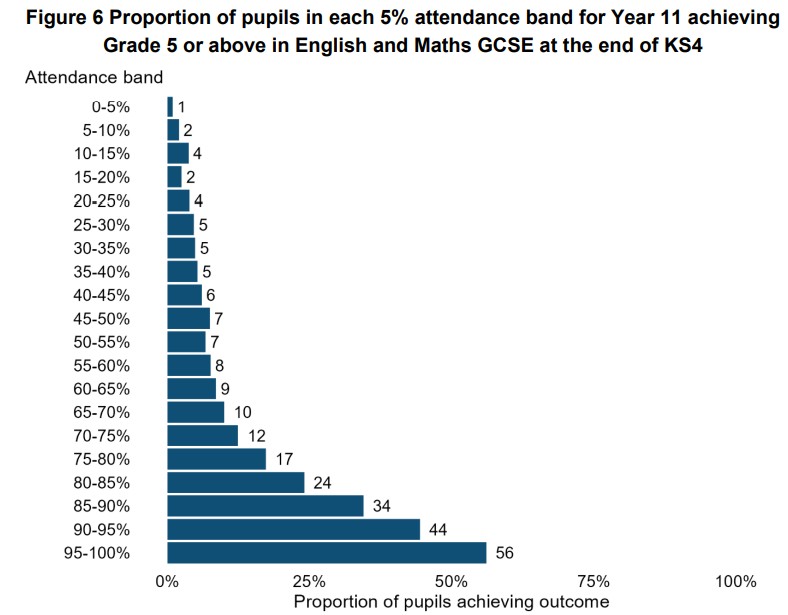
The link between attendance and attainment is at its strongest in secondary school. Year 11 students with near-perfect attendance are almost twice as likely to achieve grade 5 in English and Maths GCSE, compared to similar students attending 90-95% of the time. In other words, missing just 10 extra days a year reduces the likelihood of achieving these grades by around half.
At lower attendance levels, pupils who only attend between 50 and 55% of the time are 1.6 times more likely to achieve 9-5 in Maths and English GCSE than students who are severely absent and attend less than 50% of sessions. Increased attendance from severely absent to 60-65% (equating to approximately an extra 4-6 weeks in school) is associated with double the likelihood of the expected outcome compared with pupils who attend less than 50% of the time.
Improving attendance by just 5% makes a significant difference to academic attainment, as you can see in the chart below:
You can view the full research report here.
The link between school attendance and lifetime earnings
Missing school doesn’t just affect exam results and a child’s time in education. The impact of poor attendance has an impact on future earnings too. Related research has found that, for every day of absence between Years 7 to 11, the typical pupil could miss out on an average of £750 in future lifetime earnings. That’s £750 less for every single day missed.
The research also found that a one day increase in absence in Years 10 and 11 alone is associated with a 0.8% decrease in total yearly pay-as-you-earn earnings and declared self-employed earnings at age 28.
Persistently absent pupils in secondary school could earn £10,000 less at age 28 compared to pupils with near-perfect attendance. The likelihood of being in receipt of benefits increases by 2.7 times for
pupils who are classified as persistently absent (more than 10% absence). This rises to 4.2 times for those who are classified as severely absent (more than 50% absence).
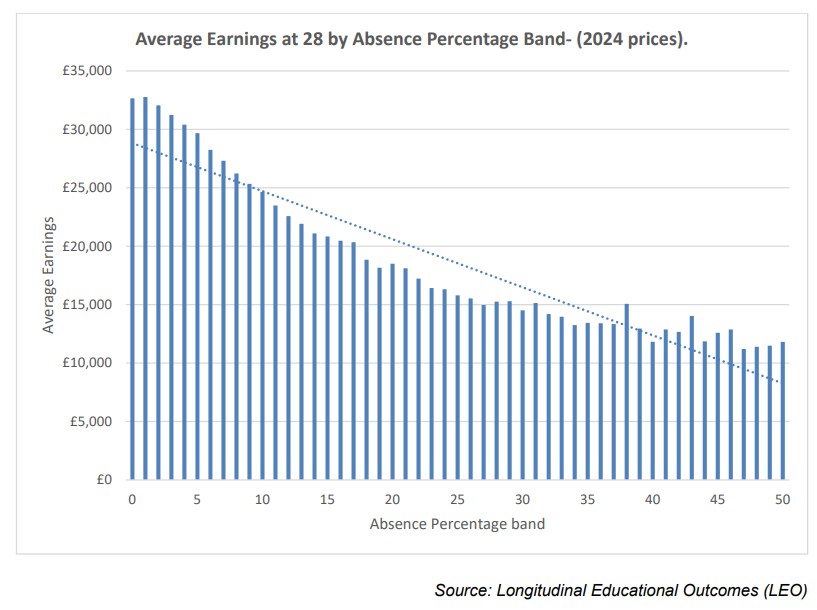
As with attainment, it is clear to see the direct relationship between good attendance at school and higher earnings at the age of 28. You can see the full research report here.
Every day matters
We need to make sure that good attendance at school remains a high priority. We already ask that families only keep children off school when they are genuinely too ill to attend. We ask that you book medical appointments and holidays outside of school time whenever possible. And we ask that you talk to us if you’re having difficulties with attendance. Because every day at school gives you a better chance of good attainment, and greater earning power in adulthood.
Good attendance is an investment in the future. Let’s make it count.


 The Headteacher's Blog