Wednesday of this week was International Women’s Day. As a proud feminist and #HeForShe advocate, I thought I would some of my feminist role models on the blog this week!
Emma Watson
The former Harry Potter star has shown how brave, intelligent and focused she is as she has taken on the role of UN Goodwill Ambassador to promote gender equality. Her passionate, often personal, and powerful speech to launch the HeForShe campaign vocalised everything that I believe to be important about gender equality and she continues to campaign today. Hermione would be proud!
Ada Lovelace
Ada Lovelace was the only legitimate child of the Romantic poet Lord Byron. Born in 1815, she worked with Charles Babbage on his new proposed mechanical general-purpose computer, the Analytical Engine. She realised, before he did, that the theoretical machine could do more than just calculations – it could follow sets of logical instructions, or algorithms, to solve problems by itself. Lovelace wrote the first algorithms for Babbage’s Analytical Engine and, in doing so, became the world’s first computer programmer.
Charlotte Brontë
All of the Brontë sisters were amazing women, living on the moors of Yorkshire and writing wild romantic poetry and fiction. They published their work under pseudonyms because they “had a vague impression that authoresses are liable to be looked on with prejudice.” I actually prefer Wuthering Heights by younger sister Emily to Charlotte Brontë’s Jane Eyre, but Charlotte wins my admiration for one particular museum exhibit: the mourning shoes she wore after her two sisters had died. When the shoes became damaged by long walks over the moors, she repaired them, stitching a sprig of heather into the fabric of the shoes to symbolise her solitude, using her dead sisters’ hair as thread. That’s pretty impressive needlework.
Katherine Johnson
Katherine Johnson featured in my assembly earlier this year. She overcame prejudice against her race and her gender to work on NASA’s space programme, calculating by hand the launch and orbit trajectories for the first manned missions beyond our atmosphere and onwards to the moon.
Carol Ann Duffy
Duffy is one of my favourite poets. She fulfilled the role of Poet Laureate with real skill, most notably with her Olympic poem Translating the Britishand her bleak 12 Days of Christmas (2009). Her unflinching honesty and her mix of horror and humour make her books a gripping read, and her trademark final-line twists mean than her poems stay with me long after I’ve put the book down. Her re-imagining of female characters from fiction and non-fiction forms the backbone of the fantastic collection The World’s Wife, providing voices for the voiceless and identity to the invisible. She continues this mission of exploration and examination of female identity in Feminine Gospels. English Literature is so often male-dominated, that it makes me proud to read and teach in a time when female voices are as influential, passionate and powerful as Duffy’s.
Taylor Swift
I am well-known for my admiration of Taylor Swift, whose complete stranglehold on the music industry is something to behold. She is a great songwriter and performer, of course, but actually an even more impressive businesswoman. She has taken on the likes of Spotify and Apple Music for not offering fair payments to musicians, and won in both cases – most spectacularly with Apple Music, who reversed their policy of not offering royalties to artists because Taylor Swift threatened to take her music off their service. All this, whilst sending Christmas presents to her devoted fans and even visiting them at home! No wonder my “I ❤ Taylor Swift” mug is one of my most prized possessions.
This Girl Can
I love the “This Girl Can” campaign – it says everything that needs to be said right there in the video!
Like A Girl
I also think that this Always campaign, from 2014, is worth revisiting.
Firstly, I’ve always loved to read. I used to read by torchlight under the covers at night when I was supposed to be asleep. I have always got a book on the go (it’s pretty much all I put on my Instagram!) and I don’t think there’s much to beat the feeling of being completely absorbed in the imagined world of a story. If I was really on a desert island I’d want to clear some of my “currently unread” pile, but here are the six books that had the biggest effect on me, or mean the most to me, in alphabetical order (author’s surname) because I can’t rank them!
Mansfield Park by Jane Austen
Jane Austen famously described her novels as “the little bit (two inches wide) of ivory on which I work with so fine a brush as produces little effect after so much labour.” In this novel the art of nuance, delicacy, and meticulously crafted language is unparalleled. It tells the story of Fanny Price, a low-born girl, adopted into the rich Bertram family. Fanny has a rock-solid moral compass, and always knows right from wrong. When her uncle, Sir Thomas Bertram, goes away to Antigua to look after the plantation full of slaves his wealth is built upon, the elder and supposedly better Bertram children begin to drift away from the straight and narrow, flirting with unsuitable people and generally getting out of hand – but Fanny stays strong. I love the fact the Austen, in 1814, was showing that those born with privilege don’t necessarily deserve it, but that being true to what you know is right will be rewarded. The novel is also notable for the fabulously awful aunt character, Mrs Norris, a horrendous snob and busybody – and the character that J.K. Rowling named Filch’s cat after in the Harry Potter series.
The Complete Poems by Emily Dickinson
Emily Dickinson is a fascinating character. She spent most of her life as a hermit, shut up alone inside her house in Amherst, Massachusetts. After her death in 1886, her sister, Lavinia, found stockpiles of poetry, hand-written and hand-bound, locked in trunks. They were breathtakingly modern, often very short, dense, and compact, using dashes as punctuation and meditating on death and immortality. She is now widely regarded as one of the most important American poets of all time. This book contains all 1775 separate poems, and I read it cover-to-cover for a final year university assignment. I’d love to have the time to do it again! As an aside, you can now see all of the original handwritten manuscripts at the open access Emily Dickinson Archive – a real treasure trove.
The Bell Jar by Sylvia Plath
This novel had a profound impact on me when I first read it in Year 12. I’d read some of Plath’s poems in class, and my English teacher recommended this novel as further reading. It’s a semi-autobiographical account of her depression and breakdown in 1950s America, told through a character called Esther Greenwood. Esther is a thinly-veiled version of Plath herself, and the novel deals with her treatment by electric shock following a suicide attempt. It is harrowing and horrific, but it is a story which has a strong thread of hope running through it. It is also brilliantly written, with metaphors and images so striking they remain with me still. Published in 1963, its unflinching first-person portrayal of mental illness is as important and relevant today as ever.
His Dark Materials by Phillip Pullman
I may be slightly cheating here by cramming a trilogy in as one book, but it has been published in one volume and it’s my list, so I’ll do what I like! The opening novel, Northern Lights, tells the story of Lyra Belaqua, living in a parallel world where people’s souls exist outside their bodies in the form of animal companions or dæmons. In the second part, The Subtle Knife, Lyra’s story intertwines with that of Will Parry, a boy from our own world, as the two of them try to find the secret of the mysterious Dust that is swirling through the universe. Supposedly a children’s book, the trilogy’s ambition and scale is huge: it takes in the nature of religion, creation, adulthood, life, death and the self within a gripping and thrilling narrative. It has to be read to be believed.
Fingersmith by Sarah Waters
Sarah Waters is a brilliant writer of historical fiction, often exploring the experience of women in different time periods. This perspective always makes for fascinating reading, but in Fingersmith she fashions a plot so fiendishly complex and so full of twists and turns that I remember gasping aloud as I read it. It’s definitely one for older readers, but the exploration of love, trust, betrayal, madness and deceit in Victorian Britain is simply stunning.
The Waves by Virginia Woolf
When I was at university, I got really interested in whether it was possible to express thoughts in writing – dreams, unconscious thoughts, the inner workings of the mind. Woolf’s attempt at that The Waves reads almost like a poem, with six characters speaking in the first person in a series of interlinked inner monologues. It’s an experimental, beautiful book.
Over to you!
What are your Desert Island Books? Let me know in the comments, or have a chat about it with your teachers. Even better, let the LRC managers know so they can add you to the #LoveToRead list!
This week Year 7 received their starting profile reports, which assess students as they start the school. These reports are the first we have issued at Churchill since national curriculum levels were removed from both primary and secondary schools. In their absence, we are using several measures to assess students at the Academy, and to track their progress. Our aim was to design an assessment system that gave useful information to students and families, whilst being clear and easy to understand.
Assessment on entry
Key Stage 2 Test Results (SATs)
We get the results for every child who has taken the SATs at the end of Year 6 in their primary school. The overall scaled score – combined from their English and Maths tests – ranges between 80 and 120, with 100 being the national average. At Churchill, the average score we have in our Year 7 is 104.
In addition to the Key Stage 2 results, we do several tests to assess students when they start at the Academy. This helps us to “triangulate” the data and gives us a level playing field for all starters.
CATs Tests
These tests include assessments of students’ performance across four “batteries” of tests:
Verbal (handling words and language)
Quantitative (handling number)
Non-verbal (problem solving)
Spatial (handling shape in two and three dimensions)
The national average across the four batteries is 100, with scores usually ranging between 90 and 110. At Churchill our average for Year 7 is 103.
NGRT Reading Test
This test assesses reading and comprehension of text. Again, the national average is 100, with scores usually ranging between 90 and 110. At Churchill the average for our Year 7 is 107.
Starting profiles
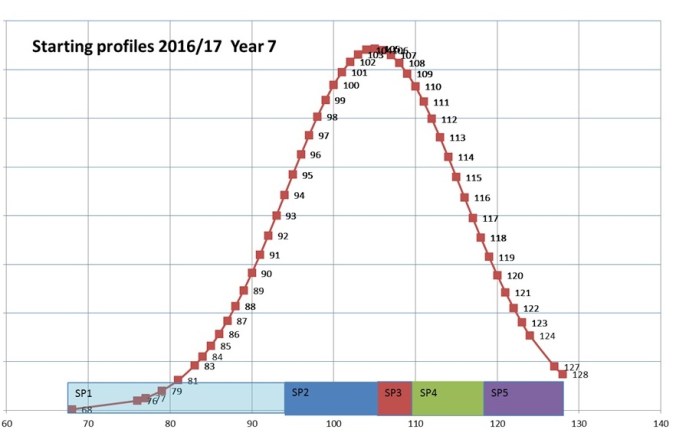
Starting profiles for our current Year 7
We use the scores from Key Stage 2 tests, CATs and the NGRT Reading Assessment to create the profile of the year group. The chart above shows distribution of the average of the scores across the three assessments in our current Year 7. This helps us to give students a “starting profile” which we can use to track progress over time. Starting Profile 5 (SP5) represents the highest scores across the assessments. Most of our students are in Starting Profile 3 (SP3 – the highest point on the curve, with the highest proportion of students). Starting Profile 1 includes students with the lowest scores, so that we can assign support as appropriate.Starting profiles are reviewed each year.
Tracking progress over time
When students are assessed in future, we will be able to track their progress relative to their starting profile. In each subject, assessments will be scored and we will be able to report to families whether students have made:
Expected progress relative to their starting profile
Good or Exceptional progress (better than expected) relative to their starting profile
Less than expected progress relative to their starting profile
In other words, if a student with a Starting Profile of 3 completes an assessment and the score shows that they remain in that bracket, they will be assessed as having made “expected progress.” If they have worked really hard and moved up in their assessments, they will be assessed as having made “better than expected progress” and so on.
In the future
At the moment, we are running this assessment system with Year 7, and tracking the progress of Year 8. Over time, as the new GCSEs are taken, we will be able to make more accurate estimates of GCSE grade expectations for students with particular starting profiles. This means we will be able to roll the system out over time across the whole school.
We hope that you find the assessment information useful!
We’re into the swing of the new school year now – the summer holidays seem like a long time ago! – and the new faces of our Year 7 students are already familiar as they approach their lessons with confidence and enthusiasm. But our Year 7s aren’t the only new faces at Churchill this September: we also welcome a fantastic group of new staff!
When I was training to be a Headteacher, I was given a lot of advice about how to improve and maintain high standards in schools. In one particularly memorable document, the following piece of advice was number one:
“The most important thing the Headteacher does is to find, recruit, develop and retain great teachers. You can’t play like Barcelona if you’ve got players from Brentwood.”
I’m sure that no disrespect was meant to Brentwood in that Headteacher’s advice, but it stuck with me! For Churchill to continue to be a great school, and to continue to go from strength to strength, the quality of the teaching needs to be the best it can be in every classroom, every day. That teaching needs to be underpinned by exceptional support staff in every role across the Academy. I am very fortunate to have inherited a school already packed with dedicated, highly skilled professionals doing a fantastic job with the students, and I am thrilled that this year’s new recruits have added to that strength.
Some of our new staff at the “meet the Governors” event this week
It is especially gratifying to have such fantastic staff joining us at a time when teacher recruitment around the country is very challenging. I know of many schools – including some locally – with unfilled vacancies in key teaching posts being covered by non-specialists or temporary staff. Our reputation and the quality of our offer here at Churchill has meant that we have filled every teaching post with subject specialists, experts in their field, and fantastic teachers to boot! And our support staff has been strengthened by the recruitment of experienced, dedicated staff who have added to our capacity to ensure our students are able to learn to the best of their ability.
This year we are joined by:
Jon Bevan (Teacher of Geography)
Harry Church (Teacher of History and Politics)
Owen Davis (Teacher of Psychology and Sociology)
Joanne Dignum (Teaching Assistant)
Eric Evans (Teacher of Physics)
Chloe Harvey (Teacher of PE)
Lizzie Hudson (School Administrator)
Alison Innalls (Head of RE)
Maire McNeil (Stuart House Mentor)
James McWilliam Woods (Teacher of Maths)
Victoria Piper (Head of Maths)
Jacqueline Sims (Teacher of Modern Languages)
Jeff Spencer (Teacher of Music)
Adam Taylor (Teaching Assistant)
James White (Performance Technician)
After the Governors met with the new staff this week, the chair of our Finance Committee sought me out to tell me how impressed he was by their energy, positivity and enthusiasm, and he remarked on how lucky our students were to have these people working with them. I couldn’t agree more! So welcome to all the new staff joining us this September. We’re thrilled to have you here, and we’re very excited about all that you have to offer the students. I hope you enjoy your time at Churchill as much as me!
We certainly know how to finish on a high here at Churchill! This week has seen four excellent Celebration of Success events held at the Academy. These events are a great way to finish the year, recognising the achievements of students who have excelled in particular subjects or as members of their tutor groups throughout the year. At each event, I read out the following quotation:
“If you are going to achieve excellence in big things, you develop the habit in little things. Excellence is not an exception – it’s an attitude.”
Colin Powell
This is the key to sustaining success. The students who received certificates as part of Celebration of Success – 1080 of them! – all demonstrated this. They were getting the little things right, day in day out, all the time. Turning up for school, on time, in the correct uniform. Listening carefully. Applying themselves. Working hard. Doing their best. Looking out for others. Caring. Smiling. Helping. Not just occasionally – but all the time. These “little things” build up an attitude and approach which contributes to bigger things, recognised in the awards handed out at Celebration of Success: the formation of an attitude which will contribute to excellence not just at school, but beyond.
Of course, not everyone wins awards at Celebration of Success, and not everyone has these habits of excellence. But they can be learned – and they can be deliberate acts. I was particularly struck by one tutor’s citation for their Tutee of the Year. The tutor said that, in the first few years of school, the student and the tutor hadn’t “clicked” and they hadn’t particularly impressed one another. But the tutee developed these habits of excellence, getting the little things right all the time, and the tutor saw this build up and recognised that this was someone deserving of recognition. It was one of the most gratifying handshakes of the week – celebrating the success of someone who had changed – and done so consciously – to ensure success.
In the midst of this celebration of success, it was serendipitous that our rescheduled Sports Day also took place. And what a day! It was great that families were able to join us on the field to celebrate success in the sporting arena. The atmosphere was full of fun and enjoyment, and the Houses as fiercely competitive as ever. Despite a strong surge from Stuart, especially in the lower years, Tudor romped home as comfortable victors. I loved the whole day! There is a gallery of photos on the school website and on Facebook, and a few of my favourites are included below.
????????????????????????????????????
????????????????????????????????????
Before we break up for the summer, we say goodbye to some excellent colleagues who are leaving the Academy this year. In particular, I would like to pay tribute to Chris George, who has been at Churchill for over 20 years. I have personally found his wise counsel and listening ear invaluable since I started in January, and I know many colleagues who have been here a lot longer than me will say the same. I wish him well in his well-earned retirement.
Chris George: Chief Timekeeper
I wish all of you a restful, happy summer holiday!
When I took up post as Headteacher, the Governors gave me 100 days to look at, listen to and learn about the Academy in order to plan the next steps. As part of that process I met students, staff, Governors, families, and representatives from the local community. I summarised all this in my post What Have I Learned? at the end of March.
The answer was to get down to the basics of what we need to do to ensure that the Churchill formula is sustainable, and that being a truly great school runs deep into every aspect of our practice. So, first of all, what is it all for?
The Aims of Churchill Academy & Sixth Form
The aims of the Academy are laid out by the Governors, and they are linked to our four core values. They are:
Care: To provide outstanding care to safeguard all members of the Academy and secure their well-being
Inspire: To provide outstanding teaching and opportunities for development for all members of the Academy
Challenge: To set ambitious goals for achievement, progress and behaviour for all members of the Academy
Achieve: To secure outstanding academic results and celebrate the wider achievements of all members of the Academy
Everything we do at the Academy is dedicated to achieving those aims. Underneath them, I wanted to put some detail into the priorities we now have as we move beyond our Outstanding status to become a truly great school.
The Priorities of Churchill Academy & Sixth Form
The Strategic Priorities for the Academy
Each of these four priorities will govern our planning over the coming years. Achieving these priorities will unlock the potential of students at the Academy to achieve the very best outcomes from their learning. You can find the details of the plan in our Strategic Priorities document, and I have summarised the key points below.
Care: to promote the welfare of students and staff
Care
This priority is fundamental to the success of learning at Churchill. Students are only prepared to take risks with their learning and push themselves forward if they feel safe, secure and cared for. Staff who are similarly cared for, nurtured and given the opportunities to grow will continue to give of their best, day in, day out.
Within the priority of Care, we aim to provide access to personalised pathways through the curriculum, and access to appropriate support, whilst promoting welfare. This means building on the strong foundation of the House system to provide first-rate pastoral care, and combining that with access to tailored academic support. It also means ensuring that the Academy continues to feel like a family, with a sense of belonging and enjoyment which comes from celebrating success in all its forms. Above all, it means remembering that every member of the Academy, student or staff, is an individual, and that we must, in the words of Daniel Pink, “treat people as people” in everything we do.
Inspire: to develop the very best practice in teaching, learning and leadership
Inspire
Teaching and learning is our core business. We already have exceptional practice across the Academy, so my priority is to ensure that exceptional becomes the norm. This involves learning from others, sharing our own best practice, and developing a culture of innovation in teaching and learning. Above all, though, it means empowering students to lead their own learning. Our teachers will always teach well, but only the students themselves can learn. Ensuring that they understand how to learn effectively, that they have a hunger for learning, and that they take responsibility for their own progress and development, is vital.
Challenge: to develop a growth mindset across the Academy, so that learners embrace challenges, persist in the face of setbacks, and see effort as the path to success
Challenge
“Learners” in this priority refers equally to students and staff, and the growth mindset approach means that we all share a belief that intelligence and ability are not fixed, but can grow and develop with effort, practice and determination. I have outlined growth mindset ideas on this blog before, in How to grow your brain, You can learn anything, and The power of praise (amongst others!). What it means in practice is that learners focus on the process of learning, over and above the final product. They see each lesson, each task, each event, as an opportunity to learn, and continue to seek challenges to help them grow. You can hear and see some of the research behind growth mindset, and the implications for schools, in the video below:
Committing to this approach will ensure that attending Churchill Academy will embed positive learning behaviours for life. It won’t be easy – but that’s why we hold “Challenge” as one of our core values!
Achieve: to set consistently high expectations so that all learners achieve exceptional personal and academic outcomes.
Achieve
This priority came out of the discussion: what is school for? Is it just about exam results? Or is it about more than that? I felt very strongly from my discussions with staff, students, families and governors that Churchill’s strength lies in the balance it strikes between academic outcomes – exam results – and the broader personal outcomes that ensure our students become good citizens with character, resilience and a set of skills valued by employers.
Academically, our aim is simple: year on year we want students at Churchill to do better here than they would have done in any other school. We want them to make more progress and achieve more than similar students do elsewhere. When families choose to send their children to Churchill I want them to know they are getting the best possible chance of success.
More broadly, it is about balancing that academic success with opportunities in the performing arts, sports, outdoor education, student leadership, community activities, volunteering and participation which will broaden and deepen students’ skills, understanding of citizenship, and sense of belonging. Within all these activities, curricular and extra-curricular, we expect consistently excellent attitudes and behaviour for learning, to embed those approaches in everything we do.
Sustainability: the Academy will ensure sustainability in achieving these priorities.
Sustainability – investing in the future
These are challenging times for all public services. Demands on our limited resources continue to increase. Our final priority is based on prudent and effective deployment of those resources so they have the maximum impact on learning, reducing waste, and ensuring that whatever we do is sustainable over the longer term. It means valuing the work/life balance of our staff and ensuring that they have the time, energy, expertise and resources they need to do the best job they possibly can. It means exploring collaborations with other schools to share resources where we can. It means redeveloping our site, buildings and grounds so that they are environmentally friendly, efficient, and fit for 21st century learning. And it means building an approach which is not a flash-in-the-pan but which can be sustained over the years to come.
These priorities are the aspirations of our Academy over the years to come. We are already planning what we are going to do to change, develop and improve our work to move ourselves towards achieving them. It’s an exciting time! We can’t wait to get started…
Inset stands for “in-service training”, and all schools have had five inset days each year since they were introduced in 1988. Schools close to students on inset days, but staff attend. Sometimes they can seem a bit mysterious to families and to students, so I thought in my blog this week I’d try to explain what actually happens on these days when the students are away!
Inset days are designed to provide compulsory training time for teaching staff so that we can continue to improve our practice, keep up to date with changes in education, and ensure that we have appropriate training to deal with the challenges of our job. Here at Churchill, we often involve our support staff in training too, so that all staff have the knowledge and skills they need to do their job to the best of their ability. We supplement our inset days with on-the-job training and provide a range of opportunities throughout the year for all staff to learn, develop and improve, but the inset days give us a real opportunity to get everyone together and spend an extended period of time working on priority issues for the Academy.
Let’s take this coming Monday (27th June) for example. There are five different strands of training happening on the day.
Whole staff briefing: Strategic Planning
As a new Headteacher I’ve been busy working on the long-term plan for Churchill following the outstanding Ofsted achieved last summer. I’ll be sharing the plan on this blog towards the end of term, but I’ll start the day by briefing staff about our priorities and how we can all work together to achieve them first thing in the morning.
Safeguarding Training
All staff have to be trained to keep children safe in education – it’s the most fundamentally important part of our job. Because it’s so important, we “refresh” this training at least every two years to ensure that all our staff have the latest guidelines and procedures clearly in mind, and know exactly what to do if there are any concerns about children’s safety. This “refresher” training will be taking place for staff who are due to have this additional training.
Workshop to Raise Awareness of Prevent (WRAP) Training
Prevent is the Government’s strategy to counteract the threat of extremism in our society. As a school we have a duty to uphold and enact the Prevent strategy and ensure that all staff are aware of what to look out for and what to do to ensure that we respond to the ideological challenge of terrorism and the threat we face from those who promote it, and to prevent people from being drawn into extremism and terrorism. All staff are required to undertake training in these aspects of the Prevent strategy and we will be providing opportunities on our inset day for this to happen at Churchill.
Pastoral development
Staff will meet in their House teams on this inset day to review and plan the work that needs to be done over the rest of this term, and in preparation for September. This includes planning the Celebration of Success events, ensuring that everything is in place to provide a smooth transition for our new Year 7 students and their families, to look at mentoring for students within the Houses, and to take time to work on particular priorities within each House. At the same time, the Sixth Form pastoral team will be meeting to plan the specialist tutor programme for next year, and ensure that the best opportunities are in place for our new Sixth Form cohort starting in September.
Extended Project Qualification (EPQ) Training
We are extending our provision of the Extended Project Qualification (EPQ) in Year 12 next year, so we are using our inset day to work in partnership with Backwell School to make sure that all staff involved in delivering the EPQ are properly trained by the exam board. We’re really looking forward to the opportunities that EPQ will give our Sixth Formers and we want to make sure we get it right!
Transition Drama Day
At the same time as all this training, our performing arts students and staff will be working hard with our new Year 7 intake on the famous “drama day” ahead of the transition day on Tuesday. There will be lots of fun, learning and confidence building going on! Watch the website for a full report…
Phew!
As you can see, it’s going to be a busy day! It’s a great opportunity to make sure that all our staff have the best and most up-to-date training to care for and deliver the best possible education to the students at the Academy. And, for our staff at least, it’s definitely not a day off!
At the start of my Headship at the Academy, I told students, staff and families that my mission up until Easter was to look, listen and learn as much about the place as I could so I could make an informed decision about what I needed to keep, grow and change. This has been a fascinating process and I wanted to share it with you!
Students
How did I do it? –I have visited lessons every day since I started at the Academy! I’ve seen lessons in every department and from every year group. I’ve also eaten lunch with the students in each of the kitchens, spent time in all of the house wells, and got down on to the field when the weather permitted us to open it. I’ve met with the House Captains and the Sixth Form Council, and met with several deputations of students who wanted to chat. I’ve taught my own Year 7 class and supported students in the Academy Skills Centre. I’ve been to Breakfast Club, run a detention, and take on Miss Bones and Jens Hullah in an epic rowing challenge. It’s been incredible!
What did they say? – students are overwhelmingly positive about the Academy. They really appreciate the expertise and energy that teachers put into their lessons. They recognise that they are lucky to come to an outstanding school and they want to make the most of every opportunity. Many students speak very highly of the wealth of extra-curricular activities on offer, including the performing arts, sports and outdoor education to name but a few! In lessons I’ve seen students eager to learn, well-organised, focused and well-behaved.
I’ve had a few requests from students to relax some of our rules and regulations. In particular, students wanted me to allow mobile phones in school. I won’t do this – we have very good reasons for not allowing them to be used in school as I explained on this blog in the post Why We Don’t Allow Mobiles In School. Along similar lines, some students wanted to be allowed to listen to music in class – but the research shows that this can undermine learning as I explained in the post Can I listen to music while I work? I revisited this theme for my assembly on Concentrationwhich seemed to go down well!
Students have been very positive about our use of social media to celebrate the work of the Academy. This is in its infancy but we’ve broken 300 followers on Instagram this week (which is nothing compared to the Performing Arts Department’s account which is nearly at 500!)
Staff
How did I do it? – I’ve been meeting with every single member of staff individually. So far I’ve held 106 meetings! I’m looking forward to the rest after the Easter holiday. It’s been great to hear what they’ve had to say and to get their perspectives on the place. I’ve asked them what the best things about working here are, and what they think I should be working on.
What did they say? – When asked what the best thing about Churchill is, almost every single member of staff has said “the students.” Time and again the teachers and the support staff have spoken about how the young people at Churchill are keen to learn, focused on achieving their best, and willing to support the Academy and one another. The warmth and strength of those relationships is a vital part of the Academy’s success – the students love the staff and the staff love the students. I sometimes feel I’m the luckiest Headteacher in the country!
Families
How did I do it? – It seems like a long time ago now, but back in January I held “Meet the Headteacher” evenings to meet with families from each of the Houses. Since then I’ve met families at many of the school events such as the Options Evening, Parents Evenings, West Side Story, the Spring Concert, the Dance Showcase, Dance Their Socks Off, Spelling Bee, Vocabulary Millionnaire final, Young Musician of the Year…it’s been busy! I’ve also been grateful to the parents who have emailed, phoned, written or come in to see me since January, and I have found this especially helpful.
What did they say? – as I explained in the newsletter in February, families are overwhelmingly positive about the work of the Academy. In particular vertical tutoring and the house system, the quality of staff, the ethos and values of the Academy and the performing arts opportunities were singled out for praise. These are all vital parts of what we do at Churchill and it’s my mission to protect them! Families advised us to improve communication, reports to parents, facilities, catering services and extra-curricular provision. These are all things we’re working on. Finally, families wanted us to enforce expectations around uniform, improve the buildings and facilities, develop homework and improve communication and reports to families. I’m on the case…
What now?
The plan for our new Business Studies and IT block – now approved!
The next step for me is to put in place the plan to take the Academy from its position of considerable strength to the next level of success. The signs are already looking promising: our successful bid for a new building begins the process of improving the quality of the facilities. We are fully subscribed for September with 270 offers of places made at Churchill to Year 6 children and their families. Students are working hard, staff are positive about their prospects, and the sun has shone sufficiently to get the field open at lunch time!
Over the next term we are working on:
Care: ensuring the wellbeing of all members of the Academy is prioritised and that appropriate support is provided to those that need it
Inspire: planning professional development so that the provision of excellent teaching and learning is the focus for all
Challenge: redeveloping assessment, target setting and reporting to make it clearer and more helpful for students, teachers, and families
Achieve: ensuring that outcomes are the best that they can be, whilst recognising that achievement is about more than just exam results.
We are also planning for our new building, preparing our new website for launch, and so much more besides! Watch this space…
First things first – I love my phone. I use it all the time. Lots of the stuff I use it for is practical: it’s an alarm clock to get me up in the morning; it’s a newspaper to read; it’s a weather forecaster to prepare me for the day; it’s my diary so I know what I’m supposed to be doing, when; it’s my satnav to get me to the places I need to be. But I’d be kidding myself if I didn’t acknowledge that it’s also a huge productivity vacuum: social media is lurking on my home screen with those tempting notification bubbles and there’s a little folder called “games” which tempts me away from what I should be doing with a little voice saying “just one more go…” You don’t get three stars on every level of Angry Birds overnight. I know if I want to get any work done, I put my phone on “Do Not Disturb”. And silent. In a different room.
Three stars on every level. A sad indictment.
And this a major issue. Whilst a mobile device is an incredible piece of technology, and has the capability to assist and develop learning in and beyond the classroom, the distraction factor far outweighs the benefit. And this isn’t just my opinion. A large scale study by the Centre for Economic Performance at the London School of Economics found schools that banned mobiles enjoyed a boost in the proportion of pupils getting five good passes at GCSE, compared with schools that allowed pupils to keep their phones. Richard Murphy, one of the co-authors of the paper, said that the distraction and low-level disruption caused by pupils having mobile phones in school appeared to be behind the results. He said “a strict ban on mobile phones does seem to be effective in improving student tests scores, especially those that a school might be concerned about, because it ups the number of students getting five good GCSEs.”
If we want students to learn, we have to ensure that they focus on the task in hand: learning. “There is plenty of solid evidence which shows that in order to learn, we have to pay attention. Again and again, research shows that when people are distracted or when they start multitasking, they don’t do as well as when they are able to concentrate fully on one task,” said Daisy Christodoulou, director of research at Ark Schools.
Another reason is one of dependency. There is a growing body of evidence that smartphones are addictive. A recent University of Derby study found that smartphone use caused distraction from employment, hobbies and studies, could increase narcissism and cause “real life” communication skills to suffer. As a school, we need to help young people develop exactly those “real life” communication skills; a day in school should be time away from the demanding electronic screens in our pockets. Essena O’Neil’s public disconnection from social media is just one example of how the pressure of life online can impact on mental health. One school in London even ran an experiment called Project Disconnect where students lived without their technology for a week. They reported feeling happier, reading more, and interacting more effectively. You can see their video below:
Finally, there’s the safeguarding issue. Over our wireless network we know that internet access is safe, monitored and filtered. But if students had phones – even if only at social times – access to 3G and 4G networks means that access to inappropriate material would be out of our control, as would the ability to take and share photographs and videos without consent or knowledge. Whilst the vast majority of our students, I’m sure, use technology responsibly, the risk to safeguarding would be significant. Besides, I’d far rather see groups of students smiling, laughing and talking to one another face to face at social times than sat around tables looking down, their faces bathed in the artificial glow of an iPhone screen.
Of course, we also have a duty to develop students’ expertise in using digital technologies and our curriculum does exactly that. But the learning comes first. Where technology is essential, or where it will enhance and improve the learning experience, we will invest in it, use it and explore it. But we must weigh up the benefits of new technologies against the potential drawbacks it might have, and in most cases there is usually a way to achieve the learning objective without a classroom of smartphones.
So this is why we don’t allow phones in school. I appreciate the irony of writing about this on a blog, and you’re probably reading on your phone right now. But I’d urge you – after you’ve followed us on Twitter, liked us on Facebook, and subscribed to our email mailing list – to switch it off, put it away, and spend some quality time IRL.
All families should have received an invitation to my “Meet the Headteacher” evenings which start this week. I am holding these events to introduce myself to you in person, so you can find out a bit more about me, what I stand for and my plans for the Academy going forward. I am also very interested to hear the views of families about the current strengths and areas for development for the Academy, and ideas about our future priorities. The evenings take place as follows:
Wednesday 13th January: Hanover
Thursday 14th January: Stuart
Wednesday 20th January: Tudor
Thursday 21st January: Windsor
Sixth Form parents – any of the above evenings (please let us know which one!)
Each meeting will begin at 6pm in the Hall. There will be a presentation from me of about half an hour, followed by an opportunity to feedback your views and for more informal discussions to take place. Please reply to the email invitation if you are planning to attend, so we have an idea of numbers. If you wish to attend a different evening to the one allocated to your House, please let us know. I look forward to meeting you.




















 The Headteacher's Blog