Improving behaviour

We implemented a new behaviour policy in September 2023. The aim of that policy is to improve behaviour in lessons and around the Academy, so that our students can learn in classrooms free from disruption and feel safe and confident in their learning environment.

Our new approach required a significant adjustment from staff, students and families. It was a big change. But has it worked? Is it working?

We asked the Lighthouse Schools Partnership to commission an independent school improvement partner (SIP) to find out. The SIP worked with the Trust’s Director of Secondary Education to undertake a whole-school behaviour review on Wednesday 15th November. The review included visits to lessons in Year 7, 8, 9 and 10 (Year 11 were doing mock exams), visits to tutor time, discussions with students and staff, observations of transitions between lessons and social times, and visits to the Refocus Room. It was a thorough and detailed review of all we are doing to improve behaviour.

We received the report last week, and the findings are overwhelmingly positive. Some findings include:

  • Behaviour in all lessons seen was improved on previous visits.
  • Teachers have communicated and used the new behaviour system and expectations well to establish positive learning climates.
  • Transitions are smoother between lessons and the increased presence and vigilance of staff is a factor in keeping students moving to their next lessons.
  • Strong practice was evident in the work of heads of house and some other staff in a ‘warm-strict’ approach.
  • Students’ behaviour at unstructured time has improved. The cafeteria was orderly, with students queuing sensibly with seemingly little need for any adult supervision.
  • Students were polite and respectful when speaking with unfamiliar adults, yet not afraid to give their views…the group of Year 11 boys spoken with at breaktime recognised that the new behaviour system was working well and that behaviour had improved across the school.
  • Visits to the tutor times in two houses found much improved student attitudes and a purposeful start to the day. Silent reading for pleasure for ten minutes is settling students ahead of lessons and all students had a book of choice. Strong relationships were evident at all levels.
  • The visits to the Refocus Room found a calm, purposeful environment and numbers entering the room have reduced.
  • All students in a broad range of informal discussions commented that they like the fact that there is a reset system to start each term afresh.

It is heartening to see the views that we have, working in the Academy every day, reflected back from visitors offering an independent, expert perspsective. Behaviour has significantly improved – and students are learning more as a result.

Of course, we are not done – there is always more to do. Our next priorities are on punctuality to school and to lessons, to ensure that students don’t miss out on valuable learning time, and on orderly entry to the classroom, focused on line-ups and the “strong start.”

We will also continue to work with students who are struggling with their behaviour to help them to improve. We have seen great strides with many of our young people, with some dramatic improvements in their conduct points scores over the course of the first two terms of this year, and a huge reduction in the frequency of their visits to Refocus.

I feel very proud of the improvements that we have seen. I want to thank my colleagues for their wholehearted commitment to our new approach, and their tireless efforts in implementing our new system – which is really paying off. I also want to thank the families in our Academy community for supporting our new policy, and for opening up constructive dialogue with us where they have had questions. These conversation have helped us to continue to improve.

But, above all, I want to thank our students. They have really grasped the message that disruptive behaviour affects everyone, and that our efforts to eliminate it are a shared endeavour. I have always been so impressed by our students who consistently behave well; but I also want to pay tribute to those students who have really pushed themselves to improve their behaviour, to avoid being sent to refocus – and, in doing to, to avoid disrupting the learning of others. This effort to make a positive difference is exactly what our Academy is set up for. I could not be more impressed by what I have seen.

Assembly: Values and Behaviours

As we return for Term 5, I have taken assemblies for each of the five houses. In my assembly, I have talked about values, and how our values inform our behaviours.

To start with, I discussed the fact that our coins are changing. For the first time in my life, we will have coins with the King’s head on the back rather than the Queen’s head. Yet, despite the coronation of a new monarch, the coins still have the same value; although they look different, they are worth the same.

The same is not true of these coins. The “one pound” coin on the left is no longer legal tender – it is worth less than the one pound coin on the right. Why is this? Simply – we have all been told that this is the case, and we all accept it. The one on the left is worthless, despite it saying “one pound” on the front, because we’ve all been told it’s worthless and we all accept this.

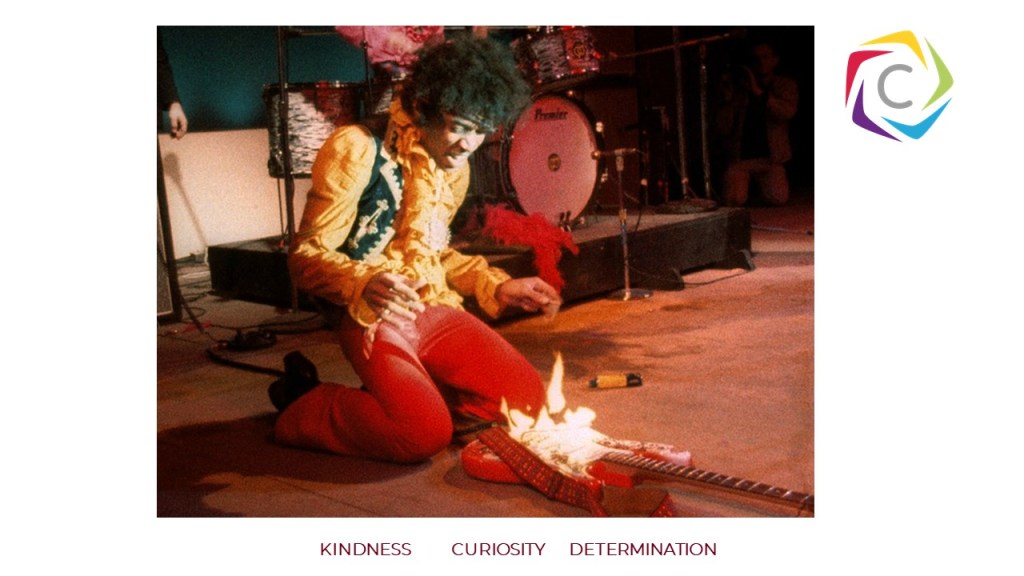
The value of something isn’t always obvious by its appearance. I would love the guitar on the left – a brand new Fender Stratocaster. But the old Fender Stratocaster on the right has no strings, the strap is on the wrong side, and it has been damaged in a fire. The surface is badly scorched and the wood underneath is burnt. It is unplayable – but somebody paid $380,000 for it. Its value is not as a musical instrument, but as a part of rock history.

The guitar was famously doused in lighter fluid and set on fire by Jimi Hendrix at the Monterey festival in 1967. This is what gives it its value – it is an artefact, not an instrument.

Swipe to see the change in value of a Ferrari

The same is not true of a Ferrari however. A brand new Ferrari, whilst worth less than a burnt Hendrix guitar, is worth a lot more new than it is when wrapped around a lamp post. The damage to this valuable asset has not increased its value – it has diminished it. This is not a part of history or culture – it is a testament to someone who needs to drive more carefully and hope they have a good insurance policy. 

So, the value something has is not intrinsic to itself. Rather, it is a shared idea, or a common belief that something has value. At Churchill, our values of kindness, curiosity and determination govern all our actions and inform our behaviours. We work hard to inspire and enable young people to make a positive difference to themselves, to the Academy community, and to the wider world, and to set no limits on what we can achieve.

Professor Carol Dweck picks up this idea of setting no limits on what we can achieve in her work on mindsets. She explains through her research how it is the effort that we put in that ensures we achieve, not our ability. As she says: “no matter what your ability is, effort is what ignites that ability and turns it into accomplishment.”

This idea of effort is something that we think has tremendous value. It is why it is the first of our six “learning values” at Churchill Academy & Sixth Form – the research-informed principles that inform our approach to pedagogy.

The things we value inform the way that we behave. At the start of every long term, in September, January, and now after Easter, I always remind students about our classroom behaviour expectations: the Top 5. This term is no exception. The students are very familiar with these expectations now, but it is no less important that they stick to them if we are to make the most of every moment of lesson time.

We also have a set of five expectations for social time behaviour, and I used this start of term assembly to run through these in detail. In particular, I explained the ways in which we have responded to student feedback with amendments to our uniform policy this year, and changes to the toilets, following student leadership initiatives – and how it is now the students’ responsibility to uphold those standards now that they are established.

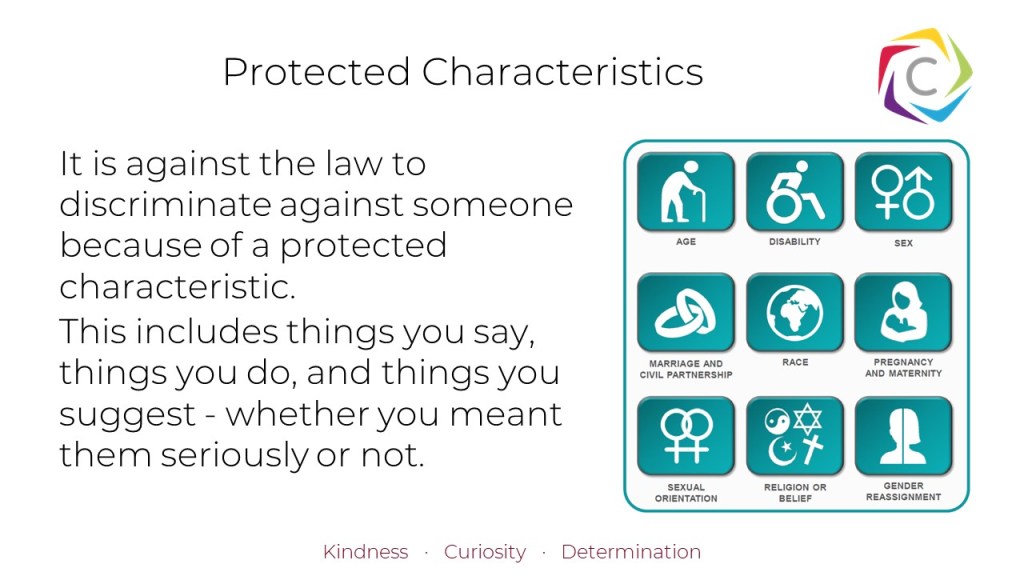
As we moved towards the conclusion of the assembly, I talked about bullying. I explained that, if you say anything that makes anyone feel uncomfortable about who they are, this is wrong and unacceptable – and may also be illegal if it references a protected characteristic. I explained that saying or doing something “as a joke” or as “banter” normalises unacceptable behaviour by making it seem okay in certain situations – but it is never okay. If we see people doing or saying unkind things again and again over time – even “as a joke” – these behaviours can become normalised. And we are all susceptible to normalisation. 

Normalisation refers to social processes through which ideas and actions come to be seen as ‘normal’ and become taken-for-granted or ‘natural’ in everyday life. There are different behavioral attitudes that humans accept as normal, such as grief for a loved one, avoiding danger, and not participating in cannibalism. Our perception of what is ‘normal’ can transform over time – and this can be a force of good and ill.

The video above gives a great example of how bizarre and unusual behaviour, that someone would never normally display, can be influenced by the behaviour of people around you and very quickly become “normal.” Although this is a light hearted example, this principle can be much more serious.

In Nazi Germany in the 1930s we saw hateful, discriminatory and abhorrent attitudes and beliefs “normalised” by society. Pastor Niemoller’s poem shows what can happen if we sit by and let things that we know to be wrong happen around us. We must stand up for what we know to be right. 

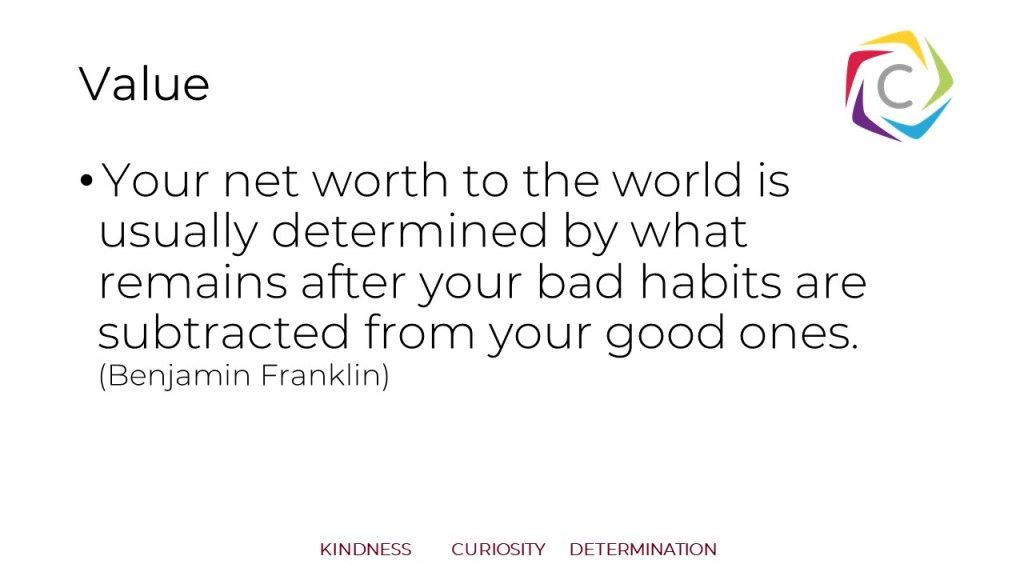
I finished the assembly – as I like to do – with a quotation. This one, from Benjamin Franklin, shows how values and behaviours are interlinked one with the other. Our values inform our behaviours, and our behaviours shape our values.

Behaviour for learning: getting the basics right

We know that good behaviour is essential for learning to take place. We reinforce this with our Code of Conduct and Effort Grades, and we incentivise it through our rewards system. We know that, over the past few years, it has been difficult to maintain consistency. COVID lockdowns, followed by periods of high staff and student absence, and the disruption to rooming in the Academy caused by works to Stuart House and Lancaster House have all contributed to a “stop-start” feeling for some classes, groups and individual students. We are certainly not alone in this: we have heard of many local schools having to close to entire year groups due to staff shortages this term, which is thankfully not a step that we have had to take.

We hope that we will now be moving into a more settled period. Stuart House is open, and the long ten-day isolation periods for COVID infections are a thing of the past. Given the disruption of recent years, attendance is more important than ever – students cannot afford to miss any more school.

But simply turning up isn’t enough. For real learning to happen, students need to work hard. Learning is difficult; it requires effort. And this is where behaviour for learning comes in.

Behaviour for learning is about more than just being kind, polite and respectful. It is about more than just wearing the correct uniform and bringing the right equipment and making sure your mobile phone is not seen or heard around the Academy. These things are important, of course – but behaviour for learning is about engaging in those actions that will enable you to take in information accurately and store it in your long term memory for later retrieval. It is rooted in our learning values, which are displayed around the Academy every day. We believe in the value of:

  • Determined and consistent effort
  • A hunger to learn new things
  • Challenging ourselves to go beyond what is comfortable
  • Viewing setbacks and mistakes as opportunities to learn and grow
  • Seeking and responding to feedback
  • Encouraging others to succeed

It is these values which underpin our approach to learning across the curriculum.

This is one of my favourite videos to illustrate “passive” learning: these characters are well-behaved, but they aren’t able to take action to “unstick” themselves when they get stuck, or to apply effort to solve a problem for themselves. They are forced to wait around for someone to come and help them out. These are not Churchill learners!

When we return after the Easter break, we will be working hard with all our students to refocus on the key elements of behaviour for learning. This includes the Code of Conduct and Effort Grades, and our learning values. But we will also be clarifying and reinforcing our expectations of behaviour for learning in lessons.

In every lesson, every time, we expect students to follow our Behaviour for Learning Top 5:

  1. Strong start: We arrive on time, line up and enter the classroom calmly
  2. Full attention: We are immediately silent and face the speaker when called to attention 
  3. Full effort: We apply ourselves with our full effort to the learning tasks set
  4. Full focus: We focus all our attention on the learning tasks set
  5. Calm finish: At the end of the lesson we wait in silence for the member of staff to dismiss us

The return to school after Easter gives us a perfect opportunity to ensure that our students make the most of every moment they have at school, and use it to make progress in their learning. Staff will be working together to ensure that these expectations are clearly explained to students, and that they are supported and challenged to meet them – in every lesson, every time. Because, after the disruption of the past couple of years, we can’t afford to waste a single moment.

Welcome Back!

The 2019-20 academic year has got off to a flying start this week. Monday and Tuesday were staff training days, focusing on our four Academy priorities, before we welcomed our Year 7-12 students back on Wednesday and our Year 13 on Thursday.

Inset Days

During our first training day on Monday, staff received training on both behaviour and teaching and learning, as well as important briefings on safeguarding and inclusion. There was also time put aside for staff to work in their faculty and house teams to prepare for the year ahead.

On the second training day, all staff spent the morning working with an expert trainer exploring mental health issues, so that we can continue our efforts to support the mental health of our students. This is a complex area, but vitally important for us as a school which values the personal accomplishments of our young people – their character, wellbeing, and attitude to learning – in equal measure to their academic progress.

The Academy Site

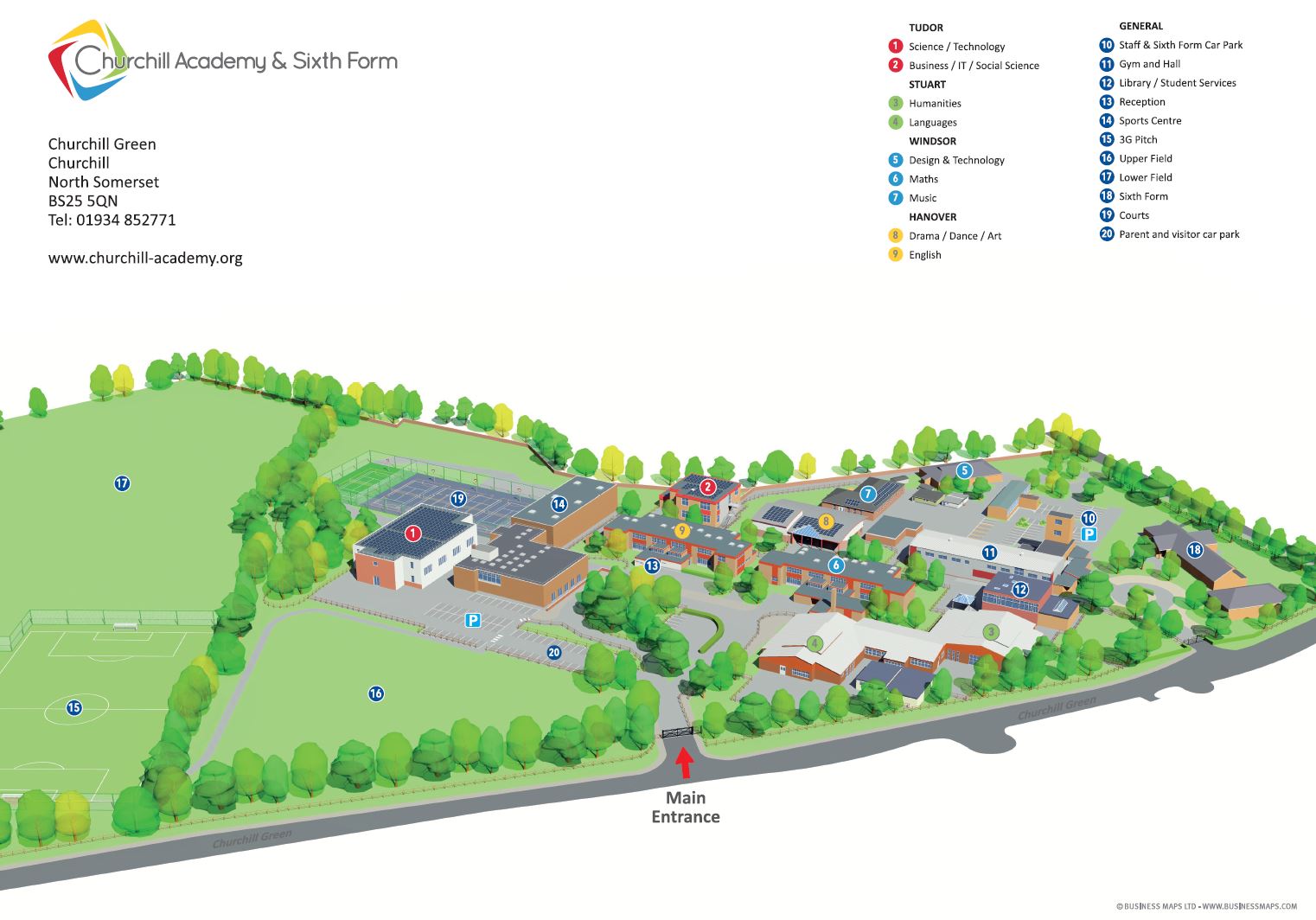
churchill_academy_3d_site_plan

A huge amount of work has gone on across the Academy Site over the summer. This includes:

  • Completion of the new reception and administration hub at the heart of the school. This facility brings together all of the administration functions – finance, human resources, office, reprographics, reception, medical – into one location, increasing our efficiency and effectiveness by creating a “one stop shop” for students, staff and visitors.
  • Completion of the new staff and sixth form car park on the footprint of the old Tudor building, which will help reduce the number of cars pared on the narrow country roads around the Academy and allow safer drop-off and pick-up in the Sports Centre car park. This work has been accompanied by a striking new “Tower” design (more of which in a future blog!)
  • Completion of a new social area for students on the site of the old reception and office area
  • Redecoration of the Windsor / Maths classrooms, complete with new furniture and carpeting. This makes a big difference to the teaching and learning, reducing echo and preventing chair-scraping noises, as well as dampening sound to create a quieter, more focused classroom environment.
  • Planting along the central broadwalk, designed by the Academy’s Green Team, creating a beautiful space which will thrive as the new plants grow and spread.

I want to pay a public tribute to our amazing Site Team, IT Network Team, contractors and administration staff who have achieved an astonishing amount in a very short space of time. The Academy looked wonderful when the students arrived on Wednesday!

Focus on behaviour

CoC
In my first assemblies with the four Houses on Wednesday, I spoke to students about our expectations of their behaviour. In consultation with students, we have revised our code of conduct so that our expectations of behaviour align with the Academy’s values of kindness, curiosity and determination. I’d like thanks to Mrs Griffiths, who led this project alongside the student representatives. The final document, pictured above, captures our high expectations of student behaviour in positive, inclusive language which links smoothly with our vision and values. I know that our students will respond well to this revision, which they helped to shape, so that we can continue to ensure that our students’ behaviour supports their learning.

I also introduced students to the revival of the Inter House Competition, which we will run this year towards the award of the House Cup – but I will save that for a future blog!

My overwhelming feeling over this first week has been one of immense pride. It is an honour to be the Headteacher of Churchill Academy & Sixth Form, working with such dedicated and expert colleagues in the teaching and support staff, and so many wonderful students. I am excited about the year ahead – there’s no limit to what we can achieve. 

Behaviour for learning

08_Chapter 8 Figure 3

Churchill Academy & Sixth Form’s Attitude to Learning Scale

This year at Churchill we have made behaviour our number one priority. We wanted to build on our already high standards to ensure the very best behaviour and conduct from all our students, all the time.

In March this year the government published an independent review of behaviour in schools. The report’s author, Tom Bennett, says:

“A student’s experience in school remains one of the most insightful indicators of later life success in any one of a number of metrics. For many it is the best chance they will ever have to flourish. How they conduct themselves at school is crucial to that experience. Helping them develop good behaviour is therefore one of the most important tasks a school faces…

…Whatever one believes the aims of education to be, all of [them] are best realised in schools where good behaviour is the norm, and antisocial, selfish, or self-destructive behaviour is minimised.”

It’s hard to argue with Bennett’s conclusions. Here at Churchill we believe that good behaviour is the foundation upon which a successful education is built. It’s a minimum expectation that students at Churchill will be polite, well-mannered, and tolerant, but we expect not just compliance but active participation in learning and taking responsibility for the choices they make. That’s why we use the Attitude to Learning Scale (pictured above) alongside the Code of Conduct (below) to help our students understand our expectations of them.

ACADEMY CODE OF CONDUCT final-1

Churchill Academy Code of Conduct

The Code of Conduct lays out our expectations of student behaviour in, around and beyond the Academy; the Attitude to Learning Scale helps students understand the things they need to do in lessons to ensure they are making the most of their opportunities to learn and make progress.

Each subject reports on Attitude to Learning in every progress check, but teachers can now reward students for demonstrating “Highly Motivated” attitudes in lessons at any time through our new rewards system. Similarly, whilst students may receive concerns for breaking the Code of Conduct, we are now placing an increased emphasis on giving rewards to those who consistently meet or exceed our expectations. Our aim is to use this positive reinforcement to ensure that those students who behave well consistently are recognised for their part in building a culture where exemplary behaviour and attitude to learning is the norm. It is this interplay between behaviour and attitude to learning that ensures the best chance of success in school.

Our staff and students have responded brilliantly to this new focus. Since the start of the term, our 1481 students have been awarded a staggering 8335 reward points for attitude to learning alone, alongside over 2000 for excellent classwork and homework and 1148 for demonstrating our values of kindness, curiosity and determination or making a contribution to Academy life. In total, across all categories, our students have been awarded 12,794 reward points in three weeks!

It’s safe to say it’s been a good start to the year.

Student Voice: behaviour in and out of the classroom

Over the course of this year, I am visiting all the tutor groups in the school. In my visits I am asking the students for their views and advice on different aspects of our provision at the Academy. Between January and April I asked students to reflect on two questions:

  1. What makes a good attitude in the classroom?
  2. What makes good behaviour at social time?

Tutor groups responded in lots of different ways. Some groups put together presentations, others worked in small groups on the questions, whilst others involved me in a whole-group discussion. What they all had in common was lots of brilliant ideas about the topic!

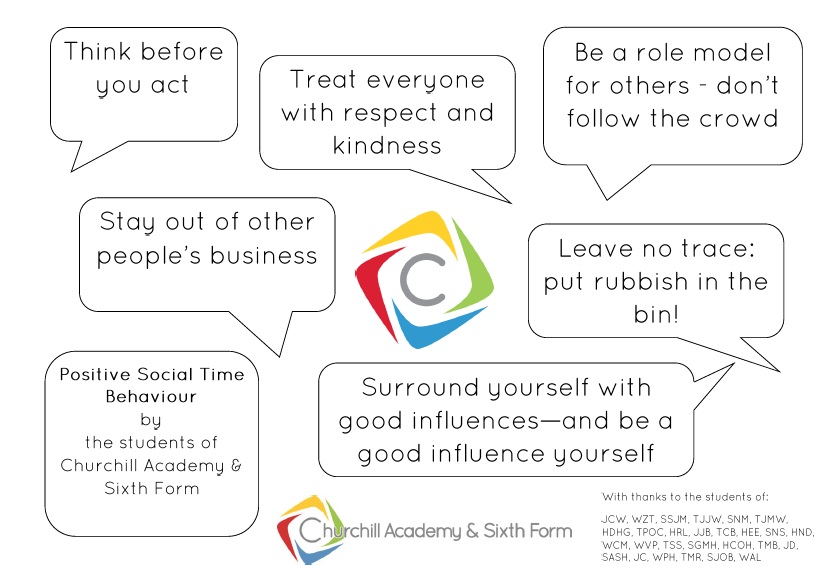
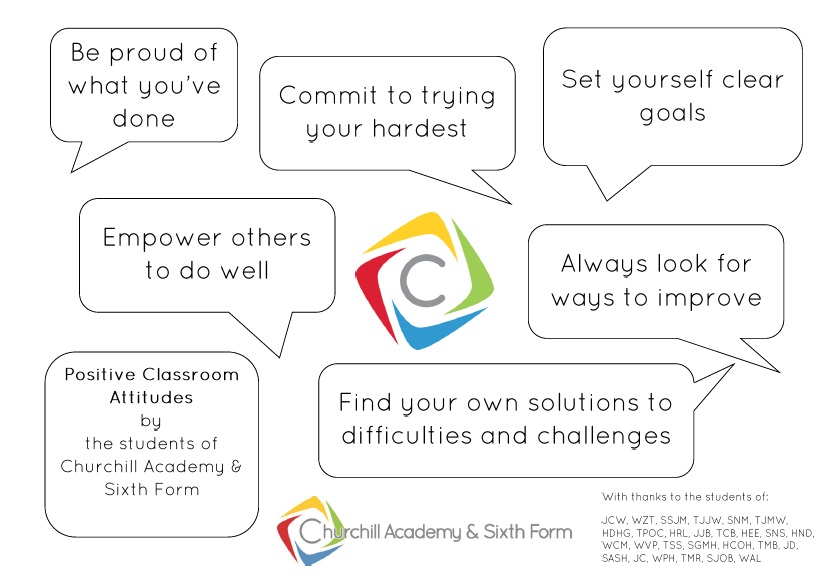
At the end of the process I had visited twenty-seven tutor groups and heard  the views of around 600 students. Over Easter, I gathered together all their thoughts and ideas. They had told me what they thought about the best way to ensure they learned effectively, and they had come up with lots of excellent suggestions for how they should behave at social time. Below, you can see the fruits of their labours:

Term 3 and 4 Positive Social Time

Term 3 and 4 Positive Classroom Attitudes

Student Voice Feedback Terms 3 and 4

These posters have been shared with all teachers and tutor groups this week, and many have been discussing it in their tutor time sessions to help everyone improve and maintain the highest standards of behaviour in school.

Over terms 5 and 6 I am getting the views of students about our Academy values of Care, Inspire, Challenge and Achieve – do they represent the Academy? What influence do they have on our day-to-day life at Churchill? And what should we value? I’ll report back when I’ve heard what they have to say!