
Equals and equality

The equals sign

Wikipedia tells me that the word “equals” derives from the Latin word “æqualis,” meaning “uniform”, or “identical”, which itself stems from aequus (“level”, “even”, or “just”). The equals sign – a pair of parallel lines, one above the other – apparently originated with a Welsh mathematician, Robert Recorde, in 1557. Bored of writing out “is equal to” again and again, he used a pair of parallel lines to stand instead.
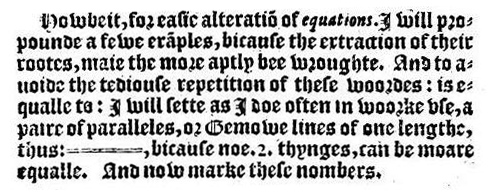
Robert Recorde’s original explanation of the equals sign

Recorde wrote: “And to auoide the tediouſe repetition of theſe woordes : is equalle to : I will ſette as I doe often in woorke vſe, a paire of paralleles, or Gemowe lines of one lengthe, thus: =, bicauſe noe .2. thynges, can be moare equalle.” In modern English, this roughly translates to: “And to avoid the tedious repetition of these words: “is equal to” I will set as I do often in work use, a pair of parallels, or duplicate lines of one [the same] length, thus: =, because no 2 things can be more equal.”

The first recorded use of the equals sign in 1557. 14x + 15 = 71

Recorde called his new symbol – a much longer pair of parallel lines than we are now used to – “Gemowe lines.” The word “Gemowe” means “twin,” from the same root as the star sign “Gemini.” What Recorde has captured in his new symbol was the idea that the two lines are not the same – one is above the other, and one below – but they are of the same value. The are worth the same. They are equally valuable – equivalent.
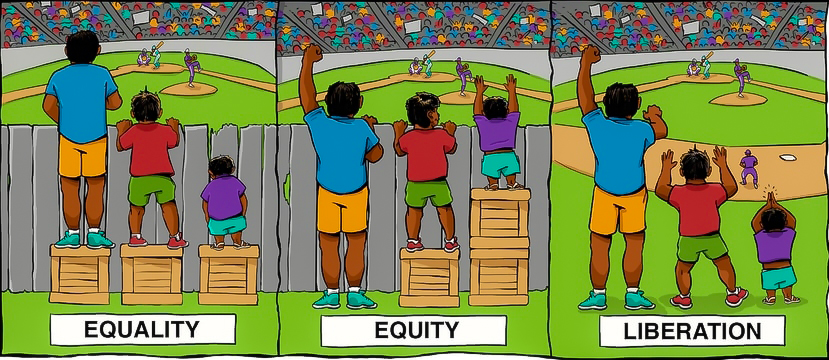
This famous illustration has been used in training to help staff think about the ideas of inclusion and diversity

We have been thinking carefully about what equality means in education. We are not all the same – each of us is unique. Achieving equality of opportunity does not mean giving everyone the same treatment – as shown in the left hand picture above. Some people need extra help or support to achieve – as shown in the middle picture – and as a school we work hard to put that in place wherever it is needed.

Our ultimate goal is to remove the barriers that stand in the way of achievement and progress, so that our students can set no limits on what they can achieve. This is illustrated in the picture on the right. We know that this is challenging, and that some of the barriers are beyond our control. We know that we can’t always achieve it on our own – but that doesn’t mean we shouldn’t try.

I recently visited a maths lesson and saw another expression of “equality.” The teacher was guiding the students through solving algebraic equations to find the value of x. Something like this:

2x2 + 12 = 44

Students volunteered to take the class through the process of solving the equation to find the value of x. The first step was to subtract 12, from both sides of the equation, to leave 2x2 = 32.

The teacher asked: “why do you need to take 12 from both sides of the equation?” The answer emerged: because both sides have to equal the same amount. If you only took 12 away from the left hand side, then they wouldn’t be equal.

The Year 8 mathematicians went on to divide both sides of the equation by 2, leaving x2= 16, before taking the square root of both sides and concluding that x=4.

After I had visited the lesson, I kept thinking about the idea of equality – in mathematics, in education, in society. 2x2 + 12 is not identical to 44 – the two sides of the equation look very different. But they have the same value. Our students are all different too, each with their own unique qualities, needs and circumstances. Their differences make them unique, and it is this uniqueness which provides the richness of our community. But every single child matters: they are all Churchill students. They are all part of the whole, all of equal value; they all belong equally.


What happens on an inset day? September 2022

The day after our Open Evening, staff were back in school for an inset day. Inset is a contraction of “in service training,” and all state schools have five inset days as part of their calendar to provide professional development to their staff. At Churchill, we like to make the very most of ours!

This year, our programme of professional development is focused on our Academy Development Plan, which has three priorities:

  • Challenge
  • The role of the tutor
  • Assessment

Our inset day drew in elements of all three priorities.

Challenge: every teacher a teacher of SEND

The morning was spent reflecting on our provision for students with special educational needs and disabilities. Our aim was to work hard to plan high quality, inclusive teaching to meet the needs of individuals and help them to overcome barriers to learning to support every student to be the very best they can be. We were supported in this work by Natalie Packer, a nationally renowned expert in the field.

Natalie took us through the five recommendations of the Education Endowment Fund’s Special Educational Needs in Mainstream Schools report. These recommendations, supported by robust evidence, provide the “best bets” for successful inclusive provision for all students.

Natalie also outlined the latest information regarding special educational needs and disabilities, including the Education Inspection Framework from Ofsted and recommendations about a high-quality, inclusive curriculum. Staff – and especially leaders – were then invited to reflect on our current practice, celebrate the many strengths, and identify areas of focus where we can develop through this year.

Lighthouse Schools Partnership

Following our SEND focused sessions, staff had a presentation from the Lighthouse Schools Partnership. The LSP is the multi-academy trust that we have committed to join, and the process of due diligence ahead of this is already well underway. School leaders have been working alongside colleagues from the partnership for many months, but this was the first opportunity for all staff to hear directly from the chief executive, chief operating officer and a deputy headteacher from a current Lighthouse Schools Partnership school. Our guests from the trust laid out their vision, their priorities, and how Churchill Academy & Sixth Form would both benefit from being part of the partnership, and strengthen it. There was then an opportunity to ask questions, and for further discussions. Work is continuing behind the scenes to ensure our transition into the trust goes as smoothly as possible.

The role of the tutor

The afternoon session began our exploration of the role of the tutor, which is our second key priority this year. Mrs James began the session by outlining the role of tutors with our Year 10 students as they start their GCSE courses. Over the coming weeks, tutors will be overseeing the target setting process with their Year 10s, ensuring that our students are fully engaged in being aspirational about their aims and objectives over the coming two years – and discussing the strategies they will need to employ to make those aspirations a reality.

We then turned our attention to six steps to being a brilliant form tutor, before the five houses (and the sixth form) got together to reflect on the skills and qualities that a brilliant form tutor needed. The house and sixth form teams also thought about the programme of activities running through our morning tutor sessions, beginning to plan to ensure we make the most of our vertical tutor groups and all the possibilities they have for growth and development.

This inset day was the starting point for this work, and we will return to it in January to develop it further.

There wasn’t time for us to watch it on the day itself, but the “role of the tutor” session was inspired by the Rita Pierson, whose famous TED talk “every kid needs a champion” provides the impetus for all of us who work in education to remember why we do it, and who we’re doing it for.

Although there were no students on site today, the thinking, reflecting and planning was really hard work. We’re confident that our students will feel the benefit over the coming weeks, months, and years as we continue to tweak, develop and improve our Academy.