The link between attendance, attainment and lifetime earnings

We have long understood the importance of good attendance at school: every moment matters. Over the past week, new research has been published which shows just how much every day at school counts.

The link between attendance and attainment

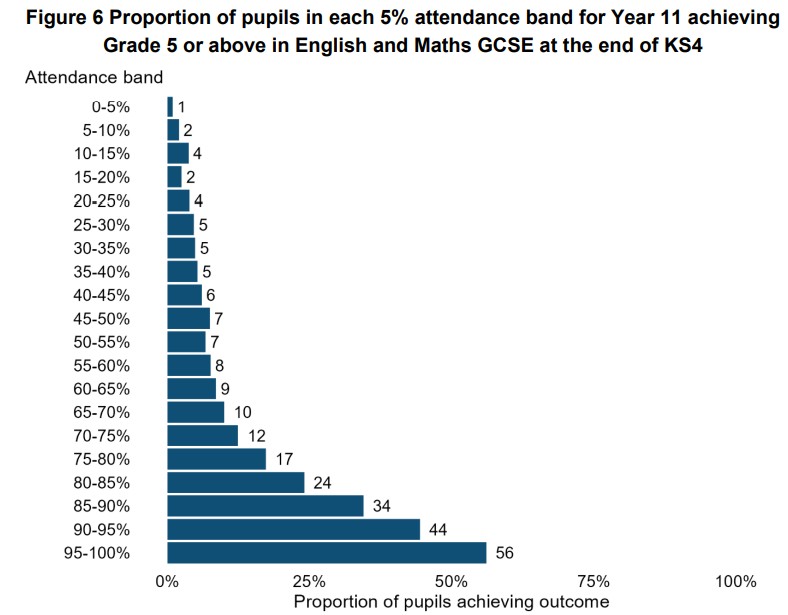
The link between attendance and attainment is at its strongest in secondary school. Year 11 students with near-perfect attendance are almost twice as likely to achieve grade 5 in English and Maths GCSE, compared to similar students attending 90-95% of the time. In other words, missing just 10 extra days a year reduces the likelihood of achieving these grades by around half.

At lower attendance levels, pupils who only attend between 50 and 55% of the time are 1.6 times more likely to achieve 9-5 in Maths and English GCSE than students who are severely absent and attend less than 50% of sessions. Increased attendance from severely absent to 60-65% (equating to approximately an extra 4-6 weeks in school) is associated with double the likelihood of the expected outcome compared with pupils who attend less than 50% of the time.

Improving attendance by just 5% makes a significant difference to academic attainment, as you can see in the chart below:

You can view the full research report here.

The link between school attendance and lifetime earnings

Missing school doesn’t just affect exam results and a child’s time in education. The impact of poor attendance has an impact on future earnings too. Related research has found that, for every day of absence between Years 7 to 11, the typical pupil could miss out on an average of £750 in future lifetime earnings. That’s £750 less for every single day missed.

The research also found that a one day increase in absence in Years 10 and 11 alone is associated with a 0.8% decrease in total yearly pay-as-you-earn earnings and declared self-employed earnings at age 28.

Persistently absent pupils in secondary school could earn £10,000 less at age 28 compared to pupils with near-perfect attendance. The likelihood of being in receipt of benefits increases by 2.7 times for
pupils who are classified as persistently absent (more than 10% absence). This rises to 4.2 times for those who are classified as severely absent (more than 50% absence).

As with attainment, it is clear to see the direct relationship between good attendance at school and higher earnings at the age of 28. You can see the full research report here.

Every day matters

We need to make sure that good attendance at school remains a high priority. We already ask that families only keep children off school when they are genuinely too ill to attend. We ask that you book medical appointments and holidays outside of school time whenever possible. And we ask that you talk to us if you’re having difficulties with attendance. Because every day at school gives you a better chance of good attainment, and greater earning power in adulthood.

Good attendance is an investment in the future. Let’s make it count.

Building your cathedral

The Parable of the Three Stonemasons

A man came across three stone masons who were working at chipping chunks of granite from large blocks. The first mason seemed unhappy at his job, chipping away and frequently looking at his watch. When the man asked what it was that he was doing, the first mason responded, rather curtly, “I’m hammering this stupid rock, and I can’t wait ’til 5 when I can go home.”

A second mason, seemingly more interested in his work, was hammering diligently and when asked what it was that he was doing, answered, “Well, I’m moulding this block of rock so that it can be used with others to construct a wall. It’s not bad work, but I’ll sure be glad when it’s done.”

A third mason was hammering at his block fervently, taking time to stand back and admire his work. He chipped off small pieces until he was satisfied that it was the best he could do. When he was questioned about his work he stopped, gazed skyward and proudly proclaimed, “I…am building a cathedral!”

(parable courtesy of Bill von Achen)

The parable of the three stonemasons reminds us always to keep in mind the larger endeavour that we are engaged in. Every lesson, every new piece of knowledge, every task, is adding a new block to our own individual cathedral. The effort we put in as we shape that new knowledge, as we fit it into our wider understanding of the world, and the way that we secure that new block so it stays in place; this is the process of learning. Every quiz, practice question, homework and class discussion is another block the cathedral of our understanding. How we sculpt and finesse that block is up to us.

How getting it wrong helps us do better

We all make mistakes. We get things wrong all the time!

It’s natural to feel frustrated after making a mistake, whether it’s in class or beyond. But the truth is, mistakes are often the best way to learn.

It’s a common belief that success means getting everything right the first time, but that’s simply not true. The most successful people in the world – from scientists and inventors to athletes and musicians – have all made countless mistakes. The difference is that they didn’t let those mistakes stop them. Instead, they learned from them and improved.

This is known as having a growth mindset. A growth mindset is the belief that your abilities can develop with effort, practice, and persistence. People with a growth mindset don’t see mistakes as failures; they see them as opportunities to grow.

How Mistakes Help Us Learn

  • They Show Us What We Need to Improve: When you get a question wrong in class, it highlights an area you don’t fully understand yet. Take it as a chance to focus on that topic and get better.
  • They Build Resilience: Mistakes can be frustrating, but they also teach you how to keep going despite setbacks. If you give up every time something goes wrong, you won’t make progress. But if you push through, you’ll develop resilience – a key skill for success in life.
  • They Encourage Creativity: Some of the world’s greatest discoveries came from mistakes: penicillin, microwave ovens, and even crisps were all created by accident. Mistakes can lead to new ideas and perspectives that you wouldn’t have considered otherwise.
  • They Help You Develop Problem-Solving Skills: When you make a mistake, you have to figure out what went wrong and how to fix it. This kind of problem-solving is an essential skill in school and in life.

Changing How You Think About Mistakes

Next time you make a mistake, don’t panic or feel discouraged. Instead, ask yourself:

  • What can I learn from this?
  • How can I improve next time?
  • What steps can I take to get better?

By embracing mistakes and adopting a growth mindset, you’ll become a stronger, more confident learner. So go ahead – make mistakes, learn from them, and keep getting better.

Putting it all together

Over the Christmas holidays, my family and I always like to complete a Christmas jigsaw. We have a few 1000 piece sets that we’ve been given over the years, and it’s always a fun challenge to try and put them together to make the complete picture. You can see our progress below!

As we were putting the jigsaw together this Christmas, I was thinking about the Academy: how every piece is different and unique, but every piece needs to be in the right place, to fit, to belong, in order to make the complete picture. We work really hard every day to help ensure that students and staff are slotted in to help make the whole thing work.

But I was also thinking about how every individual is made up of thousands of tiny pieces. These micro-decisions, little things that make up our daily lives in school. I spoke to students in assembly last week about some of these component parts:

  • Lessons: including our favourite lessons and those that we find more challenging. Our curriculum is made up of lots of component parts which all work together to make a strong, deep and broad understanding of our world. Every single piece counts.
  • Social times: ensuring that the Academy is and feels safe, welcoming and friendly for everyone in it, is everyone’s responsibility.
  • Punctuality: we are particularly focused on this important life skill at the moment, and our students are working really hard to make sure that they are on time, every time.
  • Attendance: similarly, we have been really impressed by our students’ efforts to ensure that they attend school every day, every lesson that they are able to.
  • Extra curricular: both within school and beyond, the activities our students are involved in all add up to build their skills, knowledge, character and confidence.
  • Values: our values of kindness, curiosity and determination underpin everything we do, and work together to support character development in our students
  • Wellbeing: linked to last week’s assembly on sleep, we know that looking after ourselves is important. Diet, exercise, sleep and a balanced approach to health and wellbeing are all important.

In our school, and in ourselves, every single piece matters.

What happens on an inset day? November 2024

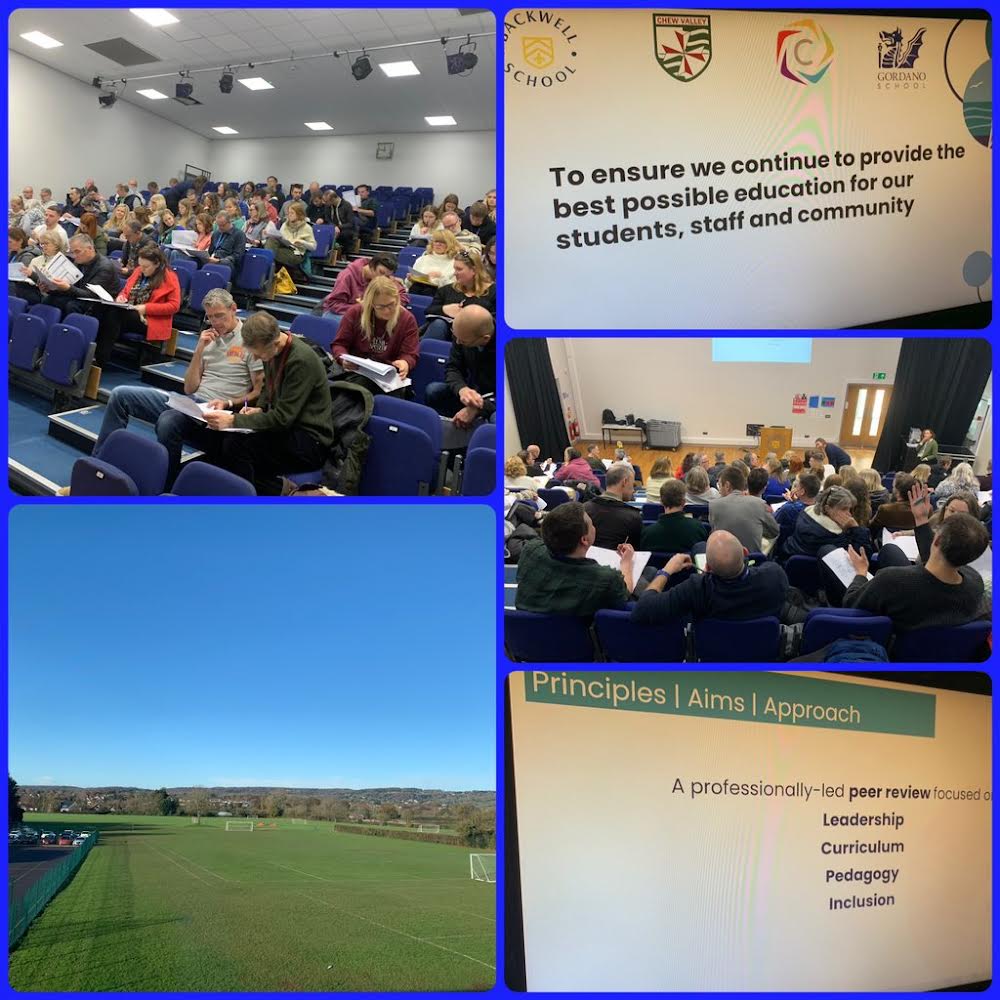
On Wednesday of this week, the four secondary schools in the Lighthouse Schools Partnership shared an inset day. Inset, which stands for “in-service training,” is a valuable opportunity for staff to refine their practice, collaborate, and develop their craft to ensure we provide the best possible education to our students. With staff from Gordano, Backwell, Chew Valley and Churchill all taking part, the day was a great success.

Subject and faculty leaders from across the trust all met at Backwell School. They met in subject groups to share lessons from analysing the summer’s GCSE, A-level and vocational exams results, to share strategies and techniques for ensuring the best possible outcomes for this year’s cohorts. This sharing of subject-specific expertise is invaluable, and all the schools in the trust benefit from these opportunities.

Later in the day, the subject and faculty leaders all came together for training in carrying out middle leadership reviews. This process sees subject experts from across the trust visiting one another’s schools to offer constructive critique, help identify areas of strength and development, and share practice to the benefit of all concerned. It is in these collaborations that the benefit of being part of a bigger trust are really apparent.

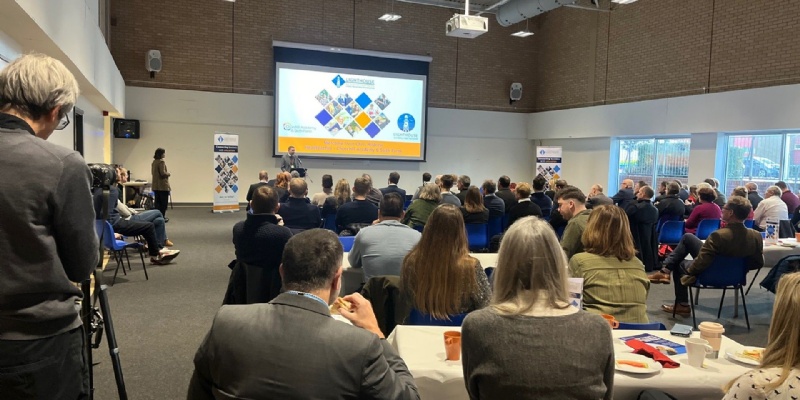
Meanwhile, back at Churchill, the day began early as we hosted the LSP’s business breakfast in the Pool Hall. Over 100 Business Partners and education colleagues attended to network, make connections, and collaborate. The main speaker at the event – Simon Lawrence OBE, General Manager of the National Trust Bristol Portfolio – provided an interesting and insightful reflection on the principles and values of ‘Servant Leadership’ that he has learnt throughout his military and diplomatic career.

Visitors also heard from Chew Valley School Headteacher, Gareth Beynon, who spoke about the importance of the outdoors when it comes to educating our children and young people. The event was closed by Sofia and Toby, from our own Churchill Sixth Form, sharing details of their upcoming trip to Madagascar.

Meanwhile, teaching staff were working on developing their questioning skills using resources from the Lighthouse Schools Partnership’s Pedagogy Framework. Questioning is fundamental teaching strategy, so getting the details right can be really significant in helping students to develop their thinking, practice key skills, and to help check for understanding. This was followed by a series of workshops on different aspects of SEND, to help us work more effectively with students with additional needs.

It was a packed day, with the importance of learning for staff at its heart: a great opportunity to refine and develop our practice across the trust to the benefit of our students. The next trust day – in February 2025 – will bring together all teaching staff from 33 primary and secondary schools in another day of collaborative learning. We can’t wait!

What happens on a joint inset day?

On Wednesday of this week, the Lighthouse Schools Partnership held its first joint secondary inset day. Inset is short for “in-service training” and is a day set aside for staff development and learning. Teaching and student-facing support staff from all four LSP secondary schools – Churchill Academy & Sixth Form, Chew Valley School, Backwell School and Gordano School – gathered together at Gordano in Portishead. This was the first time that the 400+ staff from the four schools had been together in the same place in the trust’s history.

The day began with a presentation from Chief Executive Gary Lewis, who outlined the trust’s vision under the heading “flourishing in partnership.” Being together in the same space enabled and allowed the partnership to flourish as connections were made and strengthened, common ground established, and sharing of practice enabled. There was a real buzz in the room as colleagues got together!

The rest of the morning was spent in workshops developing classroom pedagogy, with sessions on questioning, retrieval, scaffolding, checking for understanding, increasing participation ratio and modelling of example answers for colleagues to choose from. These key elements of teaching and learning are common across all our schools, and sharpening and honing our practice in them is essential for the continued success of our students.

Meanwhile, English and Maths leads were taking full advantage of the fact that the Lighthouse Schools Partnership also has 26 primary schools within the family, by spending the morning looking at key stage 2 curriculum and pedagogy in the Whiteoak Academies in Nailsea. This experience enabled leaders to get “under the skin” of the upper primary curriculum, to ensure that the transition into Year 7 is smooth and effective – and that the expectations we have of our youngest students are consistent with the expectations our primary colleagues have of their oldest.

After a lunch in which networks were formed and strengthened, subject-specific teams got together to reflect on the learning from the morning and how to implement the day’s learning back in their home schools. Subject leads were also working together to plan the next joint inset day, in February 2024, when staff will work together on subject-specific priorities at locations across the LSP’s secondary sites.

As relative newcomers to the multi-academy trust, Churchill staff are still getting used to being part of this larger organisation. Wednesday’s inset was a great opportunity to realise the benefits of collaboration across the wider trust. We look forward to continuing to flourish in partnership.

AI and ChatGPT: friend or foe?

The world of education is evolving at an unprecedented pace, and technology is playing a significant role in shaping the learning landscape. In recent years, the integration of artificial intelligence (AI) and ChatGPT, powered by OpenAI’s advanced language model, has become a topic of interest in English secondary schools. These innovations have the potential to greatly benefit students, but it is also essential for us to understand both their usefulness and the potential pitfalls. In this blog post, we’ll explore how AI and ChatGPT can be useful tools for students while highlighting some crucial warnings about their appropriate use, especially in terms of plagiarism.

The Advantages of AI and ChatGPT

  1. Personalized Learning: AI-powered educational tools can adapt to students’ individual needs, offering tailored learning experiences. ChatGPT can provide instant feedback and explanations to help students grasp complex concepts, making it an excellent resource for homework and assignments. For example, if you are struggling to understand or remember a concept or idea, asking ChatGPT to explain it may help jog your memory.
  2. Enhancing Creativity: ChatGPT can assist students in brainstorming ideas, refining their writing skills, and generating creative content. It can be a valuable companion for assignments and projects by suggesting starting points, topics for exploration, or other ideas.
  3. Access to Information: ChatGPT provides students with a vast amount of information at their fingertips. It can help students with research, giving them access to a wide range of sources and references to enrich their understanding of various topics.

Warnings and Risks

While AI and ChatGPT offer numerous advantages, they should be used judiciously, and parents and students need to be aware of the potential pitfalls:

  1. Plagiarism: One of the most significant concerns is the risk of plagiarism. ChatGPT can generate text quickly, but it’s essential for students to understand that simply copying and pasting the AI-generated content into their assignments is not acceptable. Parents should emphasize the importance of original work and proper citation. Work generated by AI is not the student’s own and attempting to pass it off as such could result in disqualification from examination courses.
  2. Overreliance: While AI can be a valuable resource, students should not become overly reliant on it. They need to develop critical thinking and problem-solving skills on their own. Encourage your child to use AI as a supplementary tool rather than a crutch.
  3. Accuracy and Credibility: Not all information available through AI is accurate or credible. Parents should teach their children to critically evaluate the sources and information provided by AI, just as they would with any other research method.
  4. Privacy and Safety: Parents should be aware of privacy and safety concerns. It’s essential to ensure that children are using AI tools in a secure and responsible manner. Discuss online safety practices, including not sharing personal information.
  5. Ethical Use: AI can sometimes generate content that may be inappropriate or offensive. Parents should educate their children about ethical behaviour and discourage any harmful use of AI.

Conclusion

AI and ChatGPT are valuable tools that can enhance the learning experience for students in English secondary schools. However, they must be used responsibly, with a focus on promoting creativity, critical thinking, and originality. Parents play a crucial role in guiding their children’s use of AI and helping them avoid pitfalls like plagiarism and overreliance. By understanding the advantages and limitations of AI in education, parents can support their children in harnessing the power of technology for their academic growth.

The blog post was written with help from ChatGPT3.5.

National Numeracy Day: the Maths of Life

This week (on 17th May) was National Numeracy Day – a day designed to help raise low levels of numeracy among both adults and children in the UK, and to promote the importance of everyday maths skills. The day aims to challenge negative attitudes towards maths and numbers, influence public policy and offer practical ways to help adults and children improve their numeracy.

We share the vision of the National Numeracy Trust. We also want to enable all our students to be confident and competent with using numbers and data, so they can make good decisions in their daily lives. Our strong Maths curriculum is testament to this, as is the fact that Maths is currently the most popular subject in our Sixth Form.

Understanding numbers and data is more important now than ever. The advent of ChatGPT this year, and the announcement that Google will be using AI within its search function, has highlighted the fact that we are entering a new era of partnership between humans and computers. Machine learning and artificial intelligence, driven by algorithms and the analysis of stupendously large datasets, will be an ever-increasing feature of all our lives over the coming years. The children we are teaching now will grow up in that world: we need to teach them to be ready.

Data is a massive part of all our lives, and it moves quickly. I can remember, when I started teaching in 1997, that we got the first computer in our English Department, and we used it to collect the exam results in a spreadsheet. It was an absolute revelation that we were able to show which students had done well in specific questions at the click of a mouse, and work out which bits of the curriculum to revise with them. Such analysis is now taken completely for granted, and it is layered with masses of additional information to enable us to make informed decisions about our work.

And this is not, of course, unique to education: every industry relies on data to help make sensible decisions, whatever the inputs and outputs – from healthcare to finance, engineering to retail, entertainment to research. Understanding that data, spotting and interpreting the patterns within it, and being able to manipulate it to reach informed conclusions, is an essential employability skill for a whole range of occupations.

Dr Hannah Fry shows why spotting patterns in data is essential for car racing, space exploration, government and more

But, at Churchill, we don’t see maths as purely utilitarian. We strongly believe that maths should be enjoyable for its own sake – for its elegance, its complexity and simplicity, for the stories that it can tell about our world, and for its quirky fun. I remember, for example, Mr Gale telling me about Belphegor’s Prime – a bizarre palindromic prime number which is a 1, followed by thirteen zeroes, followed by 666, followed by another thirteen zeroes and a final 1: 1000000000000066600000000000001. This number reads the same forwards as backwards; it is only divisible by itself and one; it contains 31 digits (which is 13 backwards). No wonder, with all these traditionally bad luck numbers layered into it, that the number was named after Belphegor, one of the seven princes of Hell, who is known primarily for tempting mortals with the gift of discovery and invention! What I find even stranger that 1000000000000077700000000000001 is also a prime number…

I have always been grateful to my maths education – even as an English Language and Literature graduate. It taught me to look for patterns, to analyse and try to understand the deeper structure of the thing that I was looking at – whether a poem, a play, a novel or, in my teaching career, a dataset, a budget or a behaviour or attendance record. This is what we aim for in our maths curriculum at Churchill – and, looking at our thriving sixth form uptake, it looks like it’s paying off.

You can only focus on one thing at a time

A lens refracts light to focus on one point (the focal point, F); our brains work in a similar way

In this week’s assemblies, I have been going through the Behaviour for Learning Top 5 we are focusing on this term:

  1. Strong start: We arrive on time, line up and enter the classroom calmly
  2. Full attention: We are immediately silent and face the speaker when called to attention 
  3. Full effort: We apply ourselves with our full effort to the learning tasks set
  4. Full focus: We focus all our attention on the learning tasks set
  5. Calm finish: At the end of the lesson we wait in silence for the member of staff to dismiss us

Part of the assembly demonstrated why it is important that we focus all our attention on the learning tasks set. The reason for this is that it’s not possible for the human brain to think about two different tasks at once.

Of course, it is possible for us to multi-task. We can walk and talk at the same time, or we can eat a snack whilst reading a book. This is possible because some of the process have become automatic in our brains: they are happening without us really thinking about then. In the examples above, the walking and eating are automatic – we can do them without thinking about them – meaning that our brain’s attention can be freed up to think about the talking or the reading.

What we can’t do, is actually think about two attention-demanding things at once.

We might think that we can – but actually what is happening is that our brain focuses on one thing, and then switches to the other thing, and then switches back to the first thing. This process is called code switching, and some people can do it faster than others – but what we can’t do is focus on two things at the same time. Like the illustration of the cats above, our focus shifts from one thing to another – but it can only be on one thing at a time.

My favourite demonstration of this is the card-sort-and-maths-questions task, as shown to students (with some helpful volunteers) in the assemblies this week.

In this demo, a willing volunteer is given a standard deck of cards and asked to sort them into suits, with each suit in number order, as shown in the illustration above. This is a simple enough task, but it requires the volunteer to think about it to make sure they identify the card, recognise it, and place it appropriately on the table in front of them. The audience watches the volunteer sorting the cards.

Then, I introduce a complication: I ask the volunteer to answer some simple mental arithmetic questions. For example:

  • What is half of 90?
  • What is 37 more than 60?
  • What is half of 8.2?
  • A television programme starts at 11:05 and ends at 12:15. How long did the programme last?
  • Three fifty pence coins have a mass of 18 grams. What is the mass of one fifty pence coin?
  • What is half of 144?
  • What is double 3.6?

Again, on their own these questions are all solvable – with a little bit of thought. So, what happens when I ask the volunteer the mental arithmetic questions, whilst they are sorting the playing cards?

Their hands stop moving.

If they try to keep sorting the cards, they can’t answer the arithmetic question. If they try to answer the arithmetic question, they can’t keep sorting the cards. It’s no reflection on your mathematical ability (or your card-sorting ability, for that matter): it’s a simple psychological fact that your brain can’t do both things at the same time.

So, why does this matter?

The reason why full focus is the fourth item on our behaviour for learning top 5, is that we need to concentrate fully on the task in hand if we are going to do it well. If something distracts us, or takes our attention away from the learning task, we simply cannot be thinking about the task – and therefore, we are not learning effectively. We are like Dug, the dog from the Pixar film “Up”, whose attention is dragged away from the conversation at hand whenever he sees a squirrel…

For our students to be successful, they need to avoid their own personal “squirrels” – the things that might distract them – to ensure that they stay focused on the learning at hand. That requires self-discipline, concentration and effort, but the impact on learning is significant.

And that is why we have made it our focus this term.

Behaviour for learning: getting the basics right

We know that good behaviour is essential for learning to take place. We reinforce this with our Code of Conduct and Effort Grades, and we incentivise it through our rewards system. We know that, over the past few years, it has been difficult to maintain consistency. COVID lockdowns, followed by periods of high staff and student absence, and the disruption to rooming in the Academy caused by works to Stuart House and Lancaster House have all contributed to a “stop-start” feeling for some classes, groups and individual students. We are certainly not alone in this: we have heard of many local schools having to close to entire year groups due to staff shortages this term, which is thankfully not a step that we have had to take.

We hope that we will now be moving into a more settled period. Stuart House is open, and the long ten-day isolation periods for COVID infections are a thing of the past. Given the disruption of recent years, attendance is more important than ever – students cannot afford to miss any more school.

But simply turning up isn’t enough. For real learning to happen, students need to work hard. Learning is difficult; it requires effort. And this is where behaviour for learning comes in.

Behaviour for learning is about more than just being kind, polite and respectful. It is about more than just wearing the correct uniform and bringing the right equipment and making sure your mobile phone is not seen or heard around the Academy. These things are important, of course – but behaviour for learning is about engaging in those actions that will enable you to take in information accurately and store it in your long term memory for later retrieval. It is rooted in our learning values, which are displayed around the Academy every day. We believe in the value of:

  • Determined and consistent effort
  • A hunger to learn new things
  • Challenging ourselves to go beyond what is comfortable
  • Viewing setbacks and mistakes as opportunities to learn and grow
  • Seeking and responding to feedback
  • Encouraging others to succeed

It is these values which underpin our approach to learning across the curriculum.

This is one of my favourite videos to illustrate “passive” learning: these characters are well-behaved, but they aren’t able to take action to “unstick” themselves when they get stuck, or to apply effort to solve a problem for themselves. They are forced to wait around for someone to come and help them out. These are not Churchill learners!

When we return after the Easter break, we will be working hard with all our students to refocus on the key elements of behaviour for learning. This includes the Code of Conduct and Effort Grades, and our learning values. But we will also be clarifying and reinforcing our expectations of behaviour for learning in lessons.

In every lesson, every time, we expect students to follow our Behaviour for Learning Top 5:

  1. Strong start: We arrive on time, line up and enter the classroom calmly
  2. Full attention: We are immediately silent and face the speaker when called to attention 
  3. Full effort: We apply ourselves with our full effort to the learning tasks set
  4. Full focus: We focus all our attention on the learning tasks set
  5. Calm finish: At the end of the lesson we wait in silence for the member of staff to dismiss us

The return to school after Easter gives us a perfect opportunity to ensure that our students make the most of every moment they have at school, and use it to make progress in their learning. Staff will be working together to ensure that these expectations are clearly explained to students, and that they are supported and challenged to meet them – in every lesson, every time. Because, after the disruption of the past couple of years, we can’t afford to waste a single moment.