The hare and the tortoise

tortoise_hare

A school year is a marathon, not a sprint: it’s important to pace ourselves. It reminds me of the story of the hare and the tortoise. The hare sets off at a terrific pace, relying on its natural talent – speed – to get it through. Initially, it pays off and the hare sprints ahead. However, it can’t maintain the pace over time, and ends up asleep under a tree. The tortoise understands that consistent, steady effort, applied over time, will bring its rewards. Because that level of effort can be sustained, the tortoise overhauls the sleeping hare and finishes ahead.

“The moment we believe that success is determined by an ingrained level of ability, we will be brittle in the face of adversity.”

Josh Waitzkin

Everyone at Churchill – staff and student – needs to put in constant and consistent effort in every lesson, every day. That way we can all stay on top of our work and make sure we haven’t got an impossible mountain to climb at the end of term or the end of the year. But it also means that we can sustain that level of effort over time, and make trying hard our default behaviour. Relying on our natural talents to get us through – coasting – may get us a certain distance, but there will come a time when it isn’t enough. Then, if we aren’t used to trying, we won’t have the reserves to make it count.

Another key element to making sure we have the energy to maintain our effort over time, is to ensure we build in relaxation time. We can’t work all the time, and time to unwind and de-stress is vital! It’s also essential that we eat and sleep well, so that we are charged up and ready for the hard work of learning during the school week.

Pace yourself – and keep going!


Bright Spots September 2016

Every day I walk the corridors of the Academy and pop into classrooms and lessons as I go. This week I thought I would share with you some of the things I’ve seen on my travels!

  • In Art, students practising single-line drawing and honing their observational drawing by creating panoramic sketches
  • In Business Studies Year 9 were exploring the factors of production, needs and wants, and e-commerce solutions
  • In Catering, there was some delicious tomato soup on the boil – the smell was fantastic!
  • In Dance, BTEC students working with professional dancer Emma Duffill from the TidalWave Dance company to develop their work in a contemporary style, adding their own choreography to a planned sequence
  • In Drama, students working on the concept of metamorphosis and presenting devised pieces showing transformations, whilst other Year 8 students were beginning preparations for their mask work.

  • In Geography one class of students were securing their knowledge of key features in glaciated landscapes – striations, cirques, glacial horns, arêtes, trim lines, U-shaped valleys, roches moutonnées, overdeepenings and hanging valleys – whilst another was exploring the human geography of Jamaica in their case study work. There was even time to model coastal features!

  • In Health and Social Care Year 10 were starting their unit on verbal communication, analysing the impact of volume, tone, pace, formality, and jargon
  • In History students were looking at the impact of the industrial revolution on child workers, including some horrific eyewitness testimony of Victorian industrial accidents
  • In Languages students were developing their description skills by creating character profiles – only French and Spanish were spoken by staff and students. No English allowed!
  • The LRC have put together a great new display of “dangerous” books

  • In Maths, Year 11 were sharpening up their understanding of indices whilst Year 13 were developing their advanced calculus by using the chain rule to differentiate functions of functions
  • In Music, GCSE students were teaching Year 7 the elements of music theory to secure their own knowledge of pitch, tempo, harmony and notation whilst introducing Year 7 to key concepts. This was amazing!
  • In PE, I saw Year 9 developing their teamwork and netball technique, Year 10 pushing themselves hard in an exercise class, and in a Year 9 theory lesson students were locating muscles and bones which were vulnerable to injury for Olympic athletes. In extra-curricular this week, girls’ football kicked off with a great turnout on Thursday.

  • In RE, Year 10 were exploring the concept of marriage, whilst Year 7 were looking at historical conceptions of God – starting with Ancient Egypt!
  • In Science, Year 12 were working on a calibration practical to analyse the concentration of glucose in urine samples
  • In Technology Year 9 were putting great work into their bug towers, working with tools and crafting their wooden structures with great skill

Nearly 2000 lessons take place every week at the Academy. This is just the tip of the iceberg! But what all these lessons had in common was the purposeful learning taking place. In every room I visited students were focused and engaged, pushing themselves to improve. It’s a privilege to witness.

For October’s Bright Spots I’ll try to take more pictures myself- but make sure you follow our social media to stay up to date!

What happens on an Inset Day?

Inset stands for “in-service training”, and all schools have had five inset days each year since they were introduced in 1988. Schools close to students on inset days, but staff attend. Sometimes they can seem a bit mysterious to families and to students, so I thought in my blog this week I’d try to explain what actually happens on these days when the students are away!

inset-day-chalk-board-cropped-192x110v2

Inset days are designed to provide compulsory training time for teaching staff so that we can continue to improve our practice, keep up to date with changes in education, and ensure that we have appropriate training to deal with the challenges of our job. Here at Churchill, we often involve our support staff in training too, so that all staff have the knowledge and skills they need to do their job to the best of their ability. We supplement our inset days with on-the-job training and provide a range of opportunities throughout the year for all staff to learn, develop and improve, but the inset days give us a real opportunity to get everyone together and spend an extended period of time working on priority issues for the Academy.

Let’s take this coming Monday (27th June) for example. There are five different strands of training happening on the day.

logo

Whole staff briefing: Strategic Planning

As a new Headteacher I’ve been busy working on the long-term plan for Churchill following the outstanding Ofsted achieved last summer. I’ll be sharing the plan on this blog towards the end of term, but I’ll start the day by briefing staff about our priorities and how we can all work together to achieve them first thing in the morning.

Safeguarding Training

All staff have to be trained to keep children safe in education – it’s the most fundamentally important part of our job. Because it’s so important, we “refresh” this training at least every two years to ensure that all our staff have the latest guidelines and procedures clearly in mind, and know exactly what to do if there are any concerns about children’s safety. This “refresher” training will be taking place for staff who are due to have this additional training.

Workshop to Raise Awareness of Prevent (WRAP) Training

Prevent Strategy

Prevent is the Government’s strategy to counteract the threat of extremism in our society. As a school we have a duty to uphold and enact the Prevent strategy and ensure that all staff are aware of what to look out for and what to do to ensure that we respond to the ideological challenge of terrorism and the threat we face from those who promote it, and to prevent people from being drawn into extremism and terrorism. All staff are required to undertake training in these aspects of the Prevent strategy and we will be providing opportunities on our inset day for this to happen at Churchill.

Pastoral development

Staff will meet in their House teams on this inset day to review and plan the work that needs to be done over the rest of this term, and in preparation for September. This includes planning the Celebration of Success events, ensuring that everything is in place to provide a smooth transition for our new Year 7 students and their families, to look at mentoring for students within the Houses, and to take time to work on particular priorities within each House. At the same time, the Sixth Form pastoral team will be meeting to plan the specialist tutor programme for next year, and ensure that the best opportunities are in place for our new Sixth Form cohort starting in September.

Extended Project Qualification (EPQ) Training

We are extending our provision of the Extended Project Qualification (EPQ) in Year 12 next year, so we are using our inset day to work in partnership with Backwell School to make sure that all staff involved in delivering the EPQ are properly trained by the exam board. We’re really looking forward to the opportunities that EPQ will give our Sixth Formers and we want to make sure we get it right!

Transition Drama Day

At the same time as all this training, our performing arts students and staff will be working hard with our new Year 7 intake on the famous “drama day” ahead of the transition day on Tuesday. There will be lots of fun, learning and confidence building going on! Watch the website for a full report…

Phew!

As you can see, it’s going to be a busy day! It’s a great opportunity to make sure that all our staff have the best and most up-to-date training to care for and deliver the best possible education to the students at the Academy. And, for our staff at least, it’s definitely not a day off!

The Learning Brain

Our brains are amazing! The average human brain weighs about three pounds, looks like a big grey wrinkly sponge, and generates enough electricity to light a bulb, or even to charge an iPhone.  The brain controls everything from breathing and blinking to our emotions and memories, through firing electrical signals between brain cells – or neurons – across tiny gaps called synapses. We have approximately 100 billion neurons in our brain, all interconnected by synapses. Because each neuron is connected to lots of other neurons, there are approximately 1 quadrillion synapses – that’s 1,000,000,000,000,000 synapses! This is equal to about a half-billion synapses per cubic millimetre. No wonder our brains are so sophisticated!

Despite all that complexity, the video above is a really clear and simple introduction to how our brains work – and how they learn most effectively. There are all sorts of great tips in there to help us all be better learners. Have a watch and see if you can put it into practice!

How to grow your brain

I’ve been a fan of the Khan Academy for a long time now. The website was set up by Salman “Sal” Khan after he began tutoring his cousin, and has developed into an international organisation with the aim of providing a free, world-class education to anyone, anywhere. There are tutorial videos on a mind-boggling array of topics – great for revision or just for pushing yourself and understanding something new. 

What’s particularly great, though, is the philosophy behind the Khan Academy – You Can Learn Anything. Khan explains: 

Most people are held back not by their innate ability, but by their mindset. They think intelligence is fixed, but it isn’t. Your brain is like a muscle. The more you use it and struggle, the more it grows. New research shows we can take control of our ability to learn. We can all become better learners. We just need to build our brains in the right way.

Khan Academy

Helpfully, the Academy has provided a couple of videos explaining exactly how the brain grows when we learn something new. Here’s the short version: 

And for those with a real appetite for it, here’s the detail: 

Finally, Sal Khan himself met with Carol Dweck to explore the ideas behind a growth mindset approach: 

Remember: if you set your mind to it, you can learn anything. 

Assembly: Concentration

This assembly owes much to a presentation on the brain given by Bradley from Inner Drive (@Inner_Drive) at #GrowEx last year, and this excellent TED talk by Peter Doolittle (@pdoopdoo) on working memory shared by Huntington Learning Hub (@HuntingtonLHub). It’s well worth a watch:

The PowerPoint slides are shared at the bottom of this post.

We start with a test of working memory (see the video for this test). I am going to ask you to remember five words just by holding them in your mind. Here are the five words:

  1. Tree
  2. Motorway
  3. Mirror
  4. Saturn
  5. Electrode

Whilst you are remembering those five words, I am going to set you three challenges.

  1. What is 23 x 8?
  2. On your left hand, use your thumb to count your fingers 1, 2, 3, 4, 5, then back again 6, 7, 8, 9, 10.
  3. Now in your head recite the last five letters of the English alphabet backwards.

How many of the five words that I asked you to remember do you still have in your memory? Does anyone still have all five?

The reason why many of you will have forgotten some of the words that I told you only a minute or so ago, is that the capacity of our working memory is limited. It can only hold so much information at any one time. Daniel Willingham provides a simplified model of the brain here:

A simple diagram of the mind (source)

A simple diagram of the mind (source)

In our test, the Environment (me) provided some information which was fed into your working memory. You didn’t do much with that information, and immediately afterwards I distracted you with three more activities which demanded space in your working memory. Little wonder, then, that when I asked you to return to the original information (the five words I asked you to remember), some or all of it had been pushed out of your mind without ever having made it into your long-term memory.

focus-and-concentration

There are some more demonstrations that will help us understand why sustained concentration on the task in hand is important. The first is to do with focus, and multitasking. You might think that you are really good at multitasking, and that you can easily do two, three or more things at once. Where some of those things are automatic – walking and talking, for example – that is probably true. However, your working memory can only focus on one cognitively demanding task at a time. In that way, it’s like focusing a lens – you can only focus on one thing at a time.

You can only focus on one thing at a time

You can only focus on one thing at a time (when in doubt, reach for the cat gifs)

Let’s take this optical illusion as an example. In the picture, the man’s face can be seen looking to the right, or looking straight ahead. See if you can see both!

Looking to the right, or looking straight ahead? Both - but not at the same time.

Looking to the right, or looking straight ahead? Both – but not at the same time.

Now try to see both at the same time. Your brain switches from one to the other – it will only let you hold one interpretation of the picture in your head at one time. This is what happens when you try to multi-task. Your working memory actually switches from one task to the other. This is called context switching, and you may be able to do this quickly (there is some evidence that women are better at it than men), but you are not multitasking. You can’t.

Finally, here’s a demonstration of context switching in action. I need a volunteer from the audience to take this box of multicoloured balls, and arrange them in rows of four in the order of the colours of the rainbow. At the same time, they will be solving some Mental Maths Questions from the KS2 Maths SAT Buster book.

I know this challenge well, because Bradley used me as his volunteer at #GrowEx when conducting the same experiment. Essentially, your brain can either focus on arranging the balls, or on doing the maths – but not both. As I was trying to arrange the balls, I got simple questions wrong. When I thought about the maths, my hands stopped moving. My working memory would not allow me to do both things at the same time. I felt embarrassed, but I shouldn’t have; I was simply demonstrating a human characteristic. Our brains cannot do two cognitively demanding things simultaneously.

Let’s think about how we can apply what we’ve seen today to the classroom. The first thing is that it only takes is a small distraction for information that you have just learned to evaporate. If you are getting to grips with a new concept in your lessons and you then think about the piece of gossip you meant to tell your neighbour, your chances of transferring the new concept to your long term memory are dramatically reduced. Distractions are compelling – it’s very easy to be like Dug from Up: 

Distractions can take your mind off the task at hand

Distractions can take your mind off the task at hand

And don’t kid yourself that you can do two things at once; you can’t. Once you’re distracted, the damage is done.

Put simply:

  1. Concentrate on the task at hand
  2. Focus on the learning
  3. Apply and use what you have learned straight away if you want to stand any chance of remembering it.

And, by the way, 23 x 8 = 184.

Good luck!

Here is the PowerPoint, though the gifs don’t work in this slideshare version. Click on this link for the full version: Concentration.

Concentration phoster

How to revise: techniques that work

loverevision

We love revision…right?

Revision – it really matters. But, with the best will in the world, it’s not the most exciting way to spend your time. The process itself requires you to look back at work you’ve already done – to “re-vision” it – to try and remember it and commit it to memory. There’s nothing “new” in it. But the trick to making it effective is to get your brain working as hard as it can be.

The reason for this is best summed up by cognitive psychologist Daniel Willingham. Willingham says:

Whatever you think about, that’s what you remember. Memory is the residue of thought. 

In other words, you need your brain to really be processing the information you are trying to revise, if you want to stand any chance of remembering it.

What doesn’t work?

There are a few techniques that seem effective – but actually aren’t. These include:

  • Highlighting
  • Re-reading
  • Summarising
highlighting

Highlighting: expectation vs reality

These techniques allow information to pass through your brain without much thinking. Covering pages of A4 with beautifully highlighted patches might make you feel like you’ve achieved something, but it won’t actually help you to remember the information. These are low challenge activities, and therefore low impact

What does work?

Practice Testing

This technique is pretty straightforward – keep testing yourself (or each other) on what you have got to learn.  This technique has been shown to have the highest impact in terms of supporting student learning.  Some ways in which you can do this easily:

  • Create some flashcards, with questions on one side and answers on the other – and keep testing yourself.
  • Work through past exam papers – many can be acquired through exam board websites.
  • Simply quiz each other (or yourself) on key bits of information.
  • Create ‘fill the gap’ exercises for you and a friend to complete.
  • Create multiple choice quizzes for friends to complete.

Distributed Practice
forgetting curve

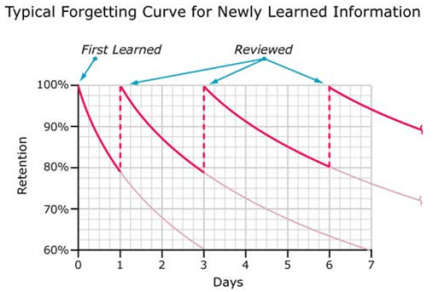
The Ebbinghaus Forgetting Curve – if you revisit newly learned information, you remember more of it

Rather than cramming all of your revision for each subject into one block, it’s better to space it out – from now, through to the exams.  Why is this better?  Bizarrely, because it gives you some forgetting time.  This means that when you come back to it a few weeks later, you will have to think harder, which actually helps you to remember it.  Furthermore, the more frequently you come back to a topic, the better you remember it.

Elaborate Interrogation

One  of the best things that you can do (either to yourself or with a friend) to support your revision is to ask why an idea or concept is true – and then answer that why question.  For example:

  • In science, increasing the temperature can increase the rate of a chemical reaction….why?
  • In geography, the leisure industry in British seaside towns like Porthcawl in South Wales has deteriorated in the last 4 decades….why?
  • In history, the 1929 American stock exchange collapsed.  This supported Hitler’s rise to power….why?

So, rather than just try to learn facts or ideas, ask yourself why they are true.

Self explanation

Rather than looking at different topics from a subject in isolation, try to think about how this new information is related to what you know already.  This is where mind- maps might come in useful – but the process of producing the mind map is probably more useful than the finished product.  So, think about a key central idea (the middle of the mind map) and then how new material, builds on the existing knowledge in the middle.

Alongside this, when you solve a problem e.g. in maths, explain to someone the steps you took to solve the problem.  This can be applied to a whole range of subjects.

Interleaved revision

When you are revising a subject, the temptation is to do it in ‘blocks’ of topics.  Like this:

revisionblocked

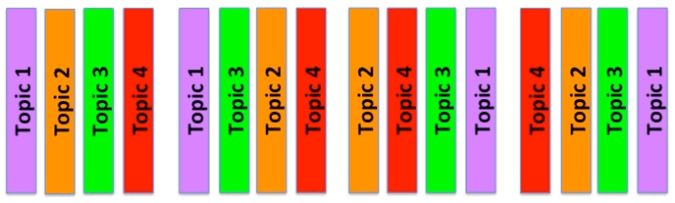
The problem with this is, is that it doesn’t support the importance of repetition – which is so important to learning (see distributed practice above!)  So rather than revising in ‘topic blocks’ it’s better to chunk these topics up in your revision programme and interleave them:
revisioninterleaved

This means that you keep coming back to the topics.  So, instead of doing a one hour block of revision on topic 1, do 15 minutes on topic 1, then 15 minutes on topic 2, then the same for topic 3 and 4. The next day, do the same. On day three – just to spice it up and stop your brain getting into a rut – mix up the topics!

Have a break

Your brain can only work effectively for so long. Scientists differ on this – some say our attention span is around 20 minutes, whilst others say we can work for longer. My advice is to revise in blocks of around 45 minutes, giving yourself a 15 minute break in each hour to recharge. Make sure you get some fresh air, relax and switch off. You don’t want to underachieve because you haven’t done enough revision – but equally, you need to stay healthy and happy if you’re going to do your best, so don’t overdo it!

Resources

There are lots of resources out there to help you revise. Here are just a few:

Good luck!


With thanks to Shaun Allison for the inspiration  and some of the images for this blog. Read Shaun’s original post here.

Can I listen to music while I work?

This week I met Lara, Holly and Melissa, three students in Year 8 who wanted me to let them listen to music whilst they revised for their exams. They wrote me a very polite letter, and they’d even discussed it with their classmates to gather a petition. They felt that listening to music when they were working helped them relax, focus, and shut out distractions. So, they asked, would I relax the rules and let them have their headphones in?

640px-earpods_derecho

Will listening to music help us concentrate?

There’s been some quite interesting research in this area. Scientists have studied how listening to music can change our performance in different types of tasks. Under some conditions, music actually improves our performance, while in other situations music makes it worse.

One study from America looked at how listening to music had an impact on surgeons’ performance in the operating theatre. This study found that listening to music made them more relaxed and they performed with more accuracy, especially if it was music they liked.

Another study, by British researcher Nick Perham, found that playing music you like can lift your mood and increase your motivation — if you listen to it before getting down to work. But it serves as a distraction from cognitively demanding tasks like learning new material or trying to memorise information.

This is a very important distinction. Surgeons in operating theatres are performing operations that they have practised many times before, and therefore they are performing things they have already learned. It’s the same principle as the research that found that music can make rote or routine tasks (like folding laundry or filing papers) less boring and more enjoyable. Runners who listen to music go faster. Music can lift us when we’re doing things that don’t require us to think too hard about them, or things that we have practised many times before.

musical-notes

Listening to music interferes with concentration when we’re trying to read or retain information, and makes us less effective learners

That’s not what lessons and revision are about however. Learning is what Nick Perham would call a “cognitively demanding task.” In one of his more recent studies, Perham says, he found that reading while listening to music, especially music with lyrics, impairs comprehension.

“You’ve got…information that you’re trying to use when you’re reading a book, and you’ve got…information from the lyrics,” Perham says. “If you can understand the lyrics, it doesn’t matter whether you like it or not, it will impair your performance of reading comprehension.”

What basically happens is that your brain will switch between the music and what you’re trying to learn or revise, and that switching distracts you from the learning process. If you’re going to be an effective learner, your brain needs to focus fully on what you are trying to learn. No distractions.

So, sorry Lara, Holly, Melissa and friends: the rule stays! If you’re learning or revising – turn the music off.

Links:

Why “I can’t do it” won’t do

Edison

Thomas Edison, inventor of the phonograph, motion picture camera, and the light bulb – he knew a thing or two about persistence (image source)

What are the biggest barriers to learning? Of course, there are many difficulties and problems which face us all when we are learning something new. We may not have the resources available; we might not have the right environment in which to learn; we might not have the skills or prior knowledge we need to grasp the concept. However, I think the biggest barrier to learning is our own attitude – the tendency to give up when it gets difficult, to throw up our hands and say “I can’t do it!”

I remember interviewing a student (let’s call her Emma*)  for a place in the sixth form a few years ago. Her mum was with her and she was really struggling in Maths. “I can’t do Maths,” she said. Her mum turned to her and said, “don’t worry, I can’t do Maths either.” Needless to say, Emma didn’t get the grade she needed in Maths to get into the sixth form. I’m sure her mum was trying to help, to offer some comfort to her daughter who was struggling with some difficult concepts. But the notion that not being able to do Maths is somehow okay gave Emma permission to believe that she genuinely couldn’t do Maths – and this wasn’t the case. Anyone can do Maths. Everyone can do Maths. But you need to work at it, and you need to believe you can do it.

Imagine for a moment if Emma had been struggling with reading. Would her mum have turned to her with the same comfort? “Don’t worry, I can’t read either.” This just wouldn’t happen, and we need to have the same attitude to all our learning.
voice-paint3

Luckily, there is a solution – and it’s one simple word. That word is YET. Adding the word “yet” to  the end of a “giving up” phrase is a simple way of reminding us that learning is a process.

  • I can’t do it…YET
  • I don’t understand it…YET
  • I’m no good at painting…YET
  • I tried question 4 and I couldn’t do it…YET
  • I’m not a Maths person…YET

The only way we can guarantee failure is if we give up. Until then, everything we’re doing is learning. What “YET” does is it says that this is a skill which is acquired over time. It’s not something you’re necessarily going to get instantly. There’s a learning curve, and to be successful we need to stay on that curve.

Even Sesame Street have tuned into the power of YET with a catchy tune from Janelle Monae. Enjoy…

You didn’t do it right now, but keep trying, you’ll learn how

You just didn’t get it yet, but you’ll get it soon I bet

That’s the power of yet. 

*Names have been changed.

The power of music

Many people have written about the power of music to move us. For example, George Eliot wrote “there is no feeling that does not find relief in music”, whilst Martin Luther is reputed to have said “my heart, which is so full to overflowing, has often been so laced and refreshed by music when sick and weary.” My personal Headteacher hero, Albus Dumbledore, reflecting on a performance of the Hogwarts school song, was moved to tears in Harry Potter and the Philosopher’s Stone: “Ah, music,” he said, wiping his eyes, “A magic beyond all which we do here!

Lucy, Joe and Reuben at the Christmas Concert

At the Churchill Music! Young Musician of the Year competition at St John’s Church on Monday evening, I was moved beyond measure by the performances I heard. At the event, I shared my thoughts about the power of music in other ways. Firstly, playing a musical instrument actually improves your brain. A recent study by Nina Kraus of Northwestern University in America, for example, showed that “music training changes the course of adolescent brain development” leading to significant gains in literacy. The theory is that in learning an instrument, you are training your brain to hear subtle differences in sound, which reinforces and strengthens your ability to process language. An earlier study from Harvard University showed the “links between musical training and enhanced cognitive skills” – in particular the executive functions of our brain’s frontal lobe which “allow for planned, controlled behaviour” according to the study’s author, Nadine Gaab. There is a wealth of research that shows that learning and playing a musical instrument has a raft of benefits for brain function, learning and intelligence.

Another benefit to playing a musical instrument is that it teaches us the power of collaboration. Of course, we can sing and play alone, and solos can be hugely powerful, but music is meant to be shared. Even a soloist is usually accompanied, and anyone who has sung in a choir or played in a band or orchestra will tell you that the shared experience of making music together is unrivalled. The discipline of listening to one another, adjusting what you are doing to match those around you, shifting your own performance to contribute to the whole, teaches us so much about selflessness and teamwork, and how we are so much more together than the sum or our parts.

D32A1023

Playing together unleashes the power of music

The other great bonus to playing an instrument is the practice. I’m not sure if the performers will agree as they attempt three octaves of a C# minor arpeggio for the tenth time, but to get good – really good – at a musical instrument takes hours and hours of practice, day after day, week after week. The famous concert pianist Artur Rubenstein said “don’t tell me how talented you are; tell me how hard you work.” This was his way of articulating Stephen King’s notion that “the difference between a talented individual and a successful one is a lot of hard work.” The work ethic of learning a music instrument teaches discipline, dedication and determination which transfer to all other aspects of your life. It takes a lot of all three to get through those early, squeaky, scratchy stages to the bit where it starts to sound like music!

D32A0974

Practice makes perfect

Finally, and perhaps most importantly, making music teaches you to feel. The wonder of a performance is that it brings the wood and metal of the instruments, and the space of the venue to life in an experience that only that audience and that performer will ever share. Musicians interpret dots and lines on a page, often written down hundreds of years ago in countries far from our own, and channel the emotions that those composers felt though themselves in a way which is unique, and all the more powerful for it.

In St John’s Church on Monday I was struck by the skill with which these talented young people were able to make an emotional connection through their instruments to the audience, transporting them through centuries and over miles to different places, different times. It was a privilege to be there and a lesson to us all to pick up an instrument and stick with it. It’s worth it.