What happens on an Inset Day?

Inset stands for “in-service training”, and all schools have had five inset days each year since they were introduced in 1988. Schools close to students on inset days, but staff attend. Sometimes they can seem a bit mysterious to families and to students, so I thought in my blog this week I’d try to explain what actually happens on these days when the students are away!

inset-day-chalk-board-cropped-192x110v2

Inset days are designed to provide compulsory training time for teaching staff so that we can continue to improve our practice, keep up to date with changes in education, and ensure that we have appropriate training to deal with the challenges of our job. Here at Churchill, we often involve our support staff in training too, so that all staff have the knowledge and skills they need to do their job to the best of their ability. We supplement our inset days with on-the-job training and provide a range of opportunities throughout the year for all staff to learn, develop and improve, but the inset days give us a real opportunity to get everyone together and spend an extended period of time working on priority issues for the Academy.

Let’s take this coming Monday (27th June) for example. There are five different strands of training happening on the day.

logo

Whole staff briefing: Strategic Planning

As a new Headteacher I’ve been busy working on the long-term plan for Churchill following the outstanding Ofsted achieved last summer. I’ll be sharing the plan on this blog towards the end of term, but I’ll start the day by briefing staff about our priorities and how we can all work together to achieve them first thing in the morning.

Safeguarding Training

All staff have to be trained to keep children safe in education – it’s the most fundamentally important part of our job. Because it’s so important, we “refresh” this training at least every two years to ensure that all our staff have the latest guidelines and procedures clearly in mind, and know exactly what to do if there are any concerns about children’s safety. This “refresher” training will be taking place for staff who are due to have this additional training.

Workshop to Raise Awareness of Prevent (WRAP) Training
Prevent Strategy

Prevent is the Government’s strategy to counteract the threat of extremism in our society. As a school we have a duty to uphold and enact the Prevent strategy and ensure that all staff are aware of what to look out for and what to do to ensure that we respond to the ideological challenge of terrorism and the threat we face from those who promote it, and to prevent people from being drawn into extremism and terrorism. All staff are required to undertake training in these aspects of the Prevent strategy and we will be providing opportunities on our inset day for this to happen at Churchill.

Pastoral development

Staff will meet in their House teams on this inset day to review and plan the work that needs to be done over the rest of this term, and in preparation for September. This includes planning the Celebration of Success events, ensuring that everything is in place to provide a smooth transition for our new Year 7 students and their families, to look at mentoring for students within the Houses, and to take time to work on particular priorities within each House. At the same time, the Sixth Form pastoral team will be meeting to plan the specialist tutor programme for next year, and ensure that the best opportunities are in place for our new Sixth Form cohort starting in September.

Extended Project Qualification (EPQ) Training

We are extending our provision of the Extended Project Qualification (EPQ) in Year 12 next year, so we are using our inset day to work in partnership with Backwell School to make sure that all staff involved in delivering the EPQ are properly trained by the exam board. We’re really looking forward to the opportunities that EPQ will give our Sixth Formers and we want to make sure we get it right!

Transition Drama Day

At the same time as all this training, our performing arts students and staff will be working hard with our new Year 7 intake on the famous “drama day” ahead of the transition day on Tuesday. There will be lots of fun, learning and confidence building going on! Watch the website for a full report…

Phew!

As you can see, it’s going to be a busy day! It’s a great opportunity to make sure that all our staff have the best and most up-to-date training to care for and deliver the best possible education to the students at the Academy. And, for our staff at least, it’s definitely not a day off!
Practice makes perfect

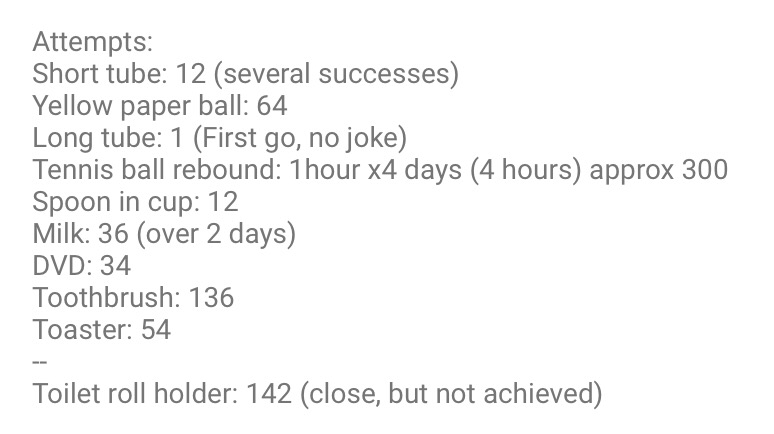
I love a good trick shot, and these trick shots captured by five-year-old Riley Dashwoood are very cool. The over-the-shoulder-DVD-into-the-tray is particularly impressive! What I love about the video description, however, is that it outlines how the shots were achieved. “Trick shot kid = persistence,” it says, followed by the attempts: 

How to get a trick shot (source)

When edited together into a cute 30 second montage, the trick shots look amazing! But below the line, we see that it took a long long time to get that montage together. Throwing a toothbrush over your shoulder 136 times? No wonder she looks happy when it finally goes in! 

Needless to say, Riley has spawned many imitators. This week I enjoyed this viral video as it popped up on my Twitter feed. Niall Brady was attempting to do a trick shot where he throws a spoon over his shoulder into a mug on the kitchen side. He made one attempt every day. It took him nearly a year:

There was certainly a big grin on my face as Niall enjoyed his moment of triumph, but I couldn’t help wondering – how many attempts would it take him to do it again? And how much practice would it take until he could do it consistently, time after time, almost without fail?

The fact is, if we want to get really good at something it’s not useful just to do it over and over again. Simple repetition does not necessarily help us to become experts. Take a tennis serve, a golf swing, or musical scales: if you’re using bad technique, practising them over and over again will only embed the bad habits and make them harder to break. What matters is the focus of that practice – the focus on developing the technique, on improving it, on making it better and better each time; the focus on what is called “high leverage practice” which makes an impact on performance. 

There are some great examples of this in sport. Take David Beckham, practising free kicks again and again on the training ground so he can deliver when it counts on the pitch: 

Although, watching that back, it’s amazing how many free kicks England got in that game – and how many he missed! 

Alternatively, take this incredible catch in the NFL in America from another Beckham – Odell Beckham Jr: 

The commentator says “you have to be kidding me! That is impossible. That is impossible.” And it does seem superhuman – until you realise that Odell Beckham Jr., like his English namesake, spends hours on the training pitch perfecting exactly that kind of catch, so he can do it seemingly with ease when it counts on the pitch. 

What we see here it that it isn’t about a one-off fluke, but careful deliberate practice which enables talent to shine when the moment arises. If you asked Niall Brady to throw a spoon over his shoulder into a cup on demand, he’d probably fail. Throw an American football at Odell Beckham Jr., however, and he’d probably catch it, even with one hand tied behind his back. 

The same principle is applied to the inspiring GiveIt100 site, which invites people to share a short video every day as they practice a new skill for 100 days. There are some great examples on the site, including this one of a guitarist: 

My final “practice makes perfect” video shows Jonny Wilkinson practising “stress kicks” in the south of France. “It’s very important,” Jonny says, “to make it more difficult…in training than it ever could be in a game.” That way, he’s ready in stressful situations, in the heat of the moment, to deliver crucial kicks – because he’s trained for it. 

We can apply the same principle to all of our learning. If we’re going to get really good at things, it’s not enough just to turn up to school every day and sit in the classroom, going through the motions, coasting along. That’s the equivalent of throwing a spoon over your shoulder every day for a year. You might get lucky once or twice, but you haven’t really mastered anything. But if you apply yourself every day, focus your practice, push and challenge yourself to do better…when the whistle blows for the big game, you’ll be ready. 

Happy practising!
In case you were wondering: 

The next steps: 2016 leavers

The last day of Term 5 is always an emotional one. It’s a day of goodbyes as leavers take their next steps. Year 11 step out of main school, and Year 13 step beyond school for good. Of course, it’s au revoir not goodbye, because students will be back in after the half term break for revision and exams, and most of Year 11 will be rejoining us in the Sixth Form anyway, but it still feels like an ending. This blog is for you: the leavers of 2016.

As a new Headteacher joining the Academy in January, I’ve only had a few months to get to know you. Oddly, it’s those in the “leavers'” years that I feel I know the best! I’ve been made to feel very welcome by you at the top of the school, and you’ve been happy to share your experiences with me. You have spent five or seven years at Churchill and have a really good perspective on the things that have made your time at the Academy successful, fulfilling and enjoyable – as well as the niggles and gripes that go into the “areas for development” category! Your approach to study, and your pride in your school, have made you excellent role models to the other students, and given me an idea about what it is possible to achieve at Churchill.

A few moments with the senior students of 2016


Being a secondary school teacher is a huge privilege. You come to us, aged 11, as children; you leave us, aged 18, as adults. We have the honour of shepherding you through the tricky terrain of the teen age as you wrestle with your changing bodies, burgeoning independence, and emotions felt more keenly and powerfully than at any other time in life. In partnership with your families we help you to understand the world around you fully and in depth. Your sense of justice and fairness, your passionately held principles, your refusal to accept that “it’s just the way things are” is inspiring. You challenge us as we challenge you, of course, but in all of you there’s the turning point when you realise that we’re all on the same side and that, actually, we can achieve much more working together than we do in opposition. Equally, your humour, warmth and wit as you realise that your teachers and parents are human too – fallible, flawed, and not always in possession of all the answers – keeps a smile on our faces every day.

img_0349

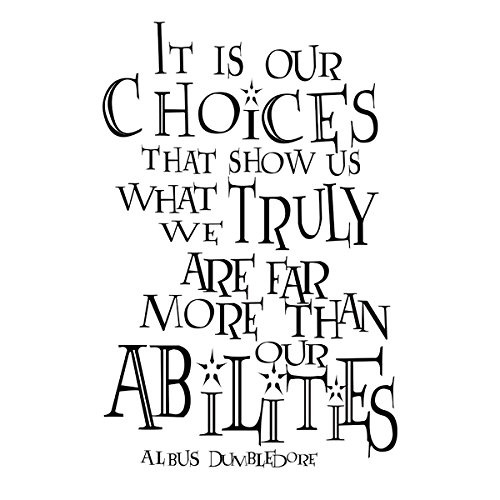
What message should you be leaving Churchill with? I think it’s the words of Albus Dumbledore that say it best: “it is our choices that show us what we truly are, far more than our abilities.”We are all born with different abilities, different predispositions, different advantages and disadvantages in life. But these are not limiting factors. We are not bound by our circumstances.  We can choose to make the most of the situations we find ourselves in, choose to take chances and opportunities when we have them, choose to take on the difficult challenge or the easy option. It is these choices that define us all. I hope that Churchill has provided you with the knowledge and skills to make the best choices, so you can be what you truly are and deserve to be.

Good luck in all you do in the future to the Churchill Leavers of 2016!

A day at the Palace

invite

When an invitation like this arrives, you don’t have to think twice!

On Monday 16th May, I had the incredible privilege of travelling down to London for a special Duke of Edinburgh Gold Award Presentation event in the gardens at Buckingham Palace. What a day!

IMG_0335

Buckingham Palace, May 16th 2016

The sun shone down as Mr Tinker (Churchill Academy’s DofE Manager) and I walked up to – and through! – the famous wrought-iron gates of the Palace. It felt very strange to be on the other side, walking past the famous Coldstream Guards in their sentry boxes and round the side to the gardens. Only official photography was allowed inside the gardens, and we weren’t allowed even to get our phones out. I can understand why, and it did make me experience the whole thing “in the moment” rather than through a screen, but the gardens and the Palace were so spectacular that they were just made for Instagram! It’d’ve been a bit of a giveaway that I’d broken the rules, though, so I was very good and kept my phone well away.

Once we’d arrived in the gardens, all the North Somerset and South Gloucestershire LOs (DofE Licensed Organisations)  were gathered together in a reception group. There were hundreds and hundreds of people there from all over the country, all looking incredibly smart and glamorous. Two separate jazz big bands competed from each end of the field, and two of the biggest marquees I’d ever seen were lined up with tea urns and row upon row of shortbread biscuits. I can safely report they were delicious!

Mr Tinker and I met up with Churchill’s Gold Award winner Amy Hogarth, before exploring the gardens. We were inspecting the Coxless Crew boat that four brave women rowed across the Pacific, when we noticed a group of people coming out of the Palace itself – the celebrity presenters! Each group had their own celebrity, and Mr Tinker and I had a great time spotting famous faces: chef Ainsley Harriott, Strictly’s Anton du Beke, Marcella actress Anna Friel, both the Weasley twins from Harry Potter (James and Oliver Phelps), rugby players James Haskell and Ben Cohen, Dr Christian Jessen from Embarrassing Bodies, musician turned businessman Levi Roots, explorer Levison Wood, Nick Hewer from the Apprentice, goalkeeper David Seaman, athlete Sally Gunnell, and Canadian Astronaut Chris Hadfield to name but a few. See who you can spot!

DofE Presenters

The celebrity presenters posed for a group shot (source)

Our group received presentations from Gail Emms MBE, mixed doubles badminton World Champion, Commonwealth Champion and Olympic Silver medallist. She was really inspiring, talking to the group about having to dig deep and persevere when playing badminton against Chinese athletes in China – where badminton has the same status as football does here! She also talked about inspiration, citing her Mum (herself an England international footballer) as one who got her into sport by beating her again and again on the badminton court until, aged 12, Gail won. And kept winning… Finally, she talked about ambition and setting yourself goals, describing how she used to visualise herself atop the podium with a gold medal round her neck, and used that as the motivation to keep going when training was tough and times were hard. She was really inspiring!

The presentations followed, with the Gold Award winners rightly the focus of the proceedings. However, as it was the Diamond Anniversary of the DofE, we also received a special plaque in recognition of the Academy’s commitment to running the DofE over twenty years as a licensed organisation. We gave the DofE a copy of our logo in return, which will be displayed alongside all the other LO logos in their offices!

IMG_0336

Our Licensed Organisation plaque – on display in reception soon!

Finally, our group was visited by HRH The Countess of Wessex, who spent time chatting to the Gold Award winners and the Licensed Organisation representatives. She was particularly interested in hearing about DofE Diamond Challenges, part of a one-off initiative to mark the 60th Anniversary of DofE which allows people of all ages to take on a DofE inspired challenge and earn a Diamond Pin. The Countess herself had just announced a 445 mile bike ride from Holyrood to Buckingham Palace as part of her own Diamond Challenge.  Mr Tinker has already completed his Diamond Challenge – a triathlon including an open-water swim! I will be taking to my bike in July for a sportive cycling challenge which includes a rather daunting 850ft climb at one point…you can sponsor me here!

It was an amazing day, but above all it was to mark a particularly good cause. The DofE gives young people a structure and framework to contribute to the community through voluntary work, whilst improving skills and developing confidence, commitment, resilience and teamwork. As we were leaving the Palace, Mr Tinker and I were both saying we wished we’d done DofE when we were at school, but we didn’t have the opportunity. To me, school should be all about opportunity – which is why I’m proud to lead an academy which is licensed to deliver the Duke of Edinburgh’s Award Scheme.


The Learning Brain

Our brains are amazing! The average human brain weighs about three pounds, looks like a big grey wrinkly sponge, and generates enough electricity to light a bulb, or even to charge an iPhone.  The brain controls everything from breathing and blinking to our emotions and memories, through firing electrical signals between brain cells – or neurons – across tiny gaps called synapses. We have approximately 100 billion neurons in our brain, all interconnected by synapses. Because each neuron is connected to lots of other neurons, there are approximately 1 quadrillion synapses – that’s 1,000,000,000,000,000 synapses! This is equal to about a half-billion synapses per cubic millimetre. No wonder our brains are so sophisticated!

Despite all that complexity, the video above is a really clear and simple introduction to how our brains work – and how they learn most effectively. There are all sorts of great tips in there to help us all be better learners. Have a watch and see if you can put it into practice!

Assembly: Different

My assembly this week explores the idea that our school is a rich, diverse community, full of unique individuals. We are all different – but our shared values and aims bring us all together. To do this I’ve attempted an acrostic assembly using the word “DIFFERENT” but I’ve played fast and loose with spelling and pronunciation to make it work. Bear with me!

D is for DNA

dna

What makes us different from one another? We all have our own uniqueness coded into our DNA. Our 46 chromosomes in 23 pairs govern our physical appearance, our predispositions to certain conditions, and our raw abilities. These tiny strands packed into the nuclei of every cell in our body make us different.

I is for Eye colour (sort of!)


Change-your-Eye-Color

Our eye colour is one of the features coded into our DNA. Retinal patterns at the back of our eyes are as unique as fingerprints, and on the surface our irises are also unique. Some have brown eyes, some have blue.

FF and E are for a FFamous Experiment

browneyesblueeyes

Jane Elliott, a famous educational researcher and teacher from the USA, conducted the Brown Eyes Blue Eyes experiment . She told a class of primary aged children that research had shown that brown-eyed children were cognitively superior and that they would have extra free time, self-directed learning and more privileges than the other children. Blue-eyed children, she told them, had been found to be inferior and would have no play-time; they would have intensive tuition to catch them up. Elliott’s aim was to simulate the prejudices that had endured in the United States around skin colour; she was prompted to conduct the exercise following the assassination of Martin Luther King. The exercise saw the children react in a variety of ways, and showed that it is not difficult to create division and prejudice if you focus attention on our differences.

R is for civil Rights and anti-Racism

segregation

Segregation by arbitrary differences is a very real part of our history, and we must learn the lessons of past mistakes

Of course, Elliott’s model in simulating this kind of division based on arbitrary physical characteristics was very real. Elliott herself had been inspired by the assassination of Dr Martin Luther King in his struggle against the oppression of black Americans in the Civil Rights movement, and by the oppression of the Jews in Nazi Germany through the Holocaust. Being told that, because someone was different, they were somehow less than you, led to extreme prejudice, hatred and violence which took generations to overcome. Our purpose in working with young people is to  learn to work together with others, no matter how diverse our backgrounds, and to reaffirm the human truth that we are all of equal value.

E is for Equality

equals

Let’s look carefully at the equals sign. Why was this sign chosen to represent “equality” – the notion that what comes before is of the same value as what comes afterwards? Both the bars are the same shape and length, but they are not identical. One is higher than the other. The are similar, but different – they are equal. Equality is not about being the same as everyone else, it is about having the same opportunities and being treated fairly by others.

N is for Now the science bit…

In this Physics experiment, the scientist sets off five metronomes at different tempos and at different times. They tick along in cacophonous chaos, independent of one another. But, when he lifts the plank onto two drinks cans, their momentum is transferred through the base and they synchronise. This shows that we don’t all have to be the same. We can tick along in our own rhythms but, if the circumstances and conditions are right, we can all beat as one. In my assembly I may have used the phrase “if we can balance the plank of our school on the coke cans of equality, we can all tick along together”. It’s important that we work together to make our community inclusive. We don’t want to make everybody the same – we value the differences between us – but we want to make sure that the conditions are right at Churchill so that difference is respected, accepted, and celebrated.

T is for To conclude…

Sophia Bailey-Klugh wrote a beautifully touching letter to President Barack Obama in November 2012 as he stood for re-election.  As the daughter of a gay couple, she thanked him for supporting same-sex marriage. She then asked for advice on how to respond to those who saw such a thing as “gross and weird.”

This slideshow requires JavaScript.

Obama’s tear-jerkingly brilliant reply is worth reproducing here:

Dear Sophia,

Thank you for writing me such a thoughtful letter about your family. Reading it made me proud to be your president and even more hopeful about the future of our nation.

In America, no two families look the same. We celebrate this diversity. And we recognize that whether you have two dads or one mom what matters above all is the love we show one another. You are very fortunate to have two parents who care deeply for you. They are lucky to have such an exceptional daughter in you.

Our differences unite us. You and I are blessed to live in a country where we are born equal no matter what we look like on the outside, where we grow up, or who our parents are. A good rule is to treat others the way you hope they will treat you. Remind your friends at school about this rule if they say something that hurts your feelings.

Thanks again for taking the time to write to me. I’m honored to have your support and inspired by your compassion. I’m sorry I couldn’t make it to dinner, but I’ll be sure to tell Sasha and Malia you say hello.

You can get the text of both letters from the fabulous Letters of Note blog.

I finish on Obama’s wonderful phrase: “even though we are all different, we all have the right to be treated equally. Far from separating us, our differences unite us.”

Get the Prezi here.

How to grow your brain

I’ve been a fan of the Khan Academy for a long time now. The website was set up by Salman “Sal” Khan after he began tutoring his cousin, and has developed into an international organisation with the aim of providing a free, world-class education to anyone, anywhere. There are tutorial videos on a mind-boggling array of topics – great for revision or just for pushing yourself and understanding something new. 

What’s particularly great, though, is the philosophy behind the Khan Academy – You Can Learn Anything. Khan explains: 

Most people are held back not by their innate ability, but by their mindset. They think intelligence is fixed, but it isn’t. Your brain is like a muscle. The more you use it and struggle, the more it grows. New research shows we can take control of our ability to learn. We can all become better learners. We just need to build our brains in the right way.

Khan Academy

Helpfully, the Academy has provided a couple of videos explaining exactly how the brain grows when we learn something new. Here’s the short version: 

And for those with a real appetite for it, here’s the detail: 

Finally, Sal Khan himself met with Carol Dweck to explore the ideas behind a growth mindset approach: 

Remember: if you set your mind to it, you can learn anything. 

Anything is possible


John F Kennedy, September 12th 1962

 
On September 12th 1962, John F Kennedy stood up at Rice Stadium near Houston in Texas and declared his intention to put a man on the moon before the decade was out. I’ve always found this speech inspiring as Kennedy set out the goal without understanding how it was to be achieved. As he said at the time: 

We choose to go to the moon. We choose to go to the moon in this decade and do the other things, not because they are easy, but because they are hard, because that goal will serve to organize and measure the best of our energies and skills, because that challenge is one that we are willing to accept, one we are unwilling to postpone, and one which we intend to win.

John F Kennedy, Rice Stadium, September 12th 1962

I love this kind of ambitious thinking. The kind of thinking that sets the goal and then works out how to do it, or even if it is possible. The kind of thinking that is about challenging yourself to push beyond what others think is possible. Of course, hindsight gives Kennedy’s words even more resonance, as we know that on 20th July 1969 Neil Armstrong stepped down from Apollo 11’s Lunar Module as the first human being to set foot on the surface of another world.  

Neil Armstrong reflected in Buzz Aldrin’s visor on the surface of the moon in 1969


Would we still admire Kennedy’s words if the lunar missions had been unsuccessful? Is it only success that makes the ambition so inspiring? I don’t think so. Setting ourselves ambitious goals and pushing ourselves beyond what we believe be to possible is the only sure way to make progress. Even if we fail, we will have learned much from trying and come so much further than we would have done otherwise. 

Michelangelo didn’t paint the ceiling of the Sistine Chapel beacuse it was easy


Taking the easy option is ultimately unsatisfying. If you get a set a questions to do and you find them all easy and get 100% right, you won’t have learned very much. You will have wasted your time. If you really have to work at it, and it’s so difficult that you make a couple of mistakes, then you’ll have learned something. Taking on hard challenges if how we grow. 

It’s little wonder, then, that Google adopted “moonshot thinking” as part of its Project X approach to developing new products. They’re currently working on self-driving cars and balloon powered Internet. Are these things impossible? I’m sure that even a few years ago to working 3D photographic maps of the whole world were impossible, but we use them every day – and we have them for Mars and the Moon as well. 

Moonshot thinking in action – climbing the “unclimbable” Dawn Wall of El Capitan

 Climbers Kevin Jorgeson and Tommy Caldwell remind us that, if you set your mind to it, anything is possible. Eight years of planning and nineteen days of climbing saw them ascend the Dawn Wall of El Capitan in January 2015 using nothing but their fingers and feet to climb with.

The pair suffered bruising falls, when their grip slipped, and they would bounce off the mountain face. Only their safety ropes saved them from further harm. At one point on the climb, Jorgeson had posted online: “As disappointing as this is, I’m learning new levels of patience, perseverance and desire. I’m not giving up. I will rest. I will try again. I will succeed.”

If you set your mind to it, you can accomplish incredible things – things that we don’t currently believe are possible. What will you achieve? 

What have I learned?

looklistenlearn

At the start of my Headship at the Academy, I told students, staff and families that my mission up until Easter was to look, listen and learn as much about the place as I could so I could make an informed decision about what I needed to keep, grow and change. This has been a fascinating process and I wanted to share it with you!

Students

How did I do it? – I have visited lessons every day since I started at the Academy! I’ve seen lessons in every department and from every year group. I’ve also eaten lunch with the students in each of the kitchens, spent time in all of the house wells, and got down on to the field when the weather permitted us to open it. I’ve met with the House Captains and the Sixth Form Council, and met with several deputations of students who wanted to chat. I’ve taught my own Year 7 class and supported students in the Academy Skills Centre. I’ve been to Breakfast Club, run a detention, and take on Miss Bones and Jens Hullah in an epic rowing challenge. It’s been incredible!

What did they say? – students are overwhelmingly positive about the Academy. They really appreciate the expertise and energy that teachers put into their lessons. They recognise that they are lucky to come to an outstanding school and they want to make the most of every opportunity. Many students speak very highly of the wealth of extra-curricular activities on offer, including the performing arts, sports and outdoor education to name but a few! In lessons I’ve seen students eager to learn, well-organised, focused and well-behaved.

I’ve had a few requests from students to relax some of our rules and regulations. In particular, students wanted me to allow mobile phones in school. I won’t do this – we have very good reasons for not allowing them to be used in school as I explained on this blog in the post Why We Don’t Allow Mobiles In SchoolAlong similar lines, some students wanted to be allowed to listen to music in class – but the research shows that this can undermine learning as I explained in the post Can I listen to music while I work? I revisited this theme for my assembly on Concentration which seemed to go down well!

Students have been very positive about our use of social media to celebrate the work of the Academy. This is in its infancy but we’ve broken 300 followers on Instagram this week (which is nothing compared to the Performing Arts Department’s account which is nearly at 500!)


Staff

How did I do it? – I’ve been meeting with every single member of staff individually. So far I’ve held 106 meetings! I’m looking forward to the rest after the Easter holiday. It’s been great to hear what they’ve had to say and to get their perspectives on the place. I’ve asked them what the best things about working here are, and what they think I should be working on.

What did they say? – When asked what the best thing about Churchill is, almost every single member of staff has said “the students.” Time and again the teachers and the support staff have spoken about how the young people at Churchill are keen to learn, focused on achieving their best, and willing to support the Academy and one another. The warmth and strength of those relationships is a vital part of the Academy’s success – the students love the staff and the staff love the students. I sometimes feel I’m the luckiest Headteacher in the country!

Families

How did I do it? – It seems like a long time ago now, but back in January I held “Meet the Headteacher” evenings to meet with families from each of the Houses. Since then I’ve met families at many of the school events such as the Options Evening, Parents Evenings, West Side Story, the Spring Concert, the Dance Showcase, Dance Their Socks Off, Spelling Bee, Vocabulary Millionnaire final, Young Musician of the Year…it’s been busy! I’ve also been grateful to the parents who have emailed, phoned, written or come in to see me since January, and I have found this especially helpful.

What did they say? – as I explained in the newsletter in February, families are overwhelmingly positive about the work of the Academy. In particular vertical tutoring and the house system, the quality of staff, the ethos and values of the Academy and the performing arts opportunities were singled out for praise. These are all vital parts of what we do at Churchill and it’s my mission to protect them! Families advised us to improve communication, reports to parents, facilities, catering services and extra-curricular provision. These are all things we’re working on. Finally, families wanted us to enforce expectations around uniform, improve the buildings and facilities, develop homework and improve communication and reports to families. I’m on the case…

What now?

bssict

The plan for our new Business Studies and IT block – now approved!

The next step for me is to put in place the plan to take the Academy from its position of considerable strength to the next level of success. The signs are already looking promising: our successful bid for a new building begins the process of improving the quality of the facilities. We are fully subscribed for September with 270 offers of places made at Churchill to Year 6 children and their families. Students are working hard, staff are positive about their prospects, and the sun has shone sufficiently to get the field open at lunch time!

Over the next term we are working on:

  • Care: ensuring the wellbeing of all members of the Academy is prioritised and that appropriate support is provided to those that need it
  • Inspire: planning professional development so that the provision of excellent teaching and learning is the focus for all
  • Challenge: redeveloping assessment, target setting and reporting to make it clearer and more helpful for students, teachers, and families
  • Achieve: ensuring that outcomes are the best that they can be, whilst recognising that achievement is about more than just exam results.

We are also planning for our new building, preparing our new website for launch, and so much more besides! Watch this space…

Assembly: Concentration

This assembly owes much to a presentation on the brain given by Bradley from Inner Drive (@Inner_Drive) at #GrowEx last year, and this excellent TED talk by Peter Doolittle (@pdoopdoo) on working memory shared by Huntington Learning Hub (@HuntingtonLHub). It’s well worth a watch:

The PowerPoint slides are shared at the bottom of this post.

We start with a test of working memory (see the video for this test). I am going to ask you to remember five words just by holding them in your mind. Here are the five words:

  1. Tree
  2. Motorway
  3. Mirror
  4. Saturn
  5. Electrode

Whilst you are remembering those five words, I am going to set you three challenges.

  1. What is 23 x 8?
  2. On your left hand, use your thumb to count your fingers 1, 2, 3, 4, 5, then back again 6, 7, 8, 9, 10.
  3. Now in your head recite the last five letters of the English alphabet backwards.

How many of the five words that I asked you to remember do you still have in your memory? Does anyone still have all five?

The reason why many of you will have forgotten some of the words that I told you only a minute or so ago, is that the capacity of our working memory is limited. It can only hold so much information at any one time. Daniel Willingham provides a simplified model of the brain here:

A simple diagram of the mind (source)

A simple diagram of the mind (source)

In our test, the Environment (me) provided some information which was fed into your working memory. You didn’t do much with that information, and immediately afterwards I distracted you with three more activities which demanded space in your working memory. Little wonder, then, that when I asked you to return to the original information (the five words I asked you to remember), some or all of it had been pushed out of your mind without ever having made it into your long-term memory.

focus-and-concentration

There are some more demonstrations that will help us understand why sustained concentration on the task in hand is important. The first is to do with focus, and multitasking. You might think that you are really good at multitasking, and that you can easily do two, three or more things at once. Where some of those things are automatic – walking and talking, for example – that is probably true. However, your working memory can only focus on one cognitively demanding task at a time. In that way, it’s like focusing a lens – you can only focus on one thing at a time.

You can only focus on one thing at a time

You can only focus on one thing at a time (when in doubt, reach for the cat gifs)

Let’s take this optical illusion as an example. In the picture, the man’s face can be seen looking to the right, or looking straight ahead. See if you can see both!

Looking to the right, or looking straight ahead? Both - but not at the same time.

Looking to the right, or looking straight ahead? Both – but not at the same time.

Now try to see both at the same time. Your brain switches from one to the other – it will only let you hold one interpretation of the picture in your head at one time. This is what happens when you try to multi-task. Your working memory actually switches from one task to the other. This is called context switching, and you may be able to do this quickly (there is some evidence that women are better at it than men), but you are not multitasking. You can’t.

Finally, here’s a demonstration of context switching in action. I need a volunteer from the audience to take this box of multicoloured balls, and arrange them in rows of four in the order of the colours of the rainbow. At the same time, they will be solving some Mental Maths Questions from the KS2 Maths SAT Buster book.

I know this challenge well, because Bradley used me as his volunteer at #GrowEx when conducting the same experiment. Essentially, your brain can either focus on arranging the balls, or on doing the maths – but not both. As I was trying to arrange the balls, I got simple questions wrong. When I thought about the maths, my hands stopped moving. My working memory would not allow me to do both things at the same time. I felt embarrassed, but I shouldn’t have; I was simply demonstrating a human characteristic. Our brains cannot do two cognitively demanding things simultaneously.

Let’s think about how we can apply what we’ve seen today to the classroom. The first thing is that it only takes is a small distraction for information that you have just learned to evaporate. If you are getting to grips with a new concept in your lessons and you then think about the piece of gossip you meant to tell your neighbour, your chances of transferring the new concept to your long term memory are dramatically reduced. Distractions are compelling – it’s very easy to be like Dug from Up: 

Distractions can take your mind off the task at hand

Distractions can take your mind off the task at hand

And don’t kid yourself that you can do two things at once; you can’t. Once you’re distracted, the damage is done.

Put simply:

  1. Concentrate on the task at hand
  2. Focus on the learning
  3. Apply and use what you have learned straight away if you want to stand any chance of remembering it.

And, by the way, 23 x 8 = 184.

Good luck!

Here is the PowerPoint, though the gifs don’t work in this slideshare version. Click on this link for the full version: Concentration.

Concentration phoster