How to revise: techniques that work

loverevision

We love revision…right?

Revision – it really matters. But, with the best will in the world, it’s not the most exciting way to spend your time. The process itself requires you to look back at work you’ve already done – to “re-vision” it – to try and remember it and commit it to memory. There’s nothing “new” in it. But the trick to making it effective is to get your brain working as hard as it can be.

The reason for this is best summed up by cognitive psychologist Daniel Willingham. Willingham says:

Whatever you think about, that’s what you remember. Memory is the residue of thought. 

In other words, you need your brain to really be processing the information you are trying to revise, if you want to stand any chance of remembering it.

What doesn’t work?

There are a few techniques that seem effective – but actually aren’t. These include:

  • Highlighting
  • Re-reading
  • Summarising
highlighting

Highlighting: expectation vs reality

These techniques allow information to pass through your brain without much thinking. Covering pages of A4 with beautifully highlighted patches might make you feel like you’ve achieved something, but it won’t actually help you to remember the information. These are low challenge activities, and therefore low impact

What does work?

Practice Testing

This technique is pretty straightforward – keep testing yourself (or each other) on what you have got to learn.  This technique has been shown to have the highest impact in terms of supporting student learning.  Some ways in which you can do this easily:

  • Create some flashcards, with questions on one side and answers on the other – and keep testing yourself.
  • Work through past exam papers – many can be acquired through exam board websites.
  • Simply quiz each other (or yourself) on key bits of information.
  • Create ‘fill the gap’ exercises for you and a friend to complete.
  • Create multiple choice quizzes for friends to complete.

Distributed Practice
forgetting curve

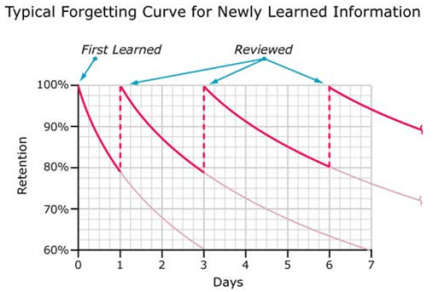
The Ebbinghaus Forgetting Curve – if you revisit newly learned information, you remember more of it

Rather than cramming all of your revision for each subject into one block, it’s better to space it out – from now, through to the exams.  Why is this better?  Bizarrely, because it gives you some forgetting time.  This means that when you come back to it a few weeks later, you will have to think harder, which actually helps you to remember it.  Furthermore, the more frequently you come back to a topic, the better you remember it.

Elaborate Interrogation

One  of the best things that you can do (either to yourself or with a friend) to support your revision is to ask why an idea or concept is true – and then answer that why question.  For example:

  • In science, increasing the temperature can increase the rate of a chemical reaction….why?
  • In geography, the leisure industry in British seaside towns like Porthcawl in South Wales has deteriorated in the last 4 decades….why?
  • In history, the 1929 American stock exchange collapsed.  This supported Hitler’s rise to power….why?

So, rather than just try to learn facts or ideas, ask yourself why they are true.

Self explanation

Rather than looking at different topics from a subject in isolation, try to think about how this new information is related to what you know already.  This is where mind- maps might come in useful – but the process of producing the mind map is probably more useful than the finished product.  So, think about a key central idea (the middle of the mind map) and then how new material, builds on the existing knowledge in the middle.

Alongside this, when you solve a problem e.g. in maths, explain to someone the steps you took to solve the problem.  This can be applied to a whole range of subjects.

Interleaved revision

When you are revising a subject, the temptation is to do it in ‘blocks’ of topics.  Like this:

revisionblocked

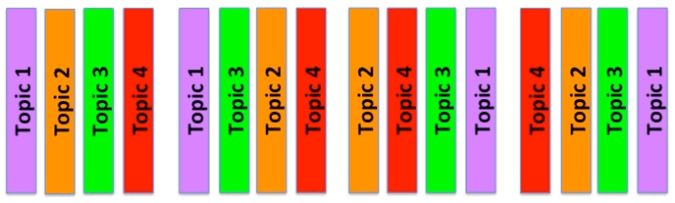
The problem with this is, is that it doesn’t support the importance of repetition – which is so important to learning (see distributed practice above!)  So rather than revising in ‘topic blocks’ it’s better to chunk these topics up in your revision programme and interleave them:
revisioninterleaved

This means that you keep coming back to the topics.  So, instead of doing a one hour block of revision on topic 1, do 15 minutes on topic 1, then 15 minutes on topic 2, then the same for topic 3 and 4. The next day, do the same. On day three – just to spice it up and stop your brain getting into a rut – mix up the topics!

Have a break

Your brain can only work effectively for so long. Scientists differ on this – some say our attention span is around 20 minutes, whilst others say we can work for longer. My advice is to revise in blocks of around 45 minutes, giving yourself a 15 minute break in each hour to recharge. Make sure you get some fresh air, relax and switch off. You don’t want to underachieve because you haven’t done enough revision – but equally, you need to stay healthy and happy if you’re going to do your best, so don’t overdo it!

Resources

There are lots of resources out there to help you revise. Here are just a few:

Good luck!


With thanks to Shaun Allison for the inspiration  and some of the images for this blog. Read Shaun’s original post here.

Can I listen to music while I work?

This week I met Lara, Holly and Melissa, three students in Year 8 who wanted me to let them listen to music whilst they revised for their exams. They wrote me a very polite letter, and they’d even discussed it with their classmates to gather a petition. They felt that listening to music when they were working helped them relax, focus, and shut out distractions. So, they asked, would I relax the rules and let them have their headphones in?

640px-earpods_derecho

Will listening to music help us concentrate?

There’s been some quite interesting research in this area. Scientists have studied how listening to music can change our performance in different types of tasks. Under some conditions, music actually improves our performance, while in other situations music makes it worse.

One study from America looked at how listening to music had an impact on surgeons’ performance in the operating theatre. This study found that listening to music made them more relaxed and they performed with more accuracy, especially if it was music they liked.

Another study, by British researcher Nick Perham, found that playing music you like can lift your mood and increase your motivation — if you listen to it before getting down to work. But it serves as a distraction from cognitively demanding tasks like learning new material or trying to memorise information.

This is a very important distinction. Surgeons in operating theatres are performing operations that they have practised many times before, and therefore they are performing things they have already learned. It’s the same principle as the research that found that music can make rote or routine tasks (like folding laundry or filing papers) less boring and more enjoyable. Runners who listen to music go faster. Music can lift us when we’re doing things that don’t require us to think too hard about them, or things that we have practised many times before.

musical-notes

Listening to music interferes with concentration when we’re trying to read or retain information, and makes us less effective learners

That’s not what lessons and revision are about however. Learning is what Nick Perham would call a “cognitively demanding task.” In one of his more recent studies, Perham says, he found that reading while listening to music, especially music with lyrics, impairs comprehension.

“You’ve got…information that you’re trying to use when you’re reading a book, and you’ve got…information from the lyrics,” Perham says. “If you can understand the lyrics, it doesn’t matter whether you like it or not, it will impair your performance of reading comprehension.”

What basically happens is that your brain will switch between the music and what you’re trying to learn or revise, and that switching distracts you from the learning process. If you’re going to be an effective learner, your brain needs to focus fully on what you are trying to learn. No distractions.

So, sorry Lara, Holly, Melissa and friends: the rule stays! If you’re learning or revising – turn the music off.

Links:

Why “I can’t do it” won’t do

Edison

Thomas Edison, inventor of the phonograph, motion picture camera, and the light bulb – he knew a thing or two about persistence (image source)

What are the biggest barriers to learning? Of course, there are many difficulties and problems which face us all when we are learning something new. We may not have the resources available; we might not have the right environment in which to learn; we might not have the skills or prior knowledge we need to grasp the concept. However, I think the biggest barrier to learning is our own attitude – the tendency to give up when it gets difficult, to throw up our hands and say “I can’t do it!”

I remember interviewing a student (let’s call her Emma*)  for a place in the sixth form a few years ago. Her mum was with her and she was really struggling in Maths. “I can’t do Maths,” she said. Her mum turned to her and said, “don’t worry, I can’t do Maths either.” Needless to say, Emma didn’t get the grade she needed in Maths to get into the sixth form. I’m sure her mum was trying to help, to offer some comfort to her daughter who was struggling with some difficult concepts. But the notion that not being able to do Maths is somehow okay gave Emma permission to believe that she genuinely couldn’t do Maths – and this wasn’t the case. Anyone can do Maths. Everyone can do Maths. But you need to work at it, and you need to believe you can do it.

Imagine for a moment if Emma had been struggling with reading. Would her mum have turned to her with the same comfort? “Don’t worry, I can’t read either.” This just wouldn’t happen, and we need to have the same attitude to all our learning.
voice-paint3

Luckily, there is a solution – and it’s one simple word. That word is YET. Adding the word “yet” to  the end of a “giving up” phrase is a simple way of reminding us that learning is a process.

  • I can’t do it…YET
  • I don’t understand it…YET
  • I’m no good at painting…YET
  • I tried question 4 and I couldn’t do it…YET
  • I’m not a Maths person…YET

The only way we can guarantee failure is if we give up. Until then, everything we’re doing is learning. What “YET” does is it says that this is a skill which is acquired over time. It’s not something you’re necessarily going to get instantly. There’s a learning curve, and to be successful we need to stay on that curve.

Even Sesame Street have tuned into the power of YET with a catchy tune from Janelle Monae. Enjoy…

You didn’t do it right now, but keep trying, you’ll learn how

You just didn’t get it yet, but you’ll get it soon I bet

That’s the power of yet. 

*Names have been changed.

West Side Story: Headteacher’s Review

WSS_Fullcomp
What a show! West Side Story ran for three nights and a matinée from 10th-12th February at The Playhouse, Weston-Super-Mare. I’ve been involved in school productions since the age of 12 and I’ve never seen anything so ambitious and so impressive. It’s not every school that puts on their show in a professional theatre, and we’re very grateful to The Playhouse for their hospitality and expertise. The facilities and the surroundings certainly added to the experience for the audience and the students lived up to the expectations, raising their game to professional standards. 

IMG_6827

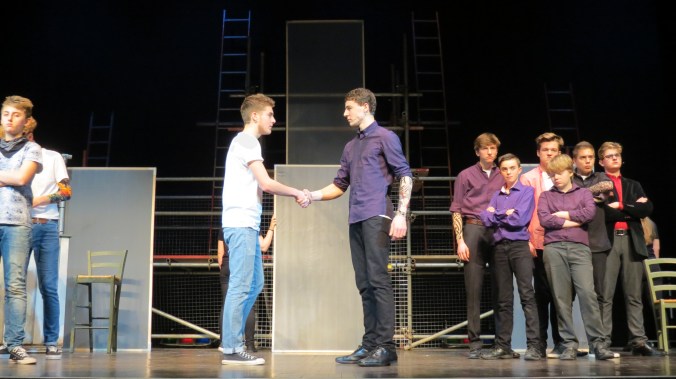
Griff and Bernardo square up


Every aspect from the costumes to the choreography, the production design to the performances, the band to the backstage crew was first-rate. The whole cast and crew meshed together in perfect sync, with the dynamic set changes smoothly managed and entrances and exits sharp, crisp and timed to perfection. Once on stage characters were clearly defined – not just from the leads. The Sharks sashayed with Latin passion, the Jets dripped with urban cool, and within the gangs it was clear to see careful and subtle characterisation. The leads, though, were truly outstanding. I saw the show on the Friday when Adam Caulfield as Riff and Michael Nickells as Bernardo seethed and glowered at one another with all the menace and threat of young men who could not – would not – back down. The tension created between these two young men, on the verge of adulthood but still with the naïvety of youth, was wonderfully counterpointed by George Davis as Tony and the Anna Lalande as Maria. George showed from his first appearance that he had outgrown the petty squabbles of the street gangs, and tackled the vocally demanding solos and duets with great assurance. Opposite him, Anna Lalande was sublime – her voice filled the auditorium and captivated everyone. I was particularly impressed by Jodie McKitterick as Anita, who managed the transition from live wire joker to broken victim with real skill. 

IMG_6722

Tony and Maria meet


Of course, it was a production with two casts, and my sources from the Thursday night performance assure me that the other performers were just as impressive. Dr Wratten wrote of the second cast: 

“they not only did their own bits brilliantly but always acted as a team. Of course, some individuals shone – the challenge of the on-going aggro and fight scenes between the boys was always compelling and strongly led by Adam, Dawid, Jasper, Jake and Christian; the sheer Latin vitality of the Sharks’ ladies was brilliant, especially Nina, Ruby, Jess, Jasmine and Rosie. But the principals shone very brightly – the duets between Edward and Molly and Molly and Lucy were well beyond their years. The almost final, haunting piece between Maria and Anita would have brought the house down if everyone wasn’t silently weeping.”

IMG_6855

Dancers in action


The dances were no less impressive. In her programme notes, Miss Lippe commented on the joy of working with male performers with little or no previous dance training – if it wasn’t for that note, I would never have known. The commitment, timing and energy of the dance from the very first number was astonishing. Particularly moving were the interpretations of Somewhere in the second half, where imagination of what was possible gave way, horrifyingly, to what was likely.

My final word goes to the incredible twenty-three piece orchestra, which delivered Leonard Bernstein’s complex and challenging score with huge energy and sensitivity. Working tirelessly to support the performances on stage, the applause for the musicians was justifiably rapturous at the final curtain call. 

What a show indeed. Thanks to all the staff, students, friends and family who made the production possible. Everyone involved – including the audience – has memories to treasure for a lifetime.

IMG_6671

The Jets

In Production


WSS_Fullcomp

The cast of West Side Story 2016

This week Churchill has been buzzing with the excitement of West Side Story being performed at The Playhouse in Weston-Super-Mare. Well over a hundred students and staff are involved in this enormous production, which has been over a year in the making and is the culmination of countless hours of hard work, dedication and effort. Is it worth it? You bet!

Programmes

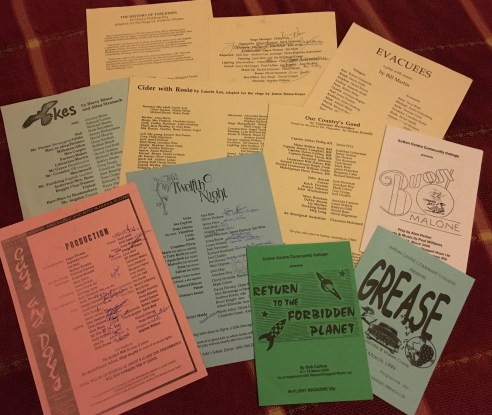
Programmes from some of the shows I’ve done…I got some of them signed in case the cast went on to be famous!

I know first hand what it means to be involved in a school production. My history with them goes right back to being second innkeeper in my primary nativity! However, it wasn’t until secondary school that I got fully involved with drama, working behind the scenes on lighting for many of our plays including Guys and Dolls, Our Country’s Good, Cider with Rosie, Animal Farm and Evacuees. The highlight for me was definitely the production of Twelfth Night we put on when I was in Year 13. It was a beautiful production and it felt like an incredible team effort!

I carried on my drama work throughout university and into my career as a teacher. I was in the band for Bugsy Malone and (my favourite show!) Return to the Forbidden Planet at my first school, and even made an appearance as Johnny Casino in our production of Grease! I ended up directing or co-directing productions later on in my career, including a heady spell of co-writing plays for our school to put on with the Head of Drama. We adapted the story of Faust in a production called “Tina”, and A Midsummer Night’s Dream became Fairylandatopia, before I returned to the Forbidden Planet for my final stint as director (in a production starring the now famous Jack Howard as Captain Tempest…but I didn’t get him to sign a programme!)

programme

The programme for West Side Story

Why do we do it? Let me count the ways! Clearly there’s the opportunity to learn such a range of skills in the performing and expressive arts area – performance is the ultimate aim. Acting, playing, singing, dancing, choreographing, directing and conducting all go into the show, alongside lighting, sound, costume, make up, set and production design and construction, stage management, marketing…the list is endless. The chance for young people to learn and practise these skills in a “live” context is invaluable.

Above all, though, it’s the connections that the production makes which mean it’s integral to the school’s calendar. The fact that so many staff and students need to work together as a single team towards a single goal galvanises the whole community, and shows that together we are so much more than the sum of our parts.

I know what it takes to put a production – the sleepless nights, the exhaustion, that bad rehearsal where everything goes wrong and you wonder if it’s ever going to work…but it always does. And when the audience is laughing or gasping or gripped in collective silence by the action on the stage, when they applaud and you just can’t stop smiling with pride – that’s when it’s worth it.

This slideshow requires JavaScript.

Well done to everybody involved in West Side Story – I can’t wait for the next one!


Why we don’t allow mobiles in school

First things first – I love my phone. I use it all the time. Lots of the stuff I use it for is practical: it’s an alarm clock to get me up in the morning; it’s a newspaper to read; it’s a weather forecaster to prepare me for the day; it’s my diary so I know what I’m supposed to be doing, when; it’s my satnav to get me to the places I need to be. But I’d be kidding myself if I didn’t acknowledge that it’s also a huge productivity vacuum: social media is lurking on my home screen with those tempting notification bubbles and there’s a little folder called “games” which tempts me away from what I should be doing with a little voice saying “just one more go…” You don’t get three stars on every level of Angry Birds overnight. I know if I want to get any work done, I put my phone on “Do Not Disturb”. And silent. In a different room.

Angry Birds

Three stars on every level. A sad indictment.

And this a major issue. Whilst a mobile device is an incredible piece of technology, and has the capability to assist and develop learning in and beyond the classroom, the distraction factor far outweighs the benefit. And this isn’t just my opinion. A large scale study by the Centre for Economic Performance at the London School of Economics found schools that banned mobiles enjoyed a boost in the proportion of pupils getting five good passes at GCSE, compared with schools that allowed pupils to keep their phones. Richard Murphy, one of the co-authors of the paper, said that the distraction and low-level disruption caused by pupils having mobile phones in school appeared to be behind the results. He said “a strict ban on mobile phones does seem to be effective in improving student tests scores, especially those that a school might be concerned about, because it ups the number of students getting five good GCSEs.”

If we want students to learn, we have to ensure that they focus on the task in hand: learning. “There is plenty of solid evidence which shows that in order to learn, we have to pay attention. Again and again, research shows that when people are distracted or when they start multitasking, they don’t do as well as when they are able to concentrate fully on one task,” said Daisy Christodoulou, director of research at Ark Schools.

Another reason is one of dependency. There is a growing body of evidence that smartphones are addictive. A recent University of Derby study found that smartphone use caused distraction from employment, hobbies and studies, could increase narcissism and cause “real life” communication skills to suffer. As a school, we need to help young people develop exactly those “real life” communication skills; a day in school should be time away from the demanding electronic screens in our pockets. Essena O’Neil’s public disconnection from social media is just one example of how the pressure of life online can impact on mental health. One school in London even ran an experiment called Project Disconnect where students lived without their technology for a week. They reported feeling happier, reading more, and interacting more effectively. You can see their video below:

Finally, there’s the safeguarding issue. Over our wireless network we know that internet access is safe, monitored and filtered. But if students had phones – even if only at social times – access to 3G and 4G networks means that access to inappropriate material would be out of our control, as would the ability to take and share photographs and videos without consent or knowledge. Whilst the vast majority of our students, I’m sure, use technology responsibly, the risk to safeguarding would be significant. Besides, I’d far rather see groups of students smiling, laughing and talking to one another face to face at social times than sat around tables looking down, their faces bathed in the artificial glow of an iPhone screen.

Of course, we also have a duty to develop students’ expertise in using digital technologies and our curriculum does exactly that. But the learning comes first. Where technology is essential, or where it will enhance and improve the learning experience, we will invest in it, use it and explore it. But we must weigh up the benefits of new technologies against the potential drawbacks it might have, and in most cases there is usually a way to achieve the learning objective without a classroom of smartphones.

So this is why we don’t allow phones in school. I appreciate the irony of writing about this on a blog, and you’re probably reading on your phone right now. But I’d urge you – after you’ve followed us on Twitter, liked us on Facebook, and subscribed to our email mailing list – to switch it off, put it away, and spend some quality time IRL.

The power of music

Many people have written about the power of music to move us. For example, George Eliot wrote “there is no feeling that does not find relief in music”, whilst Martin Luther is reputed to have said “my heart, which is so full to overflowing, has often been so laced and refreshed by music when sick and weary.” My personal Headteacher hero, Albus Dumbledore, reflecting on a performance of the Hogwarts school song, was moved to tears in Harry Potter and the Philosopher’s Stone: “Ah, music,” he said, wiping his eyes, “A magic beyond all which we do here!

Lucy, Joe and Reuben at the Christmas Concert

At the Churchill Music! Young Musician of the Year competition at St John’s Church on Monday evening, I was moved beyond measure by the performances I heard. At the event, I shared my thoughts about the power of music in other ways. Firstly, playing a musical instrument actually improves your brain. A recent study by Nina Kraus of Northwestern University in America, for example, showed that “music training changes the course of adolescent brain development” leading to significant gains in literacy. The theory is that in learning an instrument, you are training your brain to hear subtle differences in sound, which reinforces and strengthens your ability to process language. An earlier study from Harvard University showed the “links between musical training and enhanced cognitive skills” – in particular the executive functions of our brain’s frontal lobe which “allow for planned, controlled behaviour” according to the study’s author, Nadine Gaab. There is a wealth of research that shows that learning and playing a musical instrument has a raft of benefits for brain function, learning and intelligence.

Another benefit to playing a musical instrument is that it teaches us the power of collaboration. Of course, we can sing and play alone, and solos can be hugely powerful, but music is meant to be shared. Even a soloist is usually accompanied, and anyone who has sung in a choir or played in a band or orchestra will tell you that the shared experience of making music together is unrivalled. The discipline of listening to one another, adjusting what you are doing to match those around you, shifting your own performance to contribute to the whole, teaches us so much about selflessness and teamwork, and how we are so much more together than the sum or our parts.

D32A1023

Playing together unleashes the power of music

The other great bonus to playing an instrument is the practice. I’m not sure if the performers will agree as they attempt three octaves of a C# minor arpeggio for the tenth time, but to get good – really good – at a musical instrument takes hours and hours of practice, day after day, week after week. The famous concert pianist Artur Rubenstein said “don’t tell me how talented you are; tell me how hard you work.” This was his way of articulating Stephen King’s notion that “the difference between a talented individual and a successful one is a lot of hard work.” The work ethic of learning a music instrument teaches discipline, dedication and determination which transfer to all other aspects of your life. It takes a lot of all three to get through those early, squeaky, scratchy stages to the bit where it starts to sound like music!

D32A0974

Practice makes perfect

Finally, and perhaps most importantly, making music teaches you to feel. The wonder of a performance is that it brings the wood and metal of the instruments, and the space of the venue to life in an experience that only that audience and that performer will ever share. Musicians interpret dots and lines on a page, often written down hundreds of years ago in countries far from our own, and channel the emotions that those composers felt though themselves in a way which is unique, and all the more powerful for it.

In St John’s Church on Monday I was struck by the skill with which these talented young people were able to make an emotional connection through their instruments to the audience, transporting them through centuries and over miles to different places, different times. It was a privilege to be there and a lesson to us all to pick up an instrument and stick with it. It’s worth it.

The power of praise

I’ve really enjoyed meeting parents and families of students at the Academy over the past fortnight, and it’s been great to get such positive feedback about the work we do. It’s a real privilege to work with such an engaged, interested support from home and it makes all the difference!

One thing that I shared at the “Meet the Headteacher” evenings was a summary of a study completed by Carol Dweck, Professor of Psychology at Stanford University, into the impact of praise on children. She had a theory that the type of praise you gave a child had a big impact on their achievement. The study is summarized in this video from the United States:

In the study, Dweck gave students an IQ test and praised the students in two ways. The first group was praised for their intelligence: “well done, you must be really smart at this.” The second group was praised for their effort: “well done, you must have worked really hard at this.” What she found was remarkable. The students who were praised for their intelligence were less likely to take on a more challenging test afterwards, more likely to lie about their scores, more likely to give up easily, and actually ended up doing worse on a final IQ test. In contrast, the group who were praised for their effort were much more likely to take on a more challenging task, less likely to give up, and ended up improving their scores on the final test. Why should this be?

Dweck’s theory is that praise for intelligence can create what she calls a “fixed mindset” where learners create an image of themselves – I am really smart at this. This self-image works against learning because the students don’t want to jeopardise that image, the thing that has gained them praise, because they perceive that it is the thing that adults value about them. Therefore they are less likely to push themselves to a more challenging task because, if they fail, they will no longer be “really smart at this” and therefore they will be a failure. 

Contrast this with the group praised for their effort. Dweck’s theory suggests that this type of praise can create a “growth mindset” where learners see that effort is what is valued by the adults – their strategies, approaches and attitudes – rather than the outcome. Therefore taking on a difficult task is more likely to get them praise because they will need to try hard. If they fail, they will have failed the task, but they will not be a failure, because they will still have done what got them the praise in the first place – tried hard.

It’s a really thought-provoking study! How often have I said to my own children, either at home or in my classrooms, “you’re so brilliant at this!” or “you’re so clever!” Have I actually been undermining them in my attempts to build them up? I want them to take on difficult challenges, to persevere, and not to be put off when things get difficult. That’s why, now, I’m very careful to praise the strategies and the effort that I see – the process – rather than the person. By ensuring that students understand that it was their approach and their attitude that made them successful, rather than some innate quality that is part of them, it means that they can transfer that approach and attitude to other situations and be successful there, too. Why not try it?

Growth vs Fixed Mindsets

You can learn anything

In my introductory assemblies with students I have begun to explain what I believe about learning. Much of what I believe is summed up in this video from the Khan Academy:

What I like about this video is that it reminds us about the learning process: “nobody’s born smart; we all start at zero.” It can be off-putting to see experts who find what we are beginning to learn easy, but they were once beginners too – “there was a time when Einstein couldn’t count to ten, and Shakespeare had to learn his A, B, Cs just like the rest of us.” When we are struggling with a concept, a new idea or a skill that we are finding challenging, it can be comforting to remember that others – who find it easy now – struggled when they were first starting out. Struggling, finding it difficult, and having to try really hard are all signs that we are learning. If we don’t have to struggle, chances are we already knew how to do it.

The other thing I really like about this video is the way that it emphasises how important the attitude of the learner is. If a learner is put off by difficulties and mistakes, or gives up if they don’t understand things straight away, they will not succeed. However, a learner who understands that mistakes, difficulties and struggles are helpful in the learning process is more likely to grow: “each wrong answer [is] making your brain a little bit stronger. Failing is just another word for growing, and you keep going. This is learning, knowing that you’ll get it even if you haven’t got it yet.” The truth is, you only fail when you’ve given up. Until then, everything is learning.

Young boy reading book in a ruined bookshop in London devastated by an air raid - 1940

You’ve only fail when you’ve given up. Until then, everything is learning.

The final reason that this video resonates with me is that lightbulb moment: “one day, you walk.” For a teacher, watching the moment when a student gets it is what makes the job worthwhile. And the most important thing is that the learning process is completed by the learner themselves. It’s our job as teachers to create the right conditions for learning – the resources, the culture, the climate – but it’s the students who do the work. When a learner puts the effort in, struggles, fails, keeps going, tries again, tries a different way, then stops, thinks…and it clicks…that’s the moment we teach for.

For students at Churchill Academy, having the right attitude to learning is vital. We expect students to make mistakes, to get things wrong, and to find it hard – that’s the sign that they’re learning. The mark of a successful learner is one who keeps going, keeps trying, keeps putting the effort in until they’ve got it. I’ve seen evidence of this across the Academy again and again this week, and long may it continue.

Meet the Headteacher evenings

All families should have received an invitation to my “Meet the Headteacher” evenings which start this week. I am holding these events to introduce myself to you in person, so you can find out a bit more about me, what I stand for and my plans for the Academy going forward. I am also very interested to hear the views of families about the current strengths and areas for development for the Academy, and ideas about our future priorities. The evenings take place as follows:

  • Wednesday 13th January: Hanover
  • Thursday 14th January: Stuart
  • Wednesday 20th January: Tudor
  • Thursday 21st January: Windsor
  • Sixth Form parents – any of the above evenings (please let us know which one!)

Each meeting will begin at 6pm in the Hall. There will be a presentation from me of about half an hour, followed by an opportunity to feedback your views and for more informal discussions to take place. Please reply to the email invitation if you are planning to attend, so we have an idea of numbers. If you wish to attend a different evening to the one allocated to your House, please let us know. I look forward to meeting you.