Assembly: Curiosity

We began the year focusing on our value of kindness, before turning our attention to determination to see us through the dark, cold winter. Last week’s assemblies, as the days lengthen into spring, focused on our value of Curiosity.
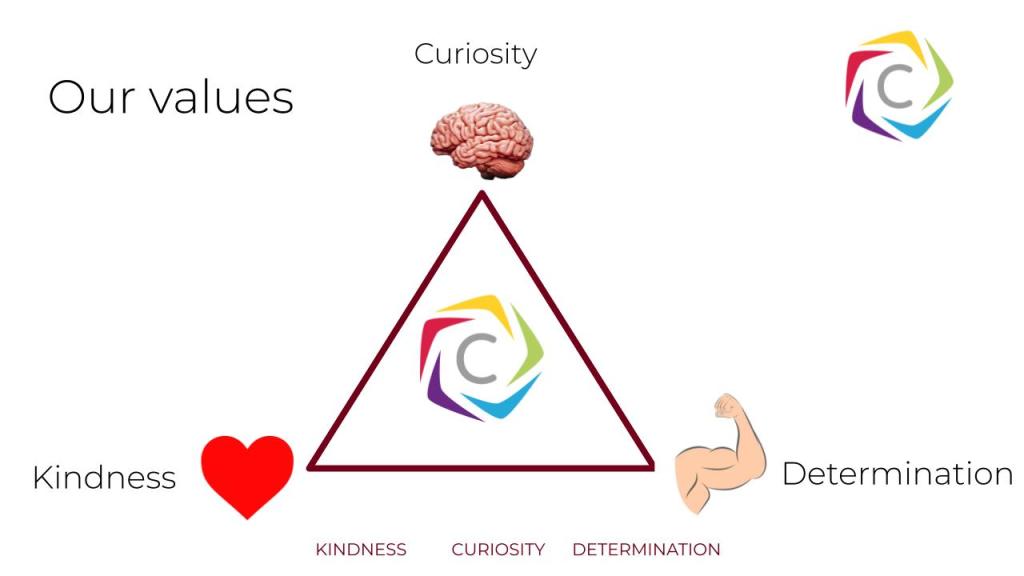
Our three values form three points on a character triangle, based on the work of CharacterLab. Kindness is a strength of the heart; curiosity a strength of the mind; determination a strength of the will. All three work together to support our students to be successful in school, and beyond, in pursuit of Martin Luther King’s maxim: “intelligence plus character – that is the goal of true education.”

Curiosity enables independent thinking and enquiry, and is the basis of human flourishing. Stone age man was driven by curiosity: what happens if I bang these two rocks together? Can I use this animal skin to store water, so I can travel further from the lake? And so on, generation after generation, we have built on the discoveries of our predecessors in a way which is unique to our species. And we are never satisfied, continuing to push the boundaries of what we know, to solve mysteries, to understand more about the world around us and the universe beyond.

It was this curiosity that led Einstein to develop his general theory of relativity – his attempt to explain how and why the universe behaves as it does. He was driven by a passionate desire to understand, to explain, to make sense of things. It is this uniquely human desire that we seek to foster in school.

This desire for discovery continues to this day, with the Curiosity Rover on Mars and recent landings on the moon. We continue to strive to know more, to understand more, to answer questions, to solve problems – and there is always more to learn.

A dopamine molecule

Curiosity has many benefits:

  • Good for our brains and aids memory: the more we learn, the better our brain gets at learning. This is because our broader general knowledge gives us more “anchor points” for new knowledge to hook onto, to connect with, and to secure itself in our memories.
  • Helps us to be empathetic: understanding people who are different to us is essential to help us collaborate and cooperate with one another, to develop our empathy, and to improve our communities.
  • Increases confidence: the more we understand about the world, the more confident we feel within it. We feel most insecure when we are uncertain, when we don’t know what is happening or why, or when we don’t understand things. The more we know, the more confident we feel.
  • Contributes to happiness: when we learn something new, solve a problem, or something slots into place in our mind – that “lightbulb” moment – we feel a little rush of satisfaction. That is the release of dopamine into our system, a chemical designed to reinforce achievements by making us feel happy. So satisfying our curiosity actually makes us happier!

In my assembly, I went through all the ways we can satisfy our curiosity and extend our learning. The first – and most important – is through reading. Reading much, and reading widely, is how humanity has broadened and extended its knowledge over millennia. Using the library to ensure that we are reading books that we are interested in, and which take us beyond what we already know, is a guaranteed way to help us learn!

We are fortunate also to live in the age of the internet, where all the world’s knowledge is at our fingertips. Satisfying our curiosity has never been easier: we can ask Siri, ask Alexa, ask Google, ask ChatGPT. But we must be careful when using these sources, and always be curious about the answers we get back. Information we get online needs to be verified, as its accuracy cannot always be trusted. And AI, whilst it is useful, is subject to similar cautions: the answers we get from AI are only as good as the questions we ask, and the sources that the AI relies on. So there is no substitute for our human curiosity – we mustn’t become lazy, and let the machines think for us.

I concluded with three ways our students can show curiosity in the classroom and beyond:

  • Enquire: Ask questions – “why” and “how” – and actively listen to the answers
  • Explore: read around the subject – find out more
  • Experience: Seek out new experiences, people and challenges

Keeping an open mind allows us, the inheritors of the benefits of millennia of human curiosity, to continue mankind’s constant journey to know and understand more – and to contribute to human progress. What a privilege learning is!
AI and ChatGPT: friend or foe?

The world of education is evolving at an unprecedented pace, and technology is playing a significant role in shaping the learning landscape. In recent years, the integration of artificial intelligence (AI) and ChatGPT, powered by OpenAI’s advanced language model, has become a topic of interest in English secondary schools. These innovations have the potential to greatly benefit students, but it is also essential for us to understand both their usefulness and the potential pitfalls. In this blog post, we’ll explore how AI and ChatGPT can be useful tools for students while highlighting some crucial warnings about their appropriate use, especially in terms of plagiarism.

The Advantages of AI and ChatGPT

  1. Personalized Learning: AI-powered educational tools can adapt to students’ individual needs, offering tailored learning experiences. ChatGPT can provide instant feedback and explanations to help students grasp complex concepts, making it an excellent resource for homework and assignments. For example, if you are struggling to understand or remember a concept or idea, asking ChatGPT to explain it may help jog your memory.
  2. Enhancing Creativity: ChatGPT can assist students in brainstorming ideas, refining their writing skills, and generating creative content. It can be a valuable companion for assignments and projects by suggesting starting points, topics for exploration, or other ideas.
  3. Access to Information: ChatGPT provides students with a vast amount of information at their fingertips. It can help students with research, giving them access to a wide range of sources and references to enrich their understanding of various topics.

Warnings and Risks

While AI and ChatGPT offer numerous advantages, they should be used judiciously, and parents and students need to be aware of the potential pitfalls:

  1. Plagiarism: One of the most significant concerns is the risk of plagiarism. ChatGPT can generate text quickly, but it’s essential for students to understand that simply copying and pasting the AI-generated content into their assignments is not acceptable. Parents should emphasize the importance of original work and proper citation. Work generated by AI is not the student’s own and attempting to pass it off as such could result in disqualification from examination courses.
  2. Overreliance: While AI can be a valuable resource, students should not become overly reliant on it. They need to develop critical thinking and problem-solving skills on their own. Encourage your child to use AI as a supplementary tool rather than a crutch.
  3. Accuracy and Credibility: Not all information available through AI is accurate or credible. Parents should teach their children to critically evaluate the sources and information provided by AI, just as they would with any other research method.
  4. Privacy and Safety: Parents should be aware of privacy and safety concerns. It’s essential to ensure that children are using AI tools in a secure and responsible manner. Discuss online safety practices, including not sharing personal information.
  5. Ethical Use: AI can sometimes generate content that may be inappropriate or offensive. Parents should educate their children about ethical behaviour and discourage any harmful use of AI.

Conclusion

AI and ChatGPT are valuable tools that can enhance the learning experience for students in English secondary schools. However, they must be used responsibly, with a focus on promoting creativity, critical thinking, and originality. Parents play a crucial role in guiding their children’s use of AI and helping them avoid pitfalls like plagiarism and overreliance. By understanding the advantages and limitations of AI in education, parents can support their children in harnessing the power of technology for their academic growth.

The blog post was written with help from ChatGPT3.5.

Kindness, Curiosity and Determination

It has been great to welcome the students back to term 6. It’s always a term of transition; with our Year 11 and 13 students off on study leave, the Academy feels a bit emptier. The tutor groups are missing their year elevens, so our year tens are now the senior main school students. The applications for the new house captains are coming in, and everyone is getting ready to welcome our new Year 7 and 12 students on the induction days coming up soon.

In my “welcome back” assemblies this week, I started with a bit of housekeeping. The Site Team and our contractors have been busy over the half term break: putting in replacement fencing, repainting classrooms and toilet areas, relocating one of our food pods, replacing windows, and making sure that everything is looking great for the students’ return. I thanked the students for their much improved use of the facilities, and urged them to ensure that they continue to look after them. There was also an opportunity for reminders about our classroom and social time expectations – and I never miss an opportunity for those!

My assembly this week focused mainly on our three Academy values: kindness, curiosity and determination. As I said in my end-of-term-5 Headteacher’s Update letter, over recent weeks I have been working with our governors on a review of our strategic planning and direction. This has taken us right back to the Academy’s vision, purpose and values, as we have reaffirmed our commitment to being a school in which we inspire and enable young people to make a positive difference, and to set no limits on what we can achieve. All of this work is underpinned by our three values.

This quotation, from aviator Amelia Earhart, guides our thinking about kindness. Kindness adds value because its impact is cumulative: the kinder we are, the kinder others become. The idea of “paying it forward” to create a positive community culture is a key part of this value.

When we first introduced our values, the students articulated what they meant for our behaviour in and around the Academy. Their description of kindness, cited above, captures that key element of our Academy community. It also underlines the fact that we all have a responsibility to that community – a responsibility to keep it healthy by maintaining the values which lie at its heart.

Curiosity is a strength of the mind. The quotation from Plutarch in the slide above emphasises the importance of taking an active role in learning, in seeking out new knowledge and skills: you can’t just wait for knowledge to come to you. You have to go out and get it. We can teach you: but only you can learn.

The students captured this spirit of curiosity in their values statement, which informs our approach to learning, which expects:

  • Determined and consistent effort
  • A hunger to learn new things
  • Challenging ourselves to go beyond what is comfortable
  • Viewing setbacks and mistakes as opportunities to learn and grow
  • Seeking and responding to feedback
  • Encouraging others to succeed

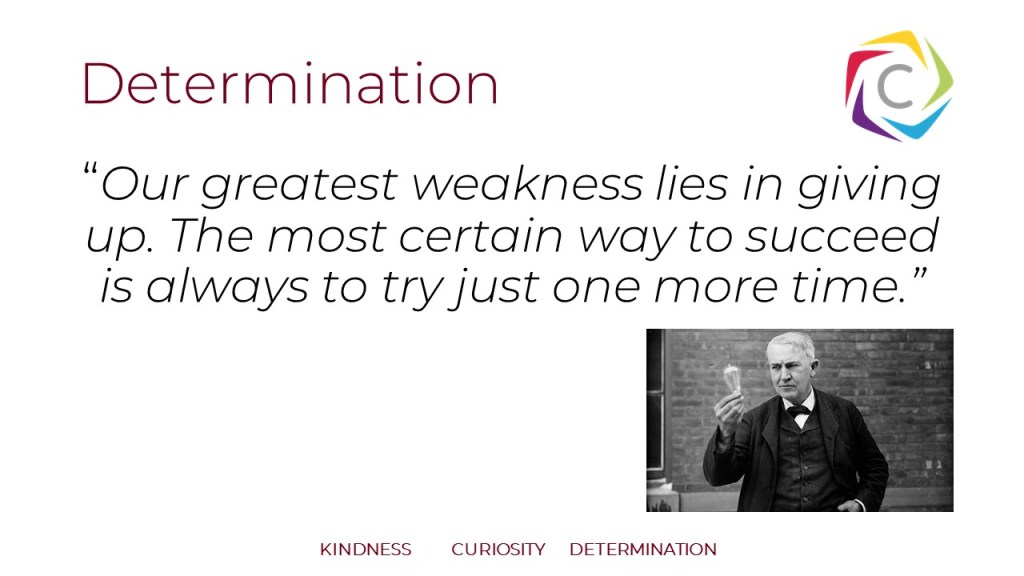
Determination is summed up in this quotation from inventor Thomas Edison, who achieved so much through constant trial and error, refinement and development, prototype after prototype. I have found Edison’s words of huge value to me in my own professional career as an adult: we all face challenges and struggles. If we give up, we are certain to fail. The only way to succeed is to keep trying.

These values form three sides of a character triangle: kindness, a strength of the heart; curiosity, a strength of the mind; determination, a strength of the will. Churchill students, who show all three values, will be well equipped to go out into the world and make a positive difference, setting no limits on what they can achieve.

I concluded the assembly with all the things we have to look forward to over the course of the rest of this term: it’s going to be a busy one!

Year 9 Learning Groups and the Academy Values

Last week’s assembly, coordinated by Mr Davies, explained the people behind the names of this year’s Year 9 learning groups. They are all people with important links to our nearest city, Bristol – and they have all showed the Academy’s values. We hope that these figures from our local history will inspire our current students to similar endeavours of kindness, curiosity, and determination.

Brunel: curiosity and determination

Brunel learning group is named for Isambard Kingdom Brunel, the mechanical and civil engineer who designed the Great Western Railway, Clifton Suspension Bridge, SS Great Britain and numerous significant ships, tunnels and bridges. He was a prominent figure during the Industrial Revolution which began in Britain, and he revolutionised public transport and modern engineering. His endless curiosity led to him finding innovative solutions to engineering problems, and his determination ensured that he overcame the challenges in his way.

Stephenson: kindness and determination

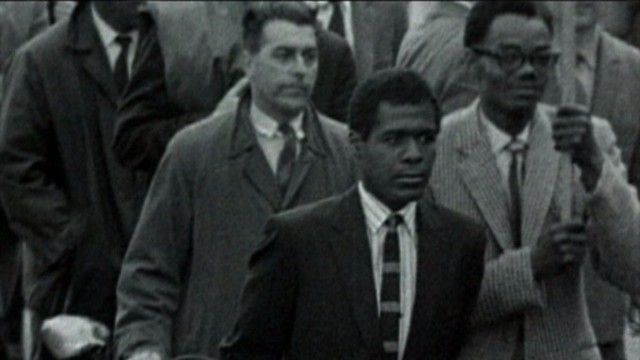
Stephenson learning group is named after the civil rights campaigner Paul Stephenson. He was born in 1937, in Essex. He joined the RAF as the only black cadet in his regiment. Many years later he became a Youth and Community Development Worker in St Pauls, Bristol. It was during this time that he campaigned for a bus boycott as he didn’t accept that the bus company wouldn’t employ black drivers. He decided he was going to do something about this! He fought for black people to be treated fairly in public places in Bristol. With Muhammed Ali, he also set up ‘Muhammed Ali Sports Development Association’ to promote sports development among ethnic minority young people to help develop self-confidence  and social interaction. In 2008 he was given the Freedom of the City of Bristol in recognition of the work he has done to bring the black and white communities together.

Fragapane: determination

Claudia Fragapane is a British artistic gymnast who grew up in Bristol. At the 2014 Commonwealth Games, she was the first English woman to win four gold medals since 1930. In 2015, Fragapane was part of the women’s gymnastics team that won Great Britain’s first-ever team medal, a bronze, at the World Artistic Gymnastics Championships. She competed at the 2016 Summer Olympics in Rio de Janeiro, alongside Churchill Academy alumnus Ruby Harrold. She also finished fourth in Strictly Come Dancing!

Park: curiosity and determination

Nick Park is the famous animator, director and writer behind Wallace and Gromit, Creature Comforts, and Shaun the Sheep. He has been nominated for an Academy Award a total of six times and won four with Creature Comforts (1989), The Wrong Trousers (1993), A Close Shave (1995) and The Curse of the Were-Rabbit (2005). He has also received five BAFTA Awards, including the BAFTA for Best Short Animation for A Matter of Loaf and Death.

He has spent most of his career working for Aardman Animations in the Bristol area. His curiosity has led him to develop a unique and appealing world of claymation animation. Meanwhile, his technique of stop-motion animation – shooting films one frame at a time, moving each model just a fraction between each shot – requires a huge amount of determination!

Blackwell: kindness, determination and curiosity

Elizabeth Blackwell was born in Bristol in 1821, although she moved with her family moved to America when she was 11 years old. She was the first woman to receive a medical degree in the USA in 1847, which required determination and curiosity. As a medical doctor, she showed great kindness when she treated wounded and injured soldiers in the American Civil War, despite strong opposition from male colleagues.

Later, she opened her own medical practices in New York (1852) and in London (1871) where she taught, trained and inspired other female doctors to follow in her footsteps. She retired from medicine in 1877 to work as a social and moral reformer, co-founding the National Health Society.

She showed determination, battled all her life and her successes had been monumental. In 1881, there were only 25 female doctors registered in England and Wales but by 1911 there were 495 registered. Her ambition and success has inspired many generations of female doctors to pursue medical careers and achieve the ‘impossible dream’.

Kenney: determination

Kenney learning group is named after Annie Kenney (1879-1953). Annie Kenney was a key figure in the suffragette movement which campaigned for women to have the vote in the early twentieth century. Kenney was one of the few working class women to rise to prominence in the Suffragette campaign. She became a leading figure in the Women’s Social and Political Union and  spent some years working as an organiser in Bristol. She hit the headlines after being imprisoned for several days for assault and obstruction, after heckling Sir Edward Grey at rally on the issue of votes for women.

Kenney was imprisoned a total of 13 times. She repeatedly went on hunger strike in prison, and underwent brutal force-feeding from the authorities. She remained determined to confront the authorities and highlight the injustice of the treatment of suffragettes by the male-dominated authorities.

When the First World War broke out, Annie Kenney accompanied Emmeline Pankhurst and other suffragettes from the WSPU in ending their activism. Instead, they took on jobs that had previously been done by men, who were now away fighting, in support of the national war effort. Her actions, and those of others in the movement, led to women gaining the vote in 1918.

Dirac: curiosity and determination

Dirac learning group is named after the physicist Paul Dirac, born in Bristol in 1902. Dirac made fundamental contributions to the early development of both quantum mechanics and quantum electrodynamics. Among other discoveries, he formulated the Dirac equation which describes the behaviour of sub-atomic particles called fermions. He also predicted the existence of antimatter. Dirac shared the 1933 Nobel Prize in Physics with Erwin Schrödinger “for the discovery of new productive forms of atomic theory”. He is widely regarded as one of the most significant physicists of the 20th Century.

Brohn: kindness and determination

Diagnosed with breast cancer in 1979, Clifton-born Penny Brohn knew she needed more than just care and treatment for her body: she recognised that she would need support for her “mind, spirit, emotions, heart and soul.” She co-founded a charity centre with her friend Pat Pilkington called the Bristol Cancer Help Centre, which offered patients complementary therapy to support them alongside medical treatment. She showed determination to overcome a great deal of controversy and scepticism to support those living with cancer. Penny Brohn died in 1999, having lived with cancer for 20 years. Her kindness lives on in the work of the charity she co-founded, which provides care to those living with cancer before, during and after treatment.

More: kindness, curiosity and determination

Last but not least, learning group More is named after Hannah More (1745-1833). Hannah More was born in Bristol, where she taught at a school founded by her father and began writing plays. She became known as a poet and playwright, as well as a writer of moral and religious texts, and moved to Wrington in 1802. She campaigned to extend education to the poor, and to girls, who otherwise had no access to schooling. Vitally, More also campaigned against the slave trade. Hannah More is buried beside her sisters at the Church of All Saints in Wrington: you can see a bust of her in the south porch to this day.

Channelling Curiosity

7724527388_5f231473ea_o

Curiosity is one of our core values at Churchill. It’s important because when you’re curious about something, you process it deeply, rather than superficially. You also voluntarily spend more time learning about things that spark your curiosity. As a result, you more readily remember what you learn. The desire to find out more about the world we live in, about other people, about the way things work…these are the fuels that feed the fire of education.

Children, adults and most animals have a natural, in-built curiosity. Biologists believe that this instinctive curiosity is a survival mechanism which was selected through evolution, because those animals that were curious and explored their environment were able to identify opportunities and risks in their environment, and were therefore more likely to survive. Clever stuff!

However, curiosity can also be harnessed as a distraction. I fell into this trap this week. Before I sat down to some school work that I needed to do, I thought I would treat myself and watch the latest Taylor Swift video on YouTube. Unfortunately, as the video finished, I noticed the title of a video in the “up next” column to the right: “Taylor Swift reacts to embarrassing footage of herself after laser eye surgery.” It caught my attention, and made me curious enough to click it to see what it was about. As did the next one. And the next one. Half an hour later, I was watching Brie Larson playing a virtual reality lightsabre game with Jimmy Fallon on a late-night American talk show. Entertaining though this was, there was actual work that I should have been doing and I’d actually only wanted to watch the one video…

clickbait

I’m sure many of you have had this same experience, and been sucked in by the clever algorithms that are designed to grab and keep our attention. Like on Netflix, when the episode finishes and you’re just reaching for the remote to switch it off because you know you really need to go to bed, but then just at that moment the next episode starts. Your curiosity is sparked, wondering what happens next…and you sink back onto the sofa with that deadly “I’ll just watch one more episode.”

Why do we fall so easily into the clickbait trap, when we know there’s important work we should be doing? Psychologist Daniel Willingham explains:

Research shows that the trigger for curiosity is our sense that there’s an easy opportunity to learn a lot. That’s a moment-to-moment judgment, which is why curiosity can come and go so quickly.

Furthermore, curiosity is not influenced by long-term learning goals. That’s why, even though I’m a psychologist who loves his work, I still might be bored at a talk on psychology. But Internet content that promises quick and easy information draws my attention even if, after the fact, it doesn’t seem worth my time.

Willingham advises that the best way to avoid the distracting diversion of tempting links is to find stimulating content that’s just as interesting as the stuff designed to keep you occupied on the internet.

Don’t expect children to avoid Internet time-wasters on their own.

Do recognize that curiosity can’t be controlled directly, but you can offer more tempting targets. Help kids find them. And model the behavior by creating a similar resource list for yourself.

I think this is helpful advice. But I know that my willpower sometimes isn’t up to it. So, to get my work done, I put my phone in another room. I close every other window and tab on my computer, other than the one I need. And I focus on just the one thing that I’m supposed to do, until it’s done. And then – after I’ve finished my work – I treat myself to that Taylor Swift video. And maybe just one more.

Why are we here?

It’s great to be back for a new year at Churchill! In my start-of-term assembly for each of the Houses, I outlined some practical priorities: some of the key changes to the Academy site which will be taking place this year, and reminders about our expectations of behaviour and conduct.

At the start of the year, however, my most important priority was to take a longer and wider view, and to remind all students why were are here, and what we are trying to achieve together at Churchill.

Our purpose: to inspire and enable young people to make a positive difference


kenya2018(school)

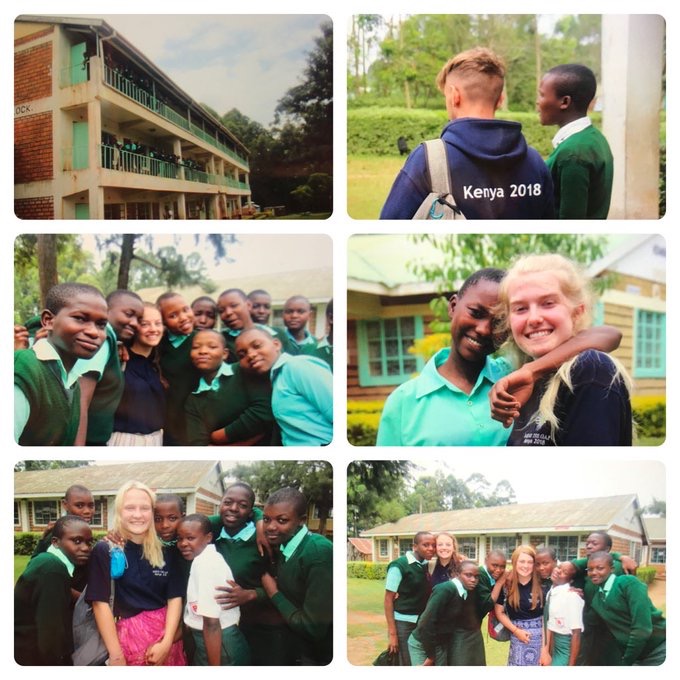
Churchill students working with young people at Rigoma Primary and Secondary School in Kenya, summer 2018 (source)

Our purpose at Churchill is “to inspire and enable young people to make a positive difference.” This can be at a personal level: we can all make a positive difference to ourselves, through the work we do to improve our knowledge, skills and character every day. We can also make a positive difference to others, through helping them when they are finding things difficult and making their experience of school better.

On a wider scale, we can all make a positive difference to the Academy community. This can be in simple, practical ways like keeping the site neat and tidy, but also in less obvious ways by contributing to our positive atmosphere: behaving kindly and respectfully; being ready and eager to learn; and supporting and encouraging one another in our efforts to improve.

Looking up still further, we know that all our young people can make a positive difference in the wider world, both during their time as students here but also after they have left us. Our hope is that, because of the education they have had here, Churchill students will go on to make the world a better place. This is a lofty ambition – but it is what motivates and guides us in the work we do every day.

Our vision: to set no limits on what we can achieve

Churchill sports Day 29th June  2018

Sports Day 2018

Our vision at Churchill is “to set no limits on what we can achieve.” Limits can be external, with other people telling you that “you’ll never be able to do X,” or “you’re only capable of Y.” We strive to avoid this kind of talk at Churchill, recognising that it is impossible to know someone’s true potential, and that effort and application make it far more likely that we will achieve our goals.

The limits we set ourselves can be far more challenging. We all have a voice inside ourselves that says “it’s too hard,” or “I’ll never be able to do it,” or “I can’t.” At Churchill we try hard to find an inner voice to talk back in, so that we can find a way to overcome those barriers we can set ourselves.

GM Phrases

Our values: kindness, curiosity, determination

Valuescropped

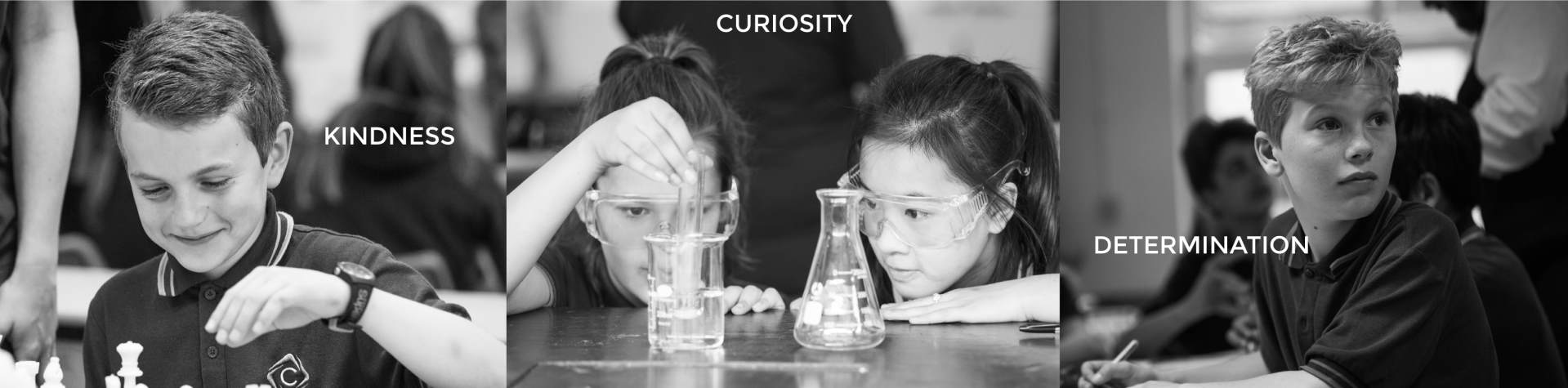
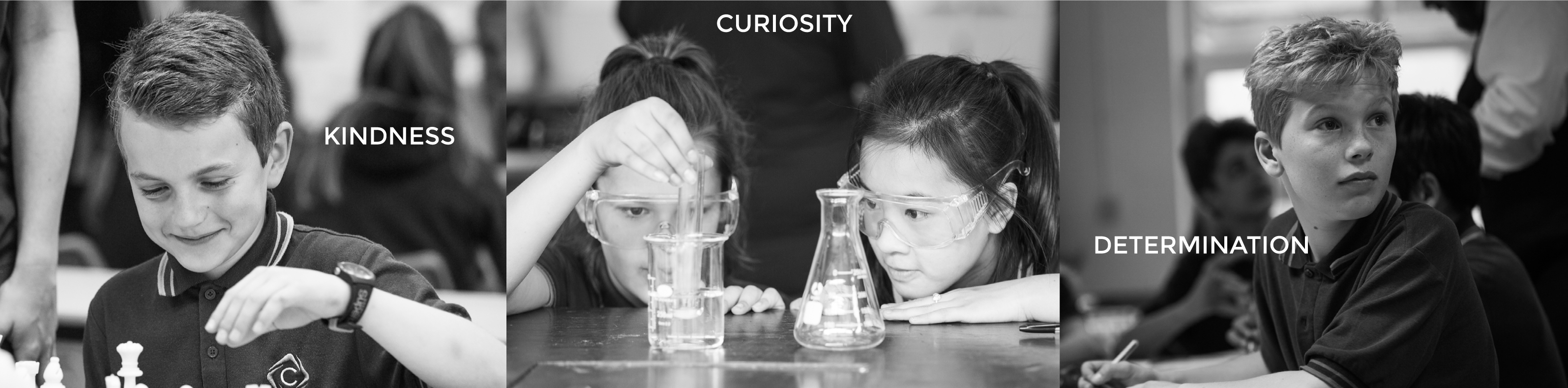
Our three values are based on the character strengths that underpin our vision and our purpose. Developing kindness, curiosity and determination will help us all to reach our goals. Each value reflects a different aspect of our character: kindness is a strength of the heart; curiosity is a strength of the mind; determination is a strength of the will.

Kindness

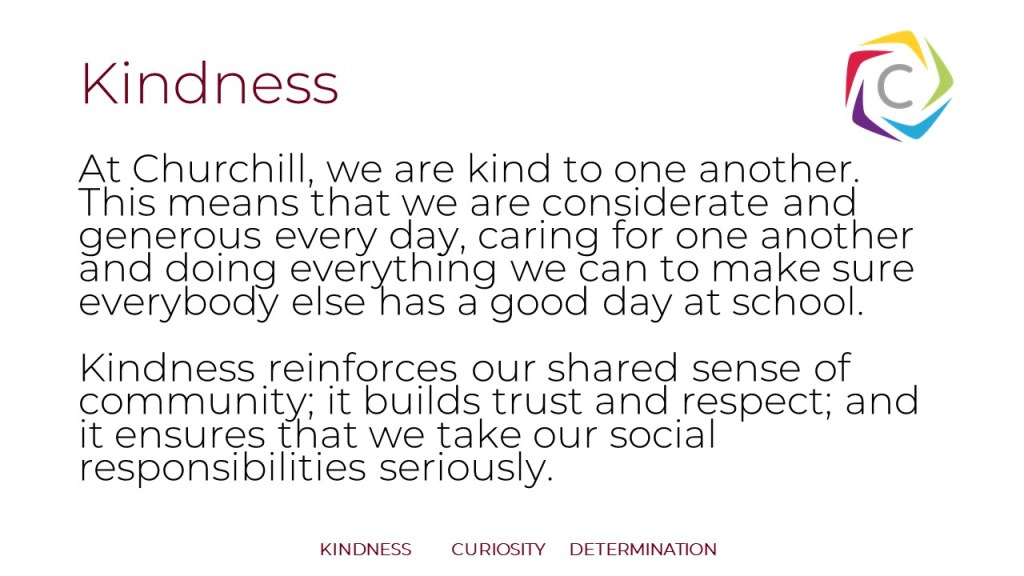
At Churchill, we are kind to one another. This means that we are considerate and generous every day, caring for one another and doing everything we can to make sure everybody else has a good day at school. Kindness reinforces our shared sense of community; it builds trust and respect; and it ensures that we take our social responsibilities seriously.

“A single act of kindness throws out roots in all directions, and the roots spring up and make new trees.” (Amelia Earhart)

Curiosity

At Churchill, we are constantly curious and hungry for new learning. We value enquiring minds and a spirit of exploration. The desire to know or learn something new motivates us to try our hardest in everything we do.

“The mind is not a vessel to be filled, but a fire to be kindled” (Plutarch)

Determination

At Churchill, we are persistent and relentless in the pursuit of our goals – both academic and personal. This determination to keep going when learning is difficult, and to come back and try again when we struggle, helps us to succeed.

“Our greatest weakness lies in giving up. The most certain way to succeed is always to try just one more time.” (Thomas Edison)

It is the interplay between our values, our vision and our purpose that enable us to achieve success. I’m looking forward, this year, to taking further strides towards our shared goals. As Henry Ford said, “if everyone is moving forward together, success takes care of itself.”

Curiosity: is there life on Mars?

curiosity_methane_main

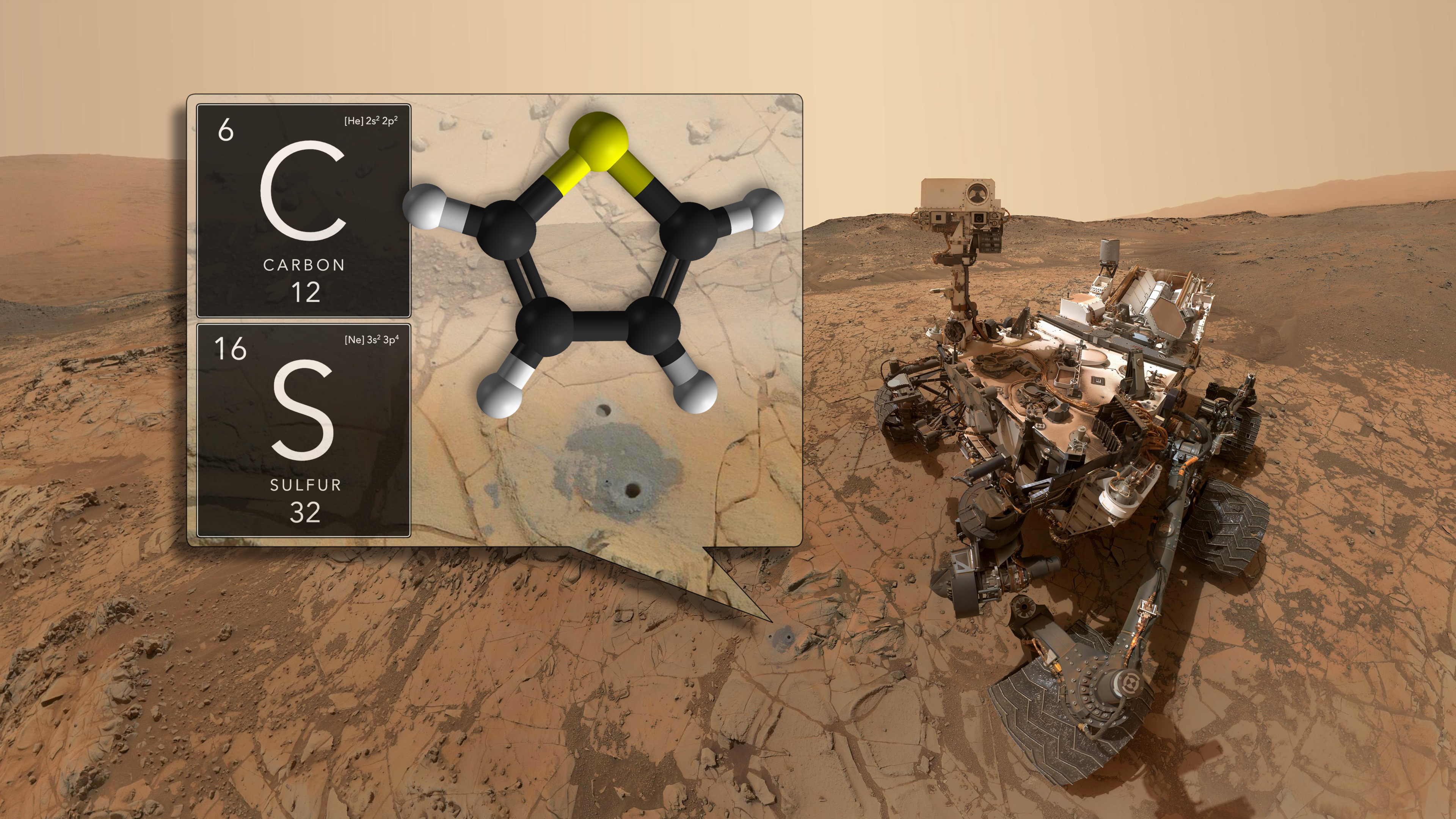
Organic molecules found on the surface of Mars (source)

Earlier this month, NASA announced that the Curiosity Rover on the Martian surface had found ancient organic molecules by drilling down into 3-billion-year-old sedimentary rocks.

“Curiosity has not determined the source of the organic molecules,” said Jen Eigenbrode of NASA. “Whether it holds a record of ancient life, was food for life, or has existed in the absence of life, organic matter in Martian materials holds chemical clues to planetary conditions and processes.”

Although the surface of Mars is inhospitable today, there is clear evidence that in the distant past, the Martian climate allowed liquid water – an essential ingredient for life as we know it – to pool at the surface. Data from Curiosity reveal that billions of years ago, a water lake inside Gale Crater held all the ingredients necessary for life.

I’m completely in awe of the Mars exploration project. It blows my mind to think that there is a machine, made by humans, rolling around on the surface of another planet and sending back pictures and information. Not only that, but the machine is drilling into Martian rocks, cooking the extracts at 500°C and analysing the vapour.

PIA19808_modest

A composite selfie taken by the Curiosity Rover on the surface of Mars (source)

The machine bears the name of one of Churchill’s values: Curiosity. It is this desire to find things out that has driven us on to this incredible achievement. The project combines Physics, Chemistry, Biology, Geography, Geology, Design, Technology, Engineering, Computing, and Mathematics just in terms of the exploration programme. The interest in these subjects started for each of the people involved when they were at school. They have built their careers on applying what they have learned to this amazing project, demonstrating creativity and ingenuity at every turn. When I look at the “selfies” taken by the rover on the surface of Mars, or I see the hole in the Martian surface left by its drill, I am staggered at what we can achieve.

21377_PIA22105-min

Artist’s impression of the Mars 2020 Rover on the surface (source)

There are two more missions to Mars planned in the near future: NASA’s Mars 2020 Rover and the European Space Agency’s ExoMars programme. What other secrets will they discover about the mysterious Red Planet? These missions are laying the ground work for a manned mission. Perhaps the generation of students currently at school will be the generation that first walks on the surface of another planet in our solar system. I hope they do – and it will be curiosity that takes them there.


Churchill’s Values: Kindness, Curiosity, Determination

Valuescropped

Our values are what we judge to be important in life; they are the principles and standards that govern our behaviour. We spent the summer term thinking long and hard about what we valued, and what we should value, as a school. A group of sixteen staff volunteers worked together to develop our ideas, before representatives from each of the main school tutor groups and the Sixth Form council offered their views.  The Governing Body formally adopted Churchill Academy & Sixth Form’s new values in July 2017.

The values are designed to guide our behaviour and decision-making in everything we do at the Academy. Our three values are kindness, curiosity, and determination.

Kindness

At Churchill, we are kind to one another. This means that we are considerate and generous every day, caring for one another and doing everything we can to make sure everybody else has a good day at school. Kindness reinforces our shared sense of community; it builds trust and respect; and it ensures that we take our social responsibilities seriously.

A single act of kindness throws out roots in all directions, and the roots spring up and make new trees.” (Amelia Earhart)

Curiosity

At Churchill, we are constantly curious and hungry for new learning. We value enquiring minds and a spirit of exploration. The desire to know or learn something new motivates us to try our hardest in everything we do.

The mind is not a vessel to be filled, but a fire to be kindled” (Plutarch)

Determination

At Churchill, we are persistent and relentless in the pursuit of our goals – both academic and personal. This determination to keep going when learning is difficult, and to come back and try again when we struggle, helps us to succeed.

Our greatest weakness lies in giving up. The most certain way to succeed is always to try just one more time.” (Thomas Edison)


Thank you to all the staff, students and Governors who contributed to the work on our vision and values.