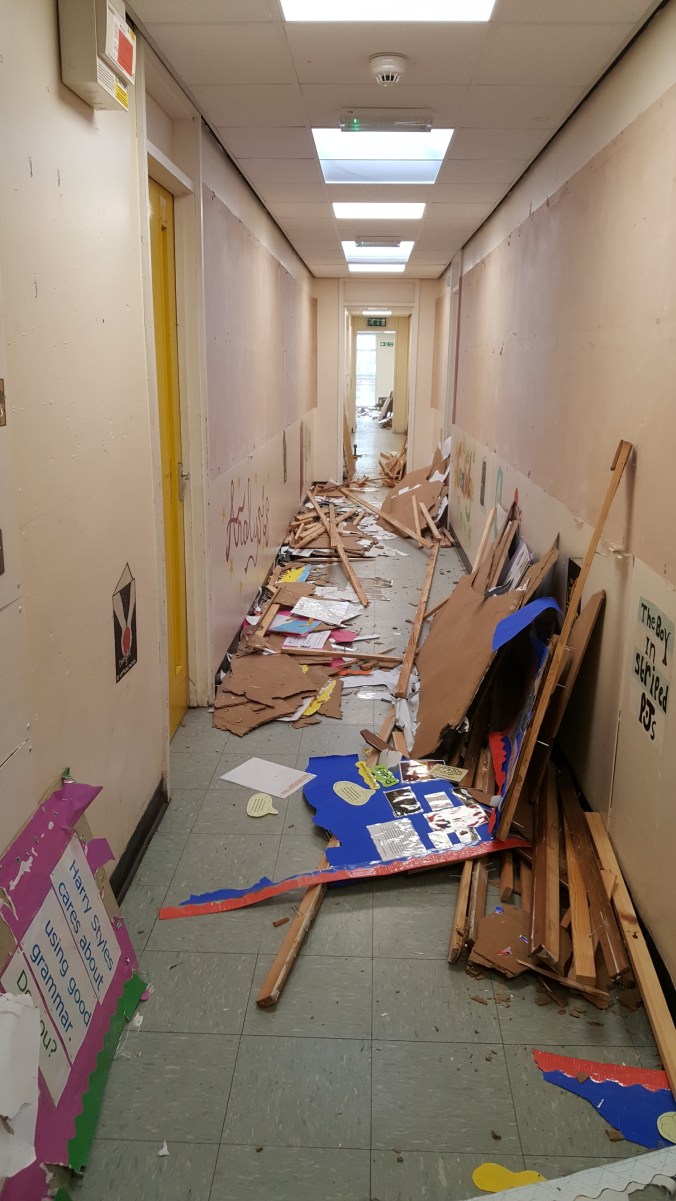
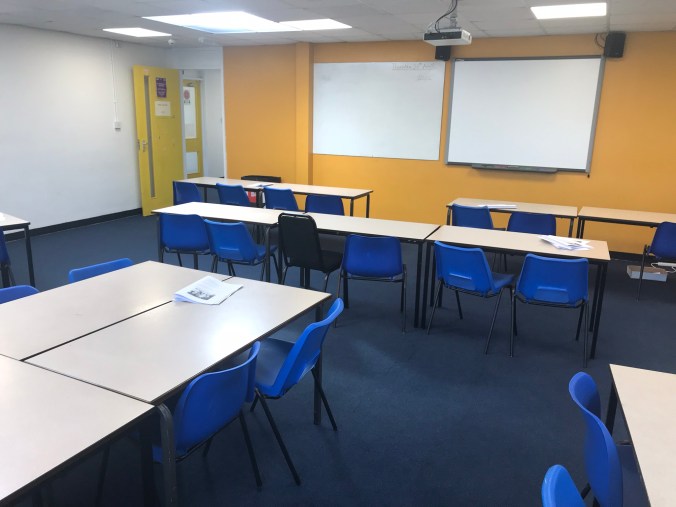
Over the past fortnight students have been getting used to a new and improved learning environment in the English department. Over the past year our site team have been working tirelessly, room-by-room, to renovate and refurbish all the classrooms in Hanover, where English is based. Over the Easter break, new carpet was laid in all classrooms and the upstairs corridor. It’s made an amazing difference!
Before…
…during…
…and after
What was once an echoing tiled space is now a quiet, padded corridor. Whereas once the slightest shift of a chair was accompanied by an ear-splitting shriek of metal on tile, now students can focus on their learning without distraction. The clutter of old resources has been removed in favour of neat storage, and classroom displays are now focused on key learning points for English classes.
The classroom design uses the same template as the Alan Turing Building, based on the Smarter Spaces research and work conducted by our students last year. The “teaching wall” is painted in a bright accent colour, to draw attention to the front of the room. The other walls are in a neutral colour, free from distractions, so that focus remains where it should be – on the learning.
Corridors are now clean and uncluttered. Hard-to-maintain displays have been removed in favour of large, robust photography. The time teachers would have spent on preparing, putting up and maintaining displays can now be spent more effectively on lessons and working with students.
We now have two buildings – the Alan Turing Building and Hanover – in this new internal design. The Athene Donald Building will make a third, and over the coming years we will also roll out the design to Windsor, Stuart and beyond. The future is bright!
We have only been able to achieve these great results thanks to the amazing efforts of our site team, who have completed this work with minimal disruption and a great end result. I’d like to thank them personally for all the work they have done – and continue to do – to transform the environment for learning for our students.
Last April I wrote “How do the new GCSE grades work” to explain about the introduction of 9-1 grades for GCSE Maths and English. This year, 9-1 grades will be used in awarding a much wider range of GCSEs, with only a few remaining on the A*-G system. This blog provides an update on the new grading system for the class of 2018.
To help people understand the grading system, Ofqual (the exams regulator) have published this video:
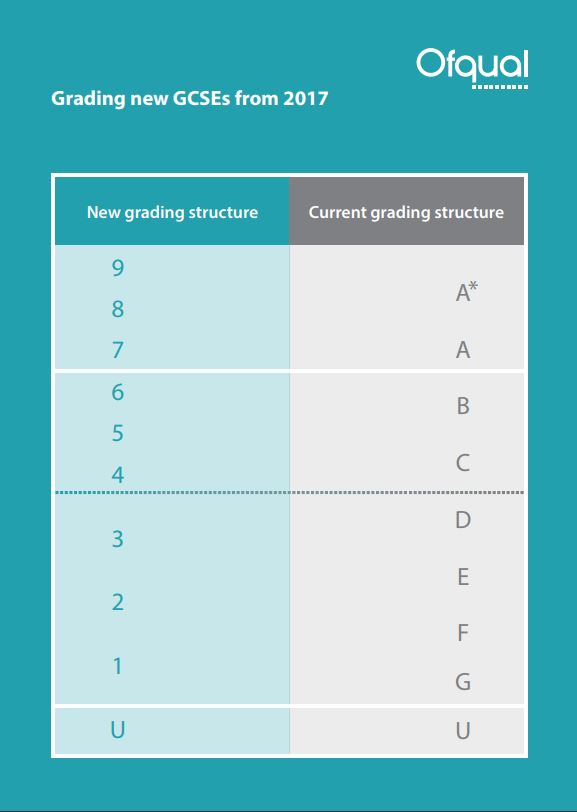
The new 9-1 grades equate to the old A*-G grades as follows:
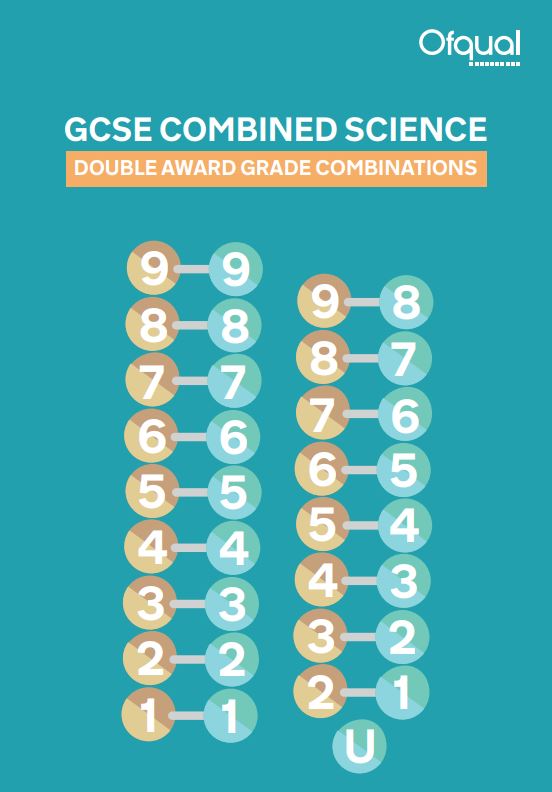
In combined Science GCSE (Double Science), candidates will get two number grades in a variety of combinations as shown below:
GCSE Double Award Science grades from 2018
In other words, double Science students will get results like 7-7, 7-6, 6-6, 6-5 and so on.
How are the grades awarded?
GCSE grades are awarded after all the exam marking has taken place.
Exams and coursework are marked according to the mark schemes issued by the examination boards. These only have numerical marks on – exams and coursework aren’t graded by markers. When all the marks for everyone who has taken the subject in the country are in, then the grade boundaries are decided according to a formula, so that roughly similar proportions of students nationally get each grade in each subject each year.
In other words, your grade at GCSE in the new system doesn’t just depend on how well you have done – it depends on how well you have done relative to all the other candidates in the country taking the same GCSE as you. If you are the top 20% of candidates in the grade 7 and above group, you will be awarded a grade 9. If you are outside that, you won’t. This will not be the same each year, and will change with each new group of students taking the exams every year.
This is significant because it means that if, nationally, lots of children do very well in the exam, the grade boundaries will move up. If it is a hard exam, and students nationally do not do as well, the boundaries will move down. This makes it difficult for teachers to predict grades accurately; we have to make our best professional judgment on the information available to us.
What does this mean for students?
The changes mean that it is impossible for teachers to say “if you do this you will definitely get a grade 5 or above,” because getting a grade 5 depends on how well everyone else in the country does relative to how well you have done. We can’t possibly know how well everyone else in the country has done or is going to do, so all we can do is teach you to get better and better at your own Maths, English, Science, History, Geography and all your other subjects, until you sit the GCSE exam. You have to keep working and pushing yourself to achieve more because what was good enough for a grade 7 last year won’t necessarily be good enough for a grade 7 this year. Don’t settle! You need to keep improving so that you go into the exam at the end of Year 11 fully prepared and confident that you are the best at each subject that you can possibly be – and then you will get the grade that you deserve.
As regular readers of this blog will know, we have been engaged in a three-phase project to replace the original 1956 school building, known as Tudor Block. In April 2016, we were awarded Phase 1: £1.3 million to build the Alan Turing Building for Business Studies, Computing and Social Sciences, which opened in June 2017. In April 2017, we were awarded Phase 2: £3.9 million to build the Athene Donald Building for Science and Technology, which is now under construction. On 29th March this year, we received the now familiar email regarding Phase 3…
Dear Colleague,
Thank you for applying to the Condition Improvement Fund (CIF) 2018 to 2019.
We received requests for more than £1.5 billion for over 4,600 projects in this year’s round. Following our assessment of applications, we have announced £514 million for 1,556 projects at 1,299 academies and sixth-form colleges.
You can view the full list of successful projects at…
And, thankfully, our third phase bid was also successful – £750,000 to demolish the Tudor block and “make good” the footprint of the building. We aim to put car parking in its place, which we hope will improve the safety of our students and members of the community on the narrow roads around the Academy by reducing congestion from on-road parking. Planning is already in place, and we will be working hard with the contractors to minimise disruption and produce the best possible outcome from the works, which are due to be completed in the middle of 2019.
Part of the Tudor Building can be seen in the background of this, the earliest school photo we have found, courtesy of alumnus Andrew Frappell who joined the school in 1958.
This is a landmark moment for the Academy. The Tudor Block was the first building to be constructed as part of the new secondary school for Churchill in 1956, and it has formed the core of the school’s facilities for many years. However, after 60 years in service it is no longer fit for purpose, and all of the classrooms from T1 onwards will be demolished. The current reception, offices, main hall and gym will remain intact.
This aerial shot from 1970 shows the original Tudor block in the right of the picture.
The removal of this building will mean a change of shape to the site, and we will be working hard over the coming year to review and redevelop our provision to accommodate this new emphasis. It’s an exciting time, and the culmination of a lot of work from a huge team of people. Particular thanks are due to Deputy Headteacher Mark Branch, who has coordinated and led the third phase of the project with great skill – and will continue to do so as the demolition progresses.
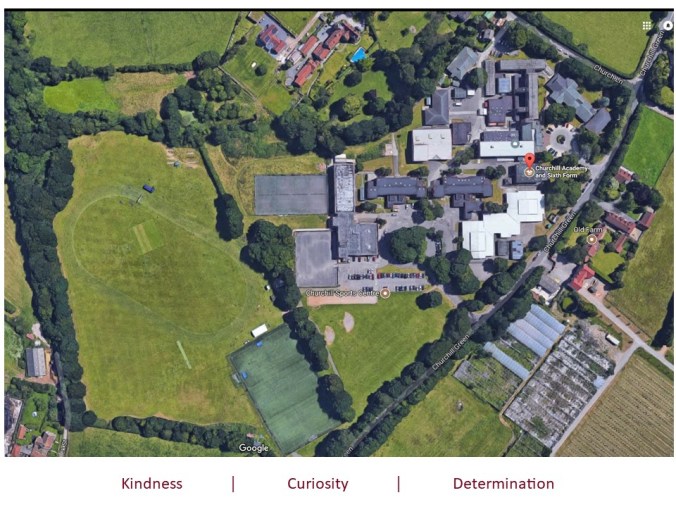
Satellite picture of our site captured in 2016, prior to commencement of the three-phase project. The Tudor block is the T-shaped building towards the top of the picture.
Deciding on whether the Academy should be open or closed in the event of adverse weather is one of those decisions which rests solely with me, the Headteacher. This week I have had to make that decision, and I thought it might be helpful to blog about how and why it was made.
Snow falling at Churchill
Closing the school is highly disruptive. It gets in the way of lessons and learning, but also all of the events, meetings, interviews, activities and discussions that have been planned, often well in advance. We have nearly 1500 students, so the decision to close has an impact on hundreds and hundreds of families across our communities. It is not a decision I can take lightly. Whatever I decide will please some and frustrate others.
This week’s cold weather and snowfall was no surprise. The “beast from the east” was well-advertised. I received twice-daily updates from the delegated services team, providing risk analysis based on the changing weather forecast from the Met Office. North Somerset Council re-published their advice about what to do in case of closure. Senior staff at the Academy ran through the procedures and processes in case we had to close- although we hoped we wouldn’t have to.
The question I ask myself in this situation is: “is it safe to open the school?”
Year 13 Photography students took the opportunity to get some snow shots on Thursday morning
Most of our students travel to school on buses, many from rural communities. Our staff – nearly 150 adults – travel in from across the region. Would it be safe for students and staff to travel? If staff are unable to get into school, will I have enough adults to ensure that students are properly supervised and have access to the high-quality teaching to which they are accustomed and entitled? Will the site be safe?
By Wednesday it became clear that the snow was coming. The Met Office shifted their Amber warning to early afternoon on Thursday. The Chief Forecaster’s assessment read:
Widespread snow is expected to develop through Thursday afternoon and evening, accompanied by strong easterly winds, leading to drifting of lying snow in places. Around 10-20 cm is likely to fall quite widely, with the potential for up to 50 cm over parts of Dartmoor and Exmoor. As less cold air follows from the south, there is a chance of snow turning to freezing rain in places, with widespread icy stretches forming making driving conditions dangerous. The warning has been updated to reflect the growing confidence of a severe spell of weather.
I consulted during the day with my senior team, primary Headteachers in the Churchill cluster, and local secondary Headteachers. By early evening, it was clear that the worst of the weather was forecast for the afternoon of the next day – Thursday. Our usual closing time – 3:20pm – was right in the middle of the heaviest forecast snowfall and high winds were predicted to make the air temperature of -4°C feel like -12°C. The morning looked okay, however – cold, with strong winds, but snow not forecast to start falling until later on.
Photo credit: A-level photography students
Rather than put off a decision until the morning, I thought that families and students deserved as much notice as possible so that they could make arrangements. I sent emails to key senior staff, spoke on the phone to one of our site team, organised contact with the bus companies and consulted the Chair of Governors. I then notified all staff via email of the plan for the next day. At 8pm on Wednesday we notified families that we would be open in the morning, but closing early at 1:10pm. I decided that this was the best compromise: we could still get four lessons worth of learning done, but students and staff should be able to get home safely.
Why not close for the whole day? Because there was a chance to get some meaningful learning done, and closure has to be a last resort. Why not stay open for the whole day? Because, in my judgment, the risks of staying open at that point outweighed the benefits.
In the end, school closure is a judgment call. This week, I had to make that call – and I did so, as with all my decisions, in the best interests of the students and the staff of the Academy. Whilst I’m sure not everyone will agree with me, I hope you at least understand my reasoning.
Stay safe, stay warm and – if you can – enjoy the snow.
As regular readers will know, we are mid-way through building a £3.9m Science and Technology facility on our site, to replace the original 1956 building, which is still in current use but no longer fit for purpose. The new building – twelve Science laboratories and two classrooms for food and nutrition – is due for completion in December this year. You can see the progress to date here.
As part of our commitment to promoting gender equality and, in particular, women in STEM, we decided we wanted to name the new building after a prominent female scientist. Our aim is to inspire young women to pursue further study and careers in Science, Technology, Engineering and Maths. As part of this process, groups of our Year 7 and 8 students were set the task of researching significant women in Science and Engineering, and presenting their research to a panel of staff and governors. The shortlist included Rosalind Franklin, Mary Somerville, Marie Curie, Anne McLaren and Athene Donald.
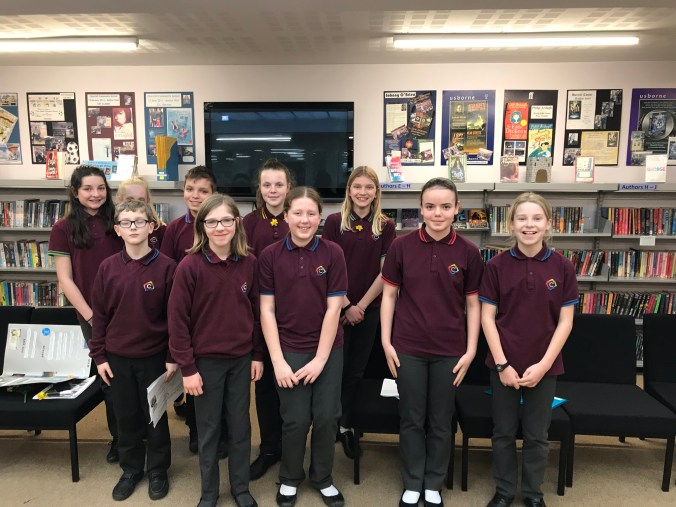
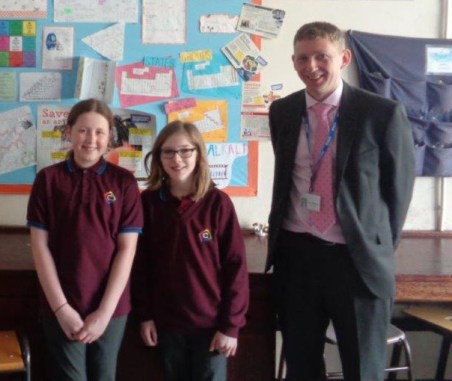
Our student researchers
The presentations took place on Monday 19th February. They were excellent: full of detailed research and high-quality presentation skills. After a lengthy discussion, the panel unanimously agreed to name the building…
The Dame Athene Donald Building
Professor Dame Athene Donald is Professor of Experimental Physics and Master of Churchill College, Cambridge. Aside from the wonderful link between the name of our Academy and her Cambridge college, Professor Donald is a fantastic advocate for Science, and in particular for gender equality in Science, Technology, Engineering and Maths. She is a director of the university’s Women in Science, Engineering and Technology initiative to inspire and support women scientists within the university. She chairs the Athena Forum which deals with issues around career progression for women in science, technology, engineering, maths and medicine subjects in higher education.
Her research applies physics to biology, exploring the structures of polymers, biopolymers and, most recently, cellular biophysics. One of her most significant projects was researching the molecular structure of food (in particular starch molecules). She is also a viola player and a singer, with a keen interest in music. She has won over 20 awards, including a Faraday Medal from the Institute of Physics, and was given the Lifetime Achievement Award at the UKRC Women of Outstanding Achievement Awards in 2011.
Professor Donald’s life and work was researched by Year 7 students Polly Jones (7WPH) and Freya Hatherall (7WSB). They said “Athene Donald is a great inspiration to us all, for her career in science and her support for gender equality. In years to come she could influence children at Churchill Academy to pursue a career a science or engineering.” You can see their presentation below.
Professor Donald commented “I am deeply honoured that you would like to name your wonderful new building after me and of course am happy to agree. What a lovely idea to set your students such a project of research, so that more female scientists of note become familiar to them. And what a happy coincidence of the name Churchill too! I wish you all the very best with the building project and, of course, that having new labs inspires a new generation to think about careers in STEM (boys and girls).”
Well done to all the students involved, and thanks to Miss Burrows for coordinating the project.
This week has been the centenary of the Representation of the People Act, the bill which finally gave women the vote on 6th February 1918. Even then, only women over the age of 30 who met a property qualification were able to vote, which enfranchised only 40 per cent of the total population of women in the UK. It was not until the Equal Franchise Act of 1928 that women over 21 were able to vote and women finally achieved the same voting rights as men. This act increased the number of women eligible to vote to 15 million.
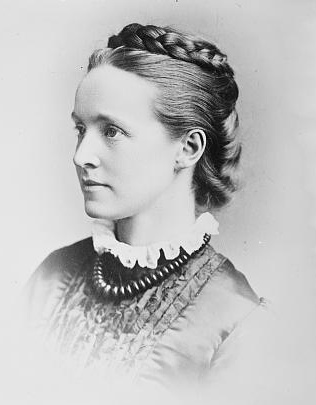
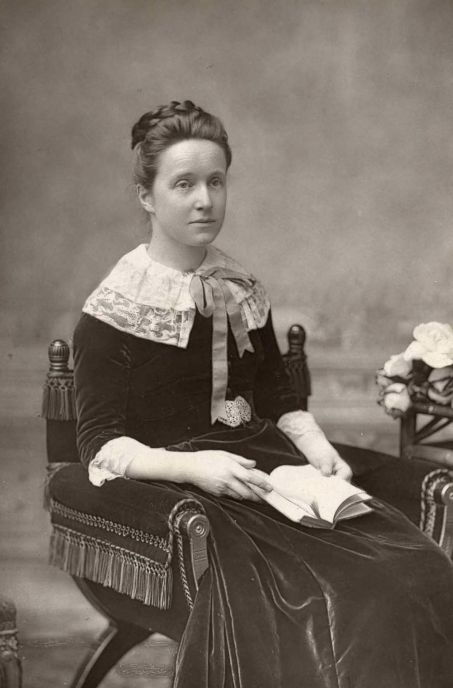
Millicent Fawcett
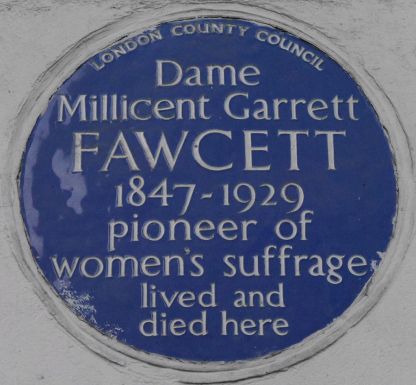
One of the heroes of the suffrage movement was Dame Millicent Fawcett. Fawcett was born in 1847, and developed an interest in women’s rights at a young age. Her sister, Elizabeth Garrett Anderson, was the first female doctor in Britain. In 1866, at the age of 19, Millicent became the secretary of the London Society for Women’s Suffrage. She dedicated her life to campaigning for equal rights for women. Fawcett was a suffragist, not a suffragette. She distanced herself from the militant and sometimes violent activities of the suffragettes, preferring instead to work within the law.
Suffragettes Annie Kenney and Christabel Pankhurst
Fawcett spoke at her first public pro-suffrage meeting in 1869, and took over as the leader of the National Union of Women’s Suffrage Societies (NUWSS) in 1890. She held this position until 1919, a year after the Representation of the People Act finally achieved the aims she had been campaigning for over the past 53 years.
When the Equal Franchise Act of 1928 was to be signed into law, the 81-year-old campaigner, now a Dame Grand Cross of the Order of the British Empire, wanted to witness the historic moment. She made her way to the House of Lords in plenty of time for the ceremony, which was due to start at 6.30pm on 3rd July. Unfortunately, the House of Lords had completed their other business more quickly than anticipated, and brought the signing ceremony forward to six o’clock. After 62 years of campaigning, Dame Millicent arrived less than a minute too late to see the law conferring equal voting rights to women given royal assent.
Fawcett died the following August, in 1929, aged 82. She was born into an era where women were seen and not heard, where they had few rights, and where they were widely believed to be “the weaker sex.” Over her lifetime, the rights of women were transformed; by the time of her death women had the same voting rights as men. Little wonder, then, that Fawcett won the vote for “most influential woman” of the last 100 years run this week by BBC Radio 4, or that she has been chosen as the subject a commemorative statue to be erected in Parliament Square.
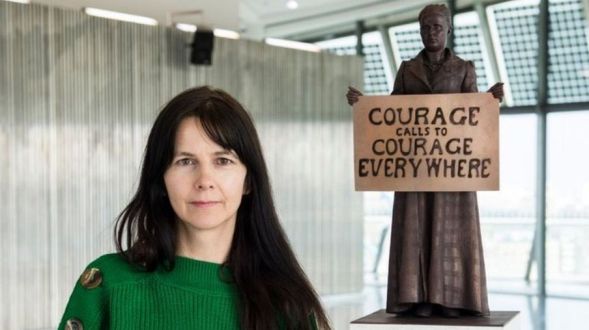
Artist Gillian Wearing with a model of the Fawcett statue
It is fitting that Fawcett continues to break new ground for women, even today: hers is the first statue of a woman to be erected in Parliament Square. The plinth will feature the names of 59 women and men who fought for women’s suffrage; it will be unveiled in April. In the statue, Fawcett holds a placard with a line from a speech she gave after the death of suffragette Emily Wilding Davison at the 1913 Epsom Derby: “courage calls to courage everywhere.”
Fawcett’s work remains incomplete, however: there are still significant gender inequalities at work in our society today. That is why Churchill Academy & Sixth Form has signed up to the Gender Equality Charter, with the aim of challenging and correcting gender imbalances wherever we find them. Click here to find out more.
Millicent Fawcett in 1870
If you want to learn more about the campaign for women’s right to vote and its impact on women’s rights and equality to the present day, you can join me in signing up for a free five-week online course (MOOC) called Beyond the Ballot: Women’s Rights and Suffrage from 1866 to Today run by Royal Holloway and the UK Parliament.
On Tuesday of this week I was invited down to the construction site where work is progressing on our new Science and Technology building. It was an important day as the contractors were using a 39 metre boom to lay down 243 cubic metres of concrete in a single slab to form the base of the building. It was quite an operation: the concrete arrived in a series of mixer wagons (30 in all during the day); it was transferred into an on-site hopper, which pumped the concrete along the boom and out into the site. One operator used a remote control to move the boom around whilst his team directed the flow of concrete into the steel mesh framework. A second pump made sure no air bubbles were trapped, whilst behind them a final contractor used a beam screeder to ensure a completely flat surface. It was amazing to watch! Over the course of twelve hours, the complete base of the building was laid out in one piece. Pipework is left to connect up the plumbing, and there are bolts sticking up from the foundation piles where the steel frame for the walls will be anchored.
As I watched this work taking place, it occurred to me that, eventually, none of this will be visible. The building will rise up, completely covering it; the ground floor materials will be mounted on top of this concrete. And yet, although none of it will be visible, it is this solid foundation which will hold the whole thing together.
As a school, we aim to provide the solid foundations and the framework upon which young people can build their futures. It’s vital to get this right. Gaps or errors in the process would be like air bubbles left in the concrete: they could weaken the whole structure. That’s why we work so hard to ensure that all our students make the most of every day, every lesson that they can.
Eventually, all the work done in school will become invisible, covered by the progress and achievements of the young people themselves as they build their own futures. But it will always be there: a firm, smooth, solid base anchoring them securely and allowing them to rise up. What a privilege it is to be a part of that process.
After last week’s blog about failure, I wanted to write a companion piece about success. We all want to be successful. We all aim for success. But what does success mean to you?
At the end of each school year at Churchill, we have our annual Celebration of Success events. These evenings aim to celebrate those student who have been successful in many different ways. Of course, academic success is a huge part of that. As a school you wouldn’t expect anything different! But, as an institution, we believe that personal and academic accomplishments are equally valuable, and we try to celebrate success in all its forms.
For some of us, a string of A* grades (or 7, 8 or 9s!) is a mark of success. For others, achieving a grade 4 will be a huge achievement. For some, winning the 1500m on Sports Day will bring that sense of pride; for others, simply finishing the race is worth even more. For those students who successfully complete their Duke of Edinburgh award, the feeling of success is palpable; I’m looking forward to handing out this year’s awards later this term.
These are all major achievements, which we rightly mark up as successes. But it’s important also to celebrate the small triumphs which occur every day. We know that for some students simply getting into school and making it through the day is a success to be celebrated. Finally grasping that difficult concept in a lesson, or having the courage to have a go at a challenging task, or recognising a mistake and going back to fix it – all of these are important successes that matter hugely to all of us.
There are interesting things happening in our brain when we are successful, with two different “feel good” chemicals being released: dopamine and serotonin. We get little shots of a chemical called dopamine when we get things done; I like to think of it as the “achievement” chemical. It exists in our brains to make sure we achieve our goals. The trouble with dopamine is that it doesn’t really differentiate between big successes and small successes, so you’ll get a little shot of dopamine if you find that pen you were looking for, even if you don’t start your homework. Dopamine can be tricky – it will reward you for completing smaller, less challenging tasks as well as the big important things.
Serotonin molecule
Serotonin is released when we get recognition from other people for something we’ve done – it feels really, really good. But the great thing about serotonin is that it’s released in other people too. When you get a little dopamine shot from ticking off something important on your list, you feel good. When you achieve something that your teacher, your parents, or your friends think is great, they feel good too. Back in caveman times, serotonin helped members of tribes work and stay together by encouraging them to invest in each other. That’s what’s so great about working in a school. When students do well, I feel proud of them – and I feel good. How brilliant is that?
That’s why recognising and celebrating success is so important. When effort leads to achievement, we feel good about ourselves. When other people tell us they’re proud of us, or celebrate that success with us, we feel even better about ourselves – and they feel great too. It’s a win-win. So cherish those moments, and celebrate every success, no matter how small – they all count.
Monday 13th November was World Kindness Day, and kicked off our Focus Fortnight on our core value of Kindness. Over this two weeks we are encouraging all students, staff and members of the Academy community to make a special effort to carry out acts of kindness for one another. Here are some of the suggestions that have been made:
This slideshow requires JavaScript.
There are global movements like Random Acts of Kindness and Pay It Forward which are founded on the idea that if each of us acts kindly towards another person for no other reason than that it’s a nice thing – the right thing – to do, it has the cumulative effect of making the world better for all of us. This is something that is really important to us at Churchill, which is why it is one of our three core values. It was also the theme of my Kindness Assembly back in March.
When we do something nice for no reason, everybody benefits. We feel better; we make somebody else’s life better too. Not just this fortnight, but from now on, we want to make sure that we all choose kindness. Do something nice for somebody else. Help one another. Not because there’s anything in it for us, but because when we do something kind, we’ve made school a nicer place for someone else to be. And if it’s a nicer place for someone else, it’ll be nicer for us too. So when we choose kindness, everybody benefits.
There’s a long tradition of naming our Key Stage 3 Learning Groups at Churchill around a particular theme. The current Year 8 groups are named after endangered or at-risk species: Panda, Turtle, Lion, Jaguar, Leopard, Tiger, Gorilla, Rhino, and Polar Bear. There’s a great display in the ground floor Science corridor giving more details about these animals, and the work of the World Wildlife Fund to help protect them.
It’s the turn of the Humanities Faculty this year, so the learning groups in Year 7 have been named after British heroes from the fields of History, Geography, and Philosophy and Ethics. Hence we have 7Brunel, 7Seacole, 7Anscombe, 7Attenborough, 7Fiennes, 7Kingsley, 7Davison, 7Locke and 7Hume being taught right across the Academy! This week Mrs Amer, Director of Humanities, has been telling the students more about these Humanities heroes in assemblies. So here’s a run-down of who the learning groups are named after…
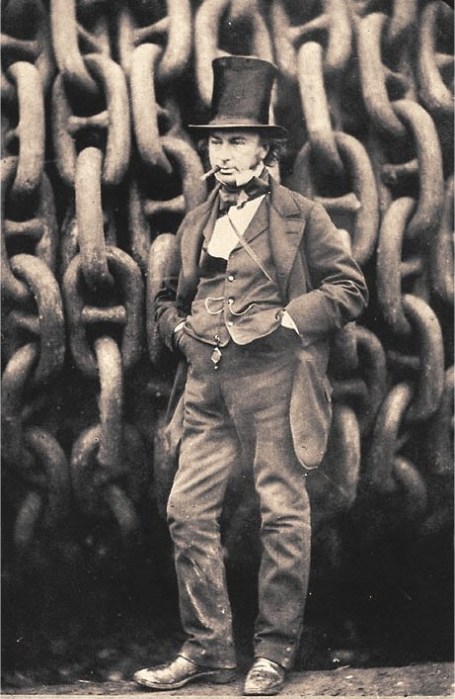
Brunel
Isambard Kingdom Brunel (1806-1859) was named as one of the greatest Britons in a BBC poll. A famous engineer, he spent much of his life in Bristol where he designed the Great Western Railway, Temple Meads Station, the SS Great Britain, and the Clifton Suspension Bridge amongst many more achievements.
Hume
David Hume (1711-1776) was a Scottish philosopher and historian, best known for developing the system known as empiricism. He argued that all human knowledge is based on experiences; he also investigated the concept of miracles and put forward opposing scientific arguments.
Kingsley
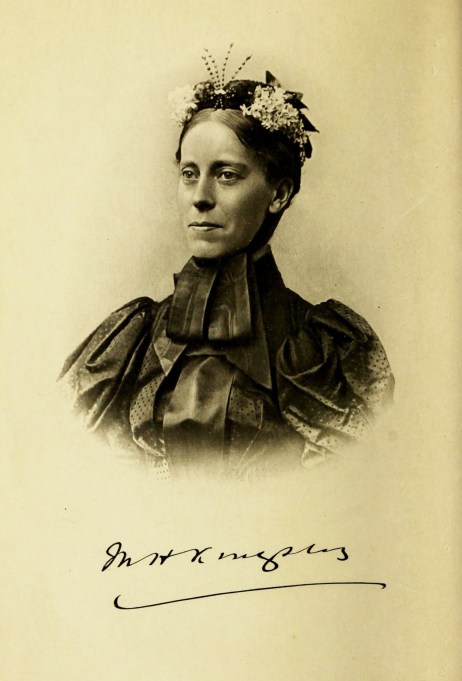
Mary Kingsley (1862-1900) was an explorer. At a time when it was unheard of for women travel alone, Kingsley explored central and west Africa. Her work was vital in helping Europeans understand African cultures and the effects of the British Empire. Kingsley also took an important stand against slavery.
Davison
Emily Wilding Davison (1872-1913) was a suffragette who campaigned for votes for women. She was arrested nine times for her protests, went on hunger strike seven times, and was force-fed in prison forty-five times. She died after being hit by King George V’s horse at the 1913 Epsom Derby when she walked onto the track during the race to protest for votes for women. Women were finally given the vote in 1918.
Locke
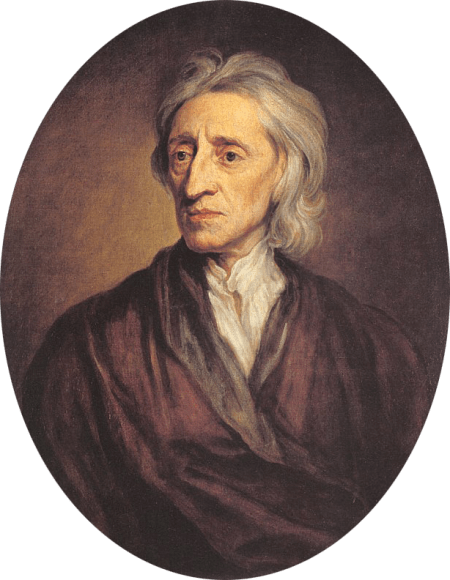
John Locke (1632-1704) was a philosopher who is known as the “Father of Liberalism.” One of the earliest empiricists, he was one of the first thinkers to define the self as a continuity of consciousness. He was also a believer in the importance of proof: for Locke, ideas had to be capable of being tested repeatedly, and nothing was exempt from being disproven. Locke was also born in Wrington!
Fiennes
Sir Ranulph Fiennes (1944- ) is an explorer and writer. He was the first person to visit the North and South Poles by surface means, and the first to cross the continent of Antarctica on foot. In 2009, at the age of 65, he became the oldest person to reach the summit of Mount Everest.
Seacole
Mary Seacole (1805-1881) was born in Jamaica. She was born mixed race, to a Scottish father and a free Jamaican mother. She overcame Victorian racial prejudice to serve as an outstanding nurse during the Crimean War and was named as the greatest black Briton in a 2004 BBC poll.
Anscombe
Elizabeth Anscombe (1919-2001) was Professor of Philosophy at both Oxford and Cambridge. Her greatest work focused on the ideas of intention, action, and practical reason. Well known for being outspoken and opinionated, when accosted by a mugger in the street she told her attacker that it was ‘no way to treat a stranger’ – they stopped and talked instead.
Attenborough
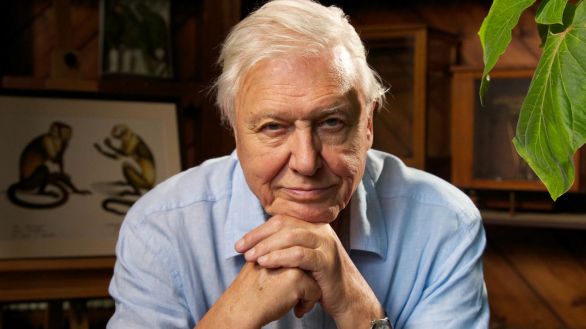
Sir David Attenborough (1926- ), the well-known broadcaster and naturalist, has done more perhaps than any living person to raise awareness of animal, plant and marine life on Earth, and the impact of human activity on the environment. Attenborough’s appetite for discovery demonstrated our core value of curiosity; he famously said:
“I just wish the world was twice as big and half of it was still unexplored.”
His most recent project, Blue Planet II, is currently being shown on BBC1.
We hope that naming our learning groups after such significant individuals will help raise awareness of their contribution to History, Geography, and Philosophy and Ethics and broaden our students’ understanding of these figures. What will we name our groups next year? Leave a comment with your suggestions!




















 The Headteacher's Blog